Explore institutional access →

3 min. read

Part 5

Instrument Makers in USA

S. W. Lewis Orchestral Horns
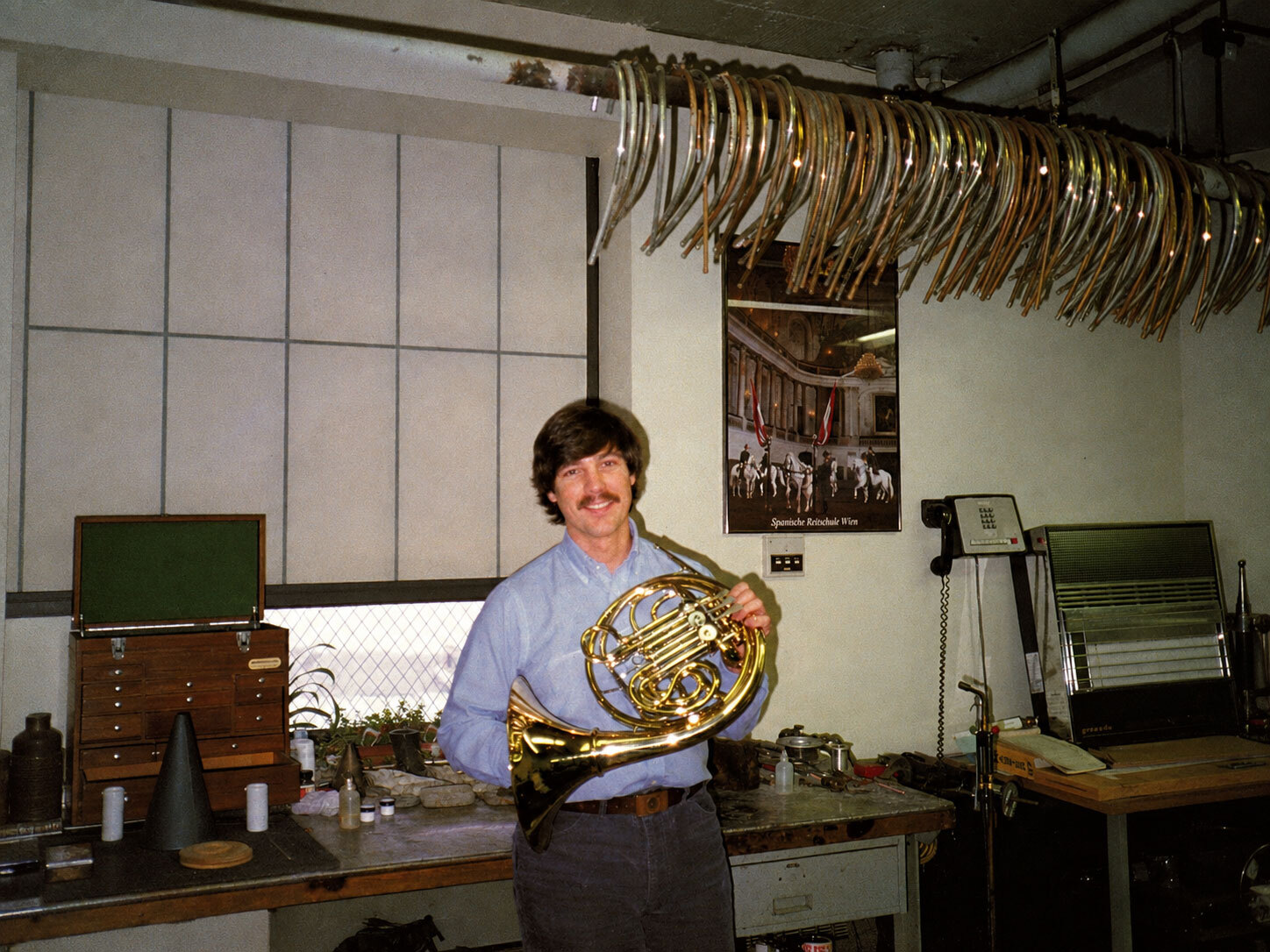
For Steven Lewis, building a horn begins with playing it: craftsmanship, acoustic compromise and observation shape instruments made for musicians rather than theory.
Instrument Makers in USA

Steven W. Lewis

“What always interested me most was playing the horn”, Steven Lewis explained to me. “Even now I get quite depressed when I am so busy that I have to neglect the horn.” And yet today he is primarily a horn maker.

His workshop has an outstanding set of machinery. Production methods follow the classical procedure, although much refined. He produces the individual components from seamless drawn tubing which he draws on his special mandrels. Worthy of note is the compound he uses to bend the tubing, a lead alloy with a very low melting point (about 70°C) so that it can be removed from the tubes with hot water. He uses a standard alloy (CuZn 30, i.e.: 30% zinc and 70% copper) normally, nickel silver or red brass only to special order. “Traditionally brass is the horn material.”

As Jeffrey Agrell mentioned in his article in BRASS BULLETIN 49, Lewis concentrates on the production of a few models: in addition to single B♭ horns, natural and descant horns he makes primarily Geyer double horns with rotary or piston quick-change valves. The number of extras he limits to the essential as he is of the opinion that a wide range of variants is so confusing that it is difficult to make a judicious choice. “If the customer likes the model that I have developed and carefully tailored to his needs, then I am happy; if he doesn’t, then, as friends, we both wait for a better opportunity.”

Lewis has had excellent training. First he studied horn at the University of North Colorado, majoring in performance; then he studied with Dale Clevenger, 1st horn at the Chicago Symphony, with the aim of working as a musician in Chicago. The rest of his career, working with Schilke and meeting the outstanding Ukrainian instrument maker and repairer Jerry Lechniuk, is recounted in detail in Jeffrey Agrell’s article.

There is now a long list of the best orchestras in the world where the approximately 120 horns he has made so far — every one by himself — are played. Every year there are about 20 to 25 more horns. Roland Pinc, who worked for Schilke for ten years, is on hand to restore old instruments and do repair work.

When I asked what he thought the greatest virtue of Lewis horns was, he pointed out the fact that they are made by hand, something of which he is — rightfully — proud; then that he is a very good horn player who knows from personal experience what a player expects from an instrument when he is standing in front of an audience in a concert hall; and finally, that his dimensions and design, both derived entirely from practice, are important.

Continue reading

Access the full Digital Edition.

Brass Bulletin 52, IV / 1985 pages 90–94

All content is protected by copyright © Brass Bulletin 1985–2026

Share this article

Facebook LinkedIn
Loading…

Questions & Answers

How the Digital Edition works

What does the Digital Edition include?

The Digital Edition brings together the articles already digitized as searchable online texts—not simply as scans or PDF files—along with their original illustrations, notes, authorship, issue information, and available translations. Related-article suggestions currently include only this digitized material.

Are the digital articles identical to the originals?

We preserve the original text, language, illustrations, captions, footnotes, and editorial context as faithfully as possible. The presentation is adapted for comfortable online reading, and obvious transcription or scanning errors may be corrected. The substance and character of the published article remain unchanged.

Which languages are available?

Brass Bulletin was published in English, French, and German throughout its history. Italian and Spanish translations were added from issue No. 60 onward.

On the Italian and Spanish sites, articles from issues 1–59 are therefore shown in English by default.

How often are new articles added?

New articles are added almost daily, with approximately one complete issue digitized each week. The pace may vary depending on the preparation, image work, and editorial checking required.

Why aren’t all articles available digitally?

The complete Brass Bulletin collection contains 1,246 articles published between 1971 and 2003. The full index is already available online, allowing readers to discover every article in the collection, including those whose complete text has not yet been digitized.

Digitization began in February 2026. Each article is carefully prepared for online reading, checked, and connected to its issue, authors, subjects, and illustrations. At the current pace of digitization, the complete collection is expected to be available online by February 2028.

Why do some references mention articles that are not available yet?

References in the original articles are preserved even when the material they point to has not yet been digitized. This keeps the historical and editorial record intact. As more issues are added to the Digital Edition, an increasing number of these references will lead to articles that can be read online.

Can I suggest an article or report a transcription error?

Yes. If there is an article you would particularly like to see digitized, or if you notice a possible transcription error or missing detail, please contact us. Reader feedback helps us improve the Digital Edition and prioritize useful connections within the archive.

How can I support Brass Bulletin?

Your support helps fund the preparation, verification, and online publication of the complete collection.

Subscribe to the Digital Edition

Prefer to support us without subscribing?

Make a donation

How is the digitization progressing?

We’re gradually making the Brass Bulletin available online, article by article. You can read newly digitized articles as soon as they’re ready, even before an entire issue is complete.

Visit our Digitization Roadmap to browse recent additions and see estimated availability for upcoming issues. These estimates follow our recent pace and may change.

Search Brass Bulletin.