3 min de lectura
Parte 5
Instrument Makers in USA
S. W. Lewis Orchestral Horns
Por Stephan Suter
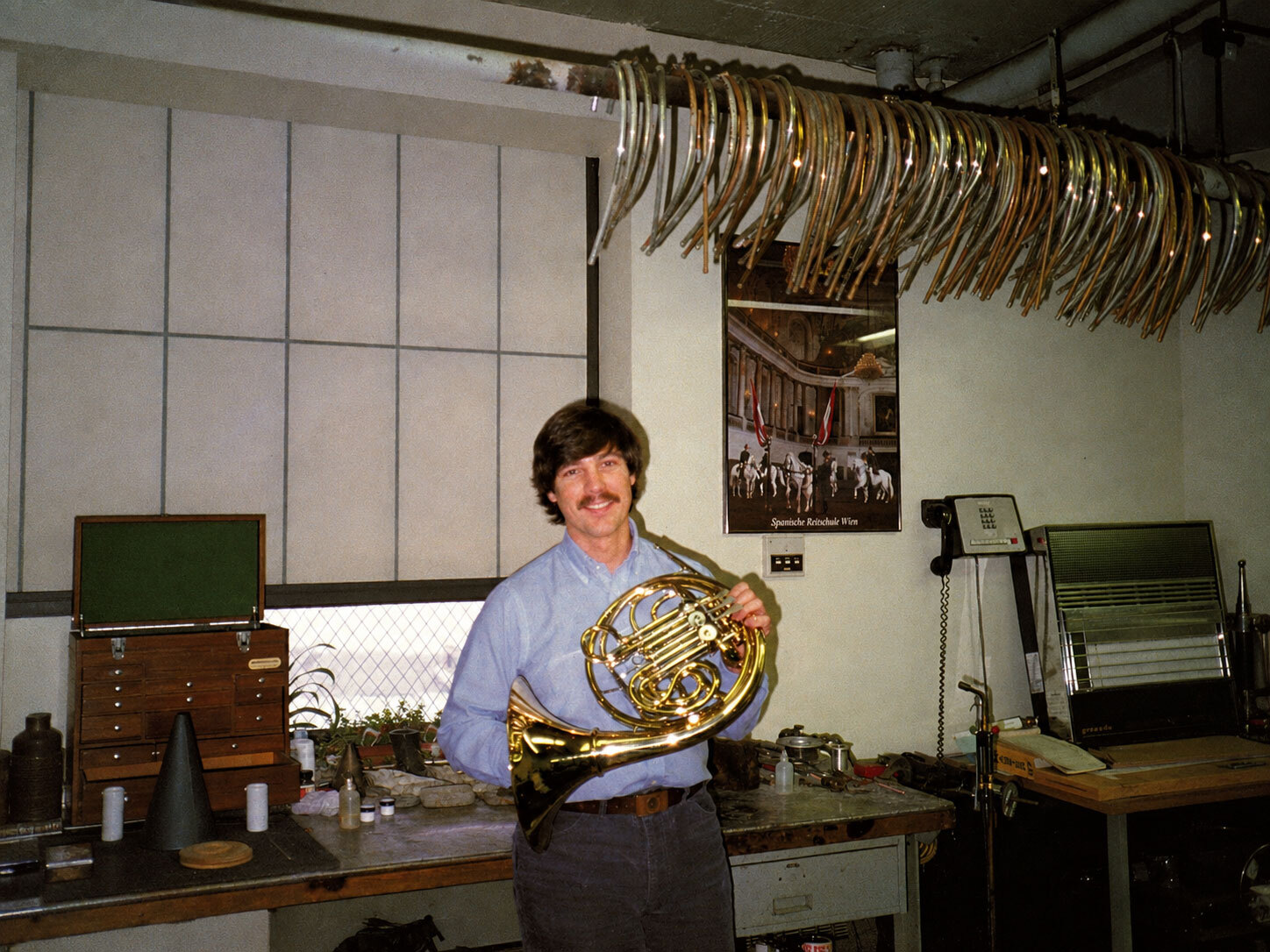
Steven W. Lewis
“What always interested me most was playing the horn”, Steven Lewis explained to me. “Even now I get quite depressed when I am so busy that I have to neglect the horn.” And yet today he is primarily a horn maker.
His workshop has an outstanding set of machinery. Production methods follow the classical procedure, although much refined. He produces the individual components from seamless drawn tubing which he draws on his special mandrels. Worthy of note is the compound he uses to bend the tubing, a lead alloy with a very low melting point (about 70°C) so that it can be removed from the tubes with hot water. He uses a standard alloy (CuZn 30, i.e.: 30% zinc and 70% copper) normally, nickel silver or red brass only to special order. “Traditionally brass is the horn material.”
As Jeffrey Agrell mentioned in his article in BRASS BULLETIN 49, Lewis concentrates on the production of a few models: in addition to single B♭ horns, natural and descant horns he makes primarily Geyer double horns with rotary or piston quick-change valves. The number of extras he limits to the essential as he is of the opinion that a wide range of variants is so confusing that it is difficult to make a judicious choice. “If the customer likes the model that I have developed and carefully tailored to his needs, then I am happy; if he doesn’t, then, as friends, we both wait for a better opportunity.”
Lewis has had excellent training. First he studied horn at the University of North Colorado, majoring in performance; then he studied with Dale Clevenger, 1st horn at the Chicago Symphony, with the aim of working as a musician in Chicago. The rest of his career, working with Schilke and meeting the outstanding Ukrainian instrument maker and repairer Jerry Lechniuk, is recounted in detail in Jeffrey Agrell’s article.
There is now a long list of the best orchestras in the world where the approximately 120 horns he has made so far — every one by himself — are played. Every year there are about 20 to 25 more horns. Roland Pinc, who worked for Schilke for ten years, is on hand to restore old instruments and do repair work.
When I asked what he thought the greatest virtue of Lewis horns was, he pointed out the fact that they are made by hand, something of which he is — rightfully — proud; then that he is a very good horn player who knows from personal experience what a player expects from an instrument when he is standing in front of an audience in a concert hall; and finally, that his dimensions and design, both derived entirely from practice, are important.
Continue reading
Accede a la edición digital completa.
Brass Bulletin 52, IV / 1985 páginas 90–94
Todo el contenido está protegido por derechos de autor © Brass Bulletin 1985–2026