Explore institutional access →

2 min. read

Part 1

Instrument Makers in USA

Instrument Makers in USA

I had the opportunity, as part of a student visit to the United States, to visit a number of brass instrument makers. I visited all the firms I had planned to (with the exception of the King Music Co. of Eastlake, Ohio, which was closed temporarily) in January and February of this year and I would like to express my deepest thanks for the friendly reception I got everywhere.

My questions were answered by the proprietors or by a manager and I was able to see and photograph the various production departments. The businesses ranged in their number of employees from one to 700. In general the machinery and production methods differ less than one might think. This sector of the economy, when compared with others, has changed relatively little in the last hundred years. There does seem to be some change in the last few years, however, especially in the area of student instruments. The time it takes to produce an instrument is getting shorter all the time, mainly as a result of new developments in the production of valves and bells. Soldering, bending, tube-making and lacquering processes are being modified and, as 95% of the market apparently consists of band instruments, further changes lie ahead. Most of the instruments are made by workers who have little contact with the finished product. As a rule they are trained only in making one particular component or in one limited process and many stay only a few years in the same business.

Most brass instruments are produced around Lake Michigan. Elkhart, Indiana, still the most important centre of US instrument making, lies there. As pay rates are higher here than in the southern states, production may be moved southwards. Semi-finished parts are already produced in Mexico, where the pay differential vis-à-vis the parent factories is even greater.

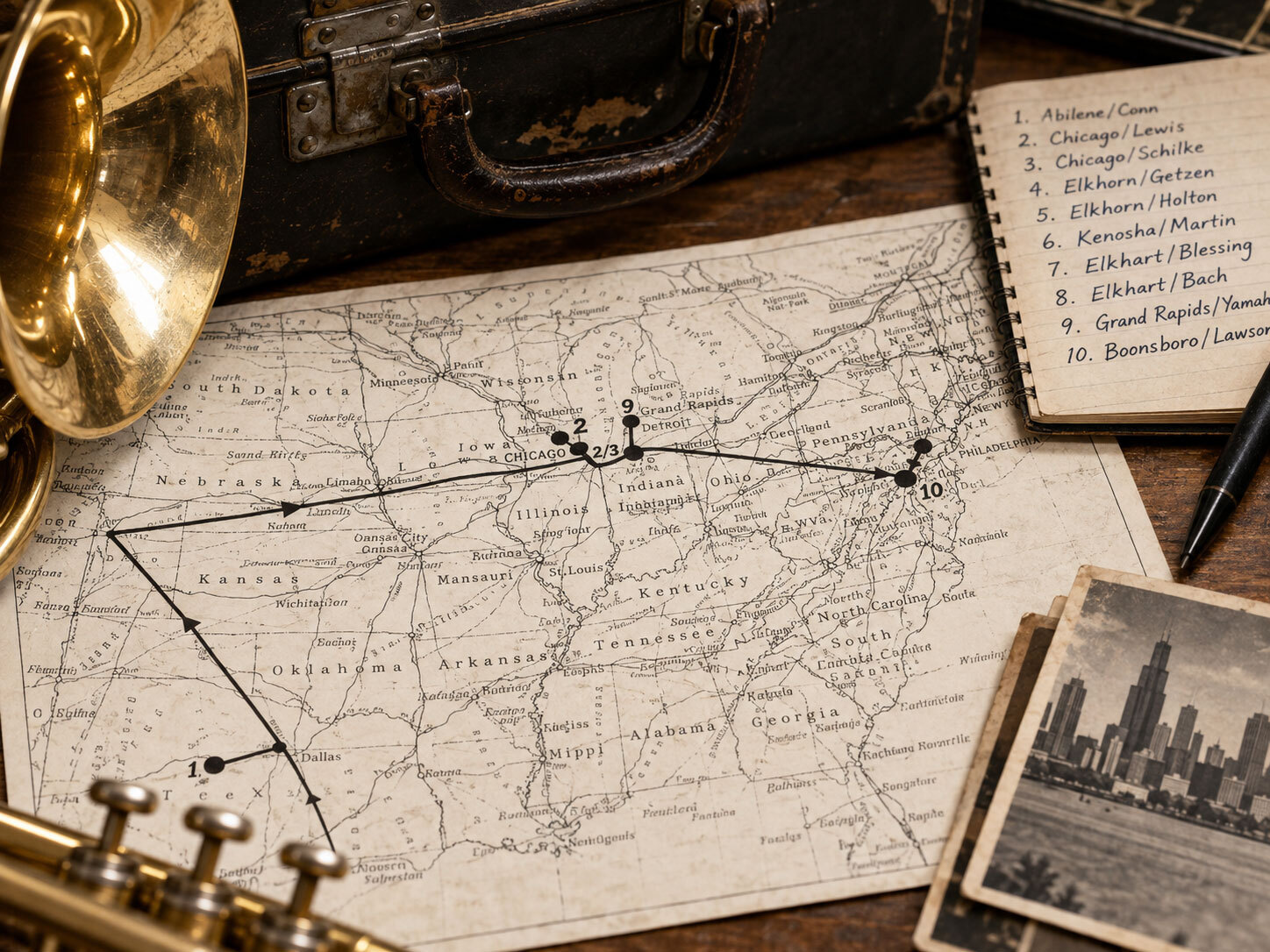
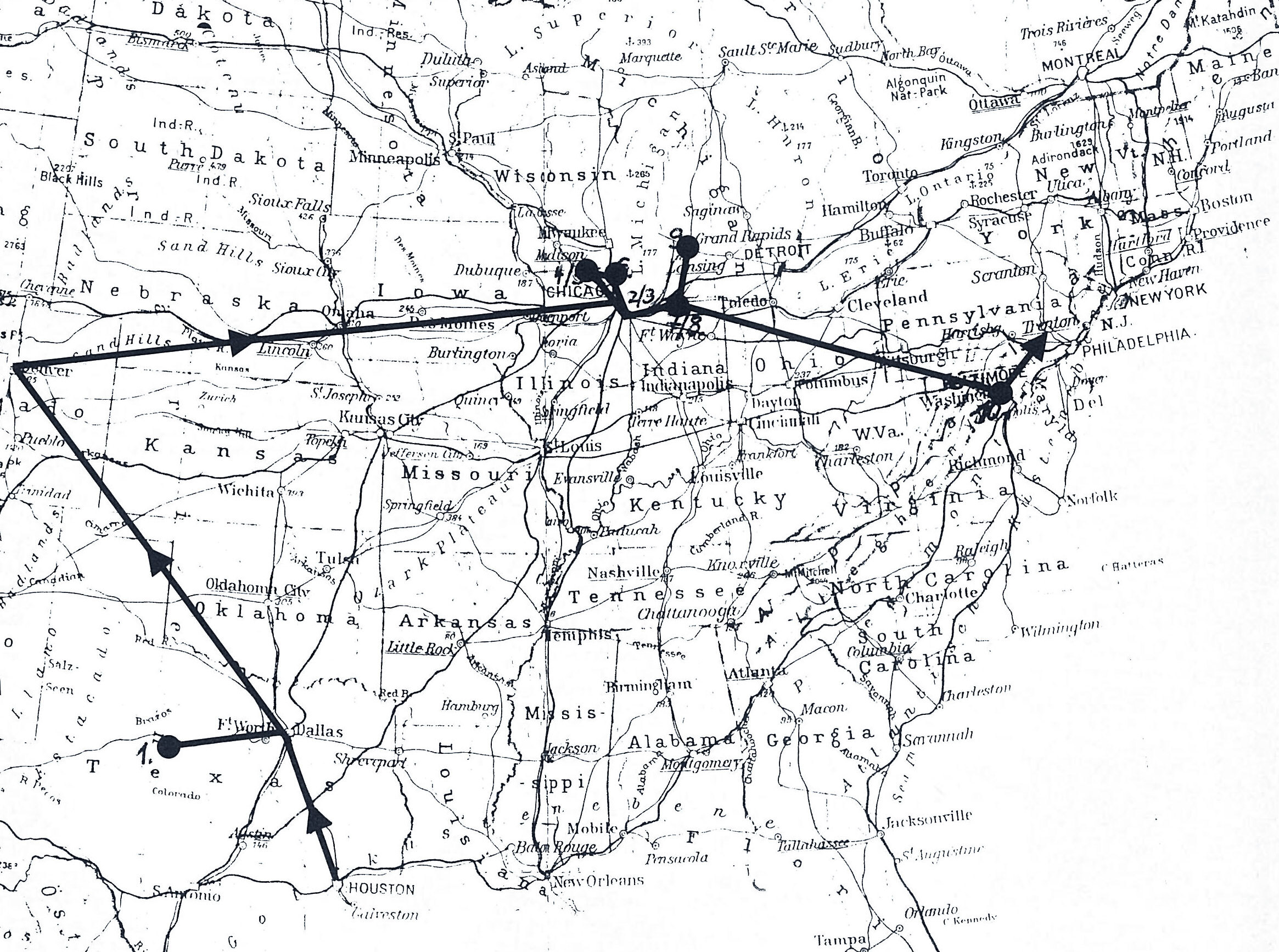
Abilene/ConnChicago/LewisChicago/SchilkeElkhorn/GetzenElkhorn/HoltonKenosha/MartinElkhart/BlessingElkhart/BachGrand Rapi...
  1. Abilene/Conn
  2. Chicago/Lewis
  3. Chicago/Schilke
  4. Elkhorn/Getzen
  5. Elkhorn/Holton
  6. Kenosha/Martin
  7. Elkhart/Blessing
  8. Elkhart/Bach
  9. Grand Rapids/Yamaha
  10. Boonsboro/Lawson

Woodwind instruments were in demand long before brass instruments. A New York document of 1786, for instance, shows a comprehensive import order of various instruments: violins, spinets, clarinets etc., but no brass. These were not yet sufficiently developed to be used in a band. The European invention of keyed instruments at the end of the 18th century and of valves at the beginning of the 19th considerably increased their usefulness. The Dodworth Band of New York, probably the first of its kind, was founded in 1834 and the Boston Brass Band a year later. The first brass instruments were built in the United States in those same years.

The most important early instrument maker was Samuel Graves, who founded Graves + Co. in 1824. At first he made only woodwind and started to make brass instruments only in 1837 with the help of James Keat, a very good instrument maker from London.

Four more 19th-century makers may be mentioned:

  • Joseph Lathrop Allen (active 1839-1869), inventor of a efficient rotary valve;
  • E.G. Wright (active 1839-1869) who, among other things, made gold and silver keyed bugles for bandleaders; together with Samuel Graves he founded the Boston Musical Instrument Manufactory in 1869;
  • Thomas D. Paine (active 1841-1881), inventor of a string mechanism for rotary valves;
  • Isaac Fiske (active 1842-1887), who took out several valve patents; Fiske's Cornet Band, which played only his instruments, was founded in the 1850's; in 1887 he sold the business to C.G. Conn + Co.

[Robert E. Eliason: “Early American Brass Makers” (Nashville, 1979); and Virginia Redway: “Music directory of early New York city” (New York, 1941)]

I plan a series of reports on my visits, beginning in the next issue with C.G. Conn + Co. and Schilke Musical Products.

* Stephan Suter (*1961): 1968-1980: Rudolf Steiner School, Basle; 1980-1984: apprenticeship with A. Egger Co., instrumentmaker in Basle (ended with mastership); 1981-1983: playing the horn with the Youth Symphony Orchestra; 1984-1985: student visit to the U.S.; 1985: working with Egger in Basle again.

Brass Bulletin 50, II / 1985 pages 18–21

All content is protected by copyright © Brass Bulletin 1985–2026

Share this article

Facebook LinkedIn
Loading…

Questions & Answers

How the Digital Edition works

What does the Digital Edition include?

The Digital Edition brings together the articles already digitized as searchable online texts—not simply as scans or PDF files—along with their original illustrations, notes, authorship, issue information, and available translations. Related-article suggestions currently include only this digitized material.

Are the digital articles identical to the originals?

We preserve the original text, language, illustrations, captions, footnotes, and editorial context as faithfully as possible. The presentation is adapted for comfortable online reading, and obvious transcription or scanning errors may be corrected. The substance and character of the published article remain unchanged.

Which languages are available?

Brass Bulletin was published in English, French, and German throughout its history. Italian and Spanish translations were added from issue No. 60 onward.

On the Italian and Spanish sites, articles from issues 1–59 are therefore shown in English by default.

How often are new articles added?

New articles are added almost daily, with approximately one complete issue digitized each week. The pace may vary depending on the preparation, image work, and editorial checking required.

Why aren’t all articles available digitally?

The complete Brass Bulletin collection contains 1,246 articles published between 1971 and 2003. The full index is already available online, allowing readers to discover every article in the collection, including those whose complete text has not yet been digitized.

Digitization began in February 2026. Each article is carefully prepared for online reading, checked, and connected to its issue, authors, subjects, and illustrations. At the current pace of digitization, the complete collection is expected to be available online by February 2028.

Why do some references mention articles that are not available yet?

References in the original articles are preserved even when the material they point to has not yet been digitized. This keeps the historical and editorial record intact. As more issues are added to the Digital Edition, an increasing number of these references will lead to articles that can be read online.

Can I suggest an article or report a transcription error?

Yes. If there is an article you would particularly like to see digitized, or if you notice a possible transcription error or missing detail, please contact us. Reader feedback helps us improve the Digital Edition and prioritize useful connections within the archive.

How can I support Brass Bulletin?

Your support helps fund the preparation, verification, and online publication of the complete collection.

Subscribe to the Digital Edition

Prefer to support us without subscribing?

Make a donation

How is the digitization progressing?

We’re gradually making the Brass Bulletin available online, article by article. You can read newly digitized articles as soon as they’re ready, even before an entire issue is complete.

Visit our Digitization Roadmap to browse recent additions and see estimated availability for upcoming issues. These estimates follow our recent pace and may change.

Search Brass Bulletin.