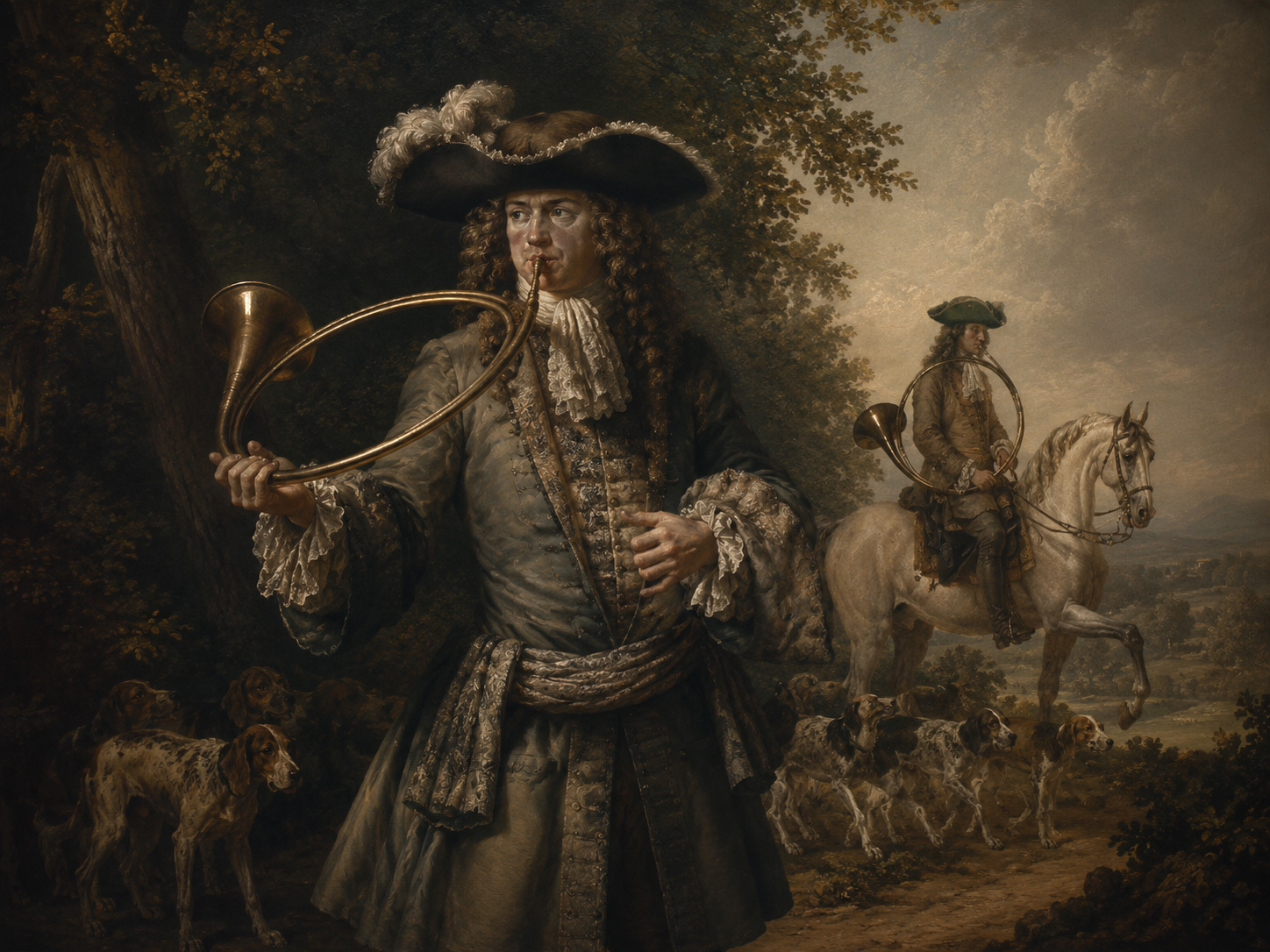
Brass Bulletin is now also available in Italian and Spanish.

18 min. read

300 Years of the Horn

1680-1980, an attempted survey

Part 1

By Peter Damm

From Versailles to Bohemia, hunting horns enter orchestral life through makers, players, early works and the Austro-Bohemian tradition.
300 Years of the Horn

Three hundred years ago in Bohemia there began that fruitful development which changed the original hunting horn (in German Jagdhorn) into one of the most beautiful and expressive of musical instruments, one of which Robert Schumann could say that it was “the soul of the orchestra”. It is a proud anniversary and it gives me an opportunity for my survey of the history of the horn, although I make no claim for the completeness of my findings.

Neither the year nor the day of the adoption of the French hunting horn in Bohemia can be precisely established. The dates given in the literature on the subject vary between 1680 and 1681. The fact is that in 1680/1681 two huntsmen of Count Sporck returned to Bohemia from Versailles. They had got to know the new hunting horns in Versailles and had learned the art of playing them. Bohemia became the home of the real Waldhorn. Here the development from tool to musical instrument was completed. Bohemian horn players propagated the art of horn playing in many European countries and became teachers in neighbouring states.
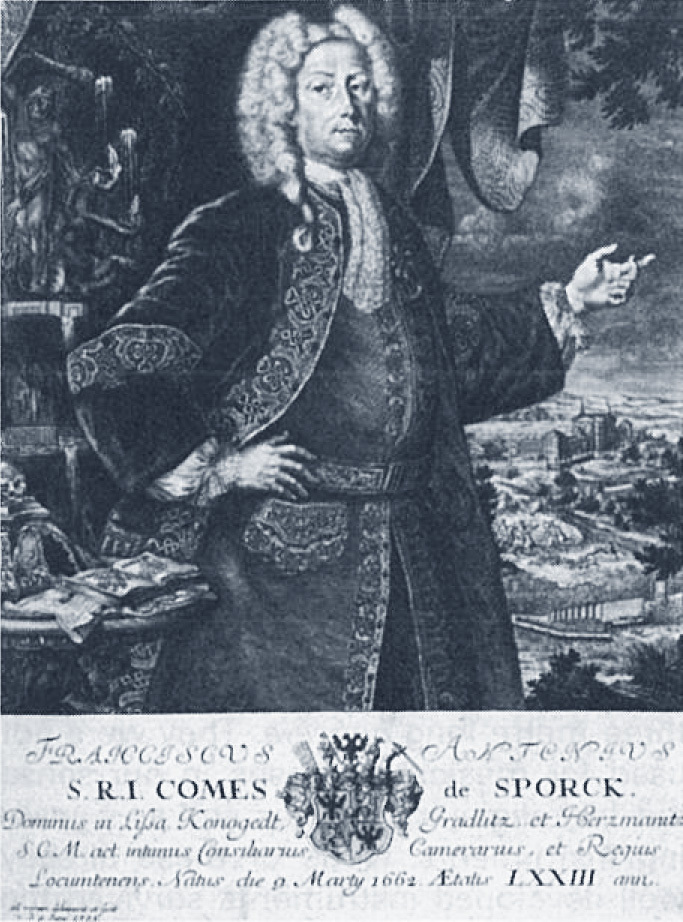
Graf von Sporck (1662–1738)(With kind permission of Oxford University Press, England)

Graf von Sporck (1662–1738)
(With kind permission of Oxford University Press, England)

One name is directly connected with the anniversary: Franz Anton Count von Sporck (1662–1738). It is to his interest in music and his enthusiasm for hunting that we owe the introduction into Bohemia of hunting horns from France. The son of an Imperial General of Cavalry who had been elevated to the nobility, Count Sporck was able after the death of his father to undertake an extended “Grand Tour”, visiting several of the royal courts of Europe. The high point was a visit to France. In Versailles Sporck experienced the splendour of the court of Louis XIV, and was delighted by the theatrical performances, the courtly music and the pleasures of the hunt. Sporck was particularly impressed by the new way of playing the hunting horn and so he decided to bring the new large hunting horns to Bohemia.

Continue reading

Access the full Digital Edition.

Brass Bulletin 31, III / 1980 pages 19–33

All content is protected by copyright © Brass Bulletin 1980–2026

Share this article

Facebook LinkedIn
Loading…

Questions & Answers

How the Digital Edition works

What does the Digital Edition include?

The Digital Edition brings together the articles already digitized as searchable online texts—not simply as scans or PDF files—along with their original illustrations, notes, authorship, issue information, and available translations. Related-article suggestions currently include only this digitized material.

Are the digital articles identical to the originals?

We preserve the original text, language, illustrations, captions, footnotes, and editorial context as faithfully as possible. The presentation is adapted for comfortable online reading, and obvious transcription or scanning errors may be corrected. The substance and character of the published article remain unchanged.

Which languages are available?

Brass Bulletin was published in English, French, and German throughout its history. Italian and Spanish translations were added from issue No. 60 onward.

On the Italian and Spanish sites, articles from issues 1–59 are therefore shown in English by default.

How often are new articles added?

New articles are added almost daily, with approximately one complete issue digitized each week. The pace may vary depending on the preparation, image work, and editorial checking required.

Why aren’t all articles available digitally?

The complete Brass Bulletin collection contains 1,246 articles published between 1971 and 2003. The full index is already available online, allowing readers to discover every article in the collection, including those whose complete text has not yet been digitized.

Digitization began in February 2026. Each article is carefully prepared for online reading, checked, and connected to its issue, authors, subjects, and illustrations. At the current pace of digitization, the complete collection is expected to be available online by February 2028.

Why do some references mention articles that are not available yet?

References in the original articles are preserved even when the material they point to has not yet been digitized. This keeps the historical and editorial record intact. As more issues are added to the Digital Edition, an increasing number of these references will lead to articles that can be read online.

Can I suggest an article or report a transcription error?

Yes. If there is an article you would particularly like to see digitized, or if you notice a possible transcription error or missing detail, please contact us. Reader feedback helps us improve the Digital Edition and prioritize useful connections within the archive.

How can I support Brass Bulletin?

Your support helps fund the preparation, verification, and online publication of the complete collection.

Subscribe to the Digital Edition

Prefer to support us without subscribing?

Make a donation

Search Brass Bulletin.