Explore institutional access →

2 min. read

Part 7

Instrument Makers in USA

Martin (G. Leblanc Corporation)
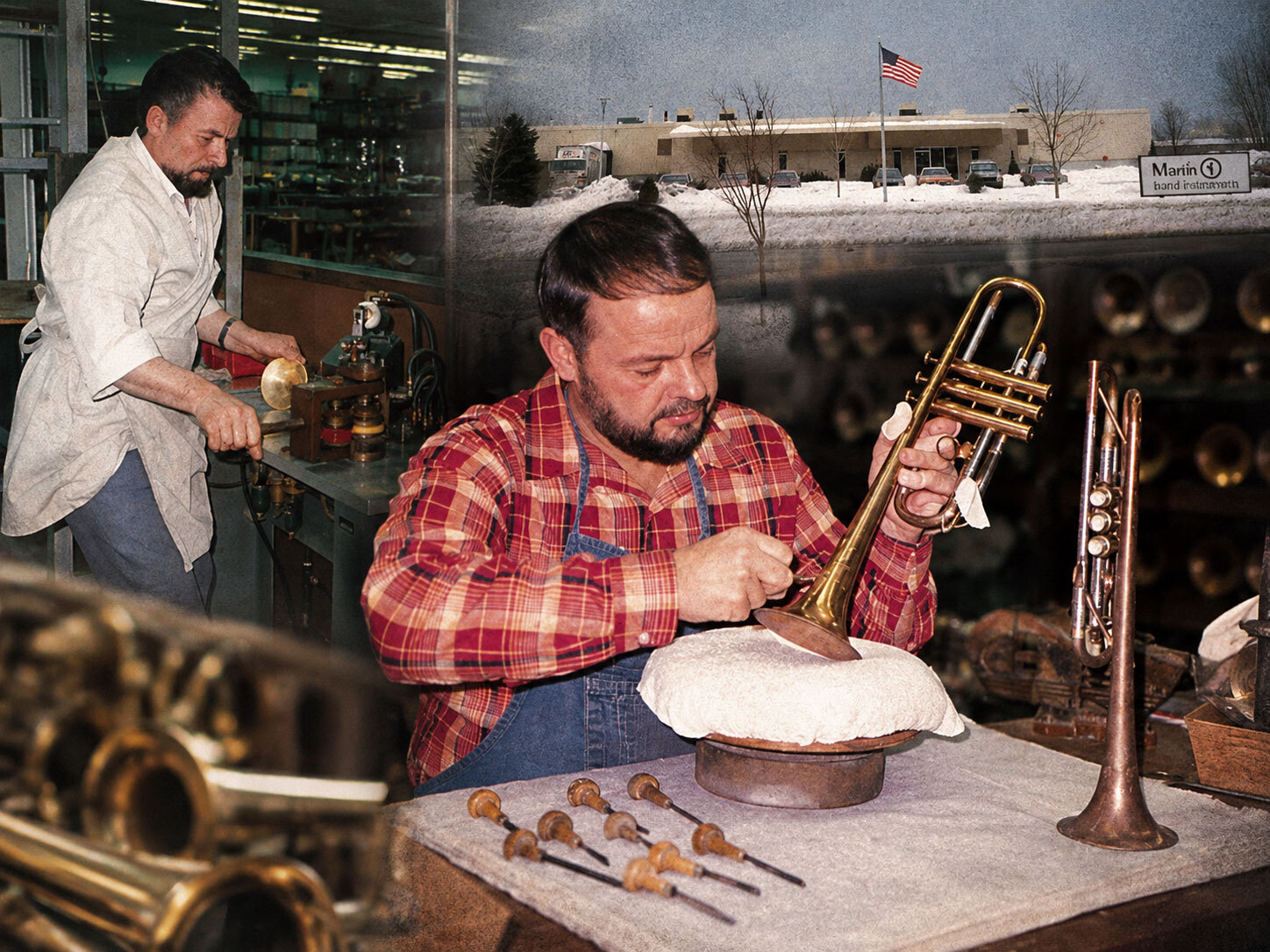
In 1970s Wisconsin, industrial efficiency transformed brass instrument production, yet traditional craftsmanship still had a place on the factory floor.
Instrument Makers in USA

Like Holton, the Martin company belongs to the G. Leblanc corporation (see box).

The Martin factory seems to me to have the most modern equipment of all the American brass instrument makers I visited.

In the sixties, when it was still located in Elkhart, Indiana, Martin was taken over by Leblanc. Production was moved to Arizona on cost grounds. This was short-lived: a serious fire burned the factory to the ground. So Martin started up again in Kenosha, Wisconsin, close to the Leblanc corporate headquarters.

Production methods are highly rationalised: a student trumpet requires only six man-hours' work! The individual production phase are carefully divided up. The assembly of a trumpet from finished components, for example, is divided among three people: the first cleans the inner slides and attaches the water keys; the second puts the valves in and screws the valve caps on; and the third puts the slides on and attaches the triggers where necessary. There is very little rotation among the various work processes except for when an employee is absent and someone stands in.

Continue reading

Access the full Digital Edition.

Brass Bulletin 53, I / 1986 pages 113–115

All content is protected by copyright © Brass Bulletin 1986–2026

Share this article

Facebook LinkedIn
Loading…

Questions & Answers

How the Digital Edition works

What does the Digital Edition include?

The Digital Edition brings together the articles already digitized as searchable online texts—not simply as scans or PDF files—along with their original illustrations, notes, authorship, issue information, and available translations. Related-article suggestions currently include only this digitized material.

Are the digital articles identical to the originals?

We preserve the original text, language, illustrations, captions, footnotes, and editorial context as faithfully as possible. The presentation is adapted for comfortable online reading, and obvious transcription or scanning errors may be corrected. The substance and character of the published article remain unchanged.

Which languages are available?

Brass Bulletin was published in English, French, and German throughout its history. Italian and Spanish translations were added from issue No. 60 onward.

On the Italian and Spanish sites, articles from issues 1–59 are therefore shown in English by default.

How often are new articles added?

New articles are added almost daily, with approximately one complete issue digitized each week. The pace may vary depending on the preparation, image work, and editorial checking required.

Why aren’t all articles available digitally?

The complete Brass Bulletin collection contains 1,246 articles published between 1971 and 2003. The full index is already available online, allowing readers to discover every article in the collection, including those whose complete text has not yet been digitized.

Digitization began in February 2026. Each article is carefully prepared for online reading, checked, and connected to its issue, authors, subjects, and illustrations. At the current pace of digitization, the complete collection is expected to be available online by February 2028.

Why do some references mention articles that are not available yet?

References in the original articles are preserved even when the material they point to has not yet been digitized. This keeps the historical and editorial record intact. As more issues are added to the Digital Edition, an increasing number of these references will lead to articles that can be read online.

Can I suggest an article or report a transcription error?

Yes. If there is an article you would particularly like to see digitized, or if you notice a possible transcription error or missing detail, please contact us. Reader feedback helps us improve the Digital Edition and prioritize useful connections within the archive.

How can I support Brass Bulletin?

Your support helps fund the preparation, verification, and online publication of the complete collection.

Subscribe to the Digital Edition

Prefer to support us without subscribing?

Make a donation

How is the digitization progressing?

We’re gradually making the Brass Bulletin available online, article by article. You can read newly digitized articles as soon as they’re ready, even before an entire issue is complete.

Visit our Digitization Roadmap to browse recent additions and see estimated availability for upcoming issues. These estimates follow our recent pace and may change.

Search Brass Bulletin.