Discoveries for brass players, once a month. Join our free newsletter →
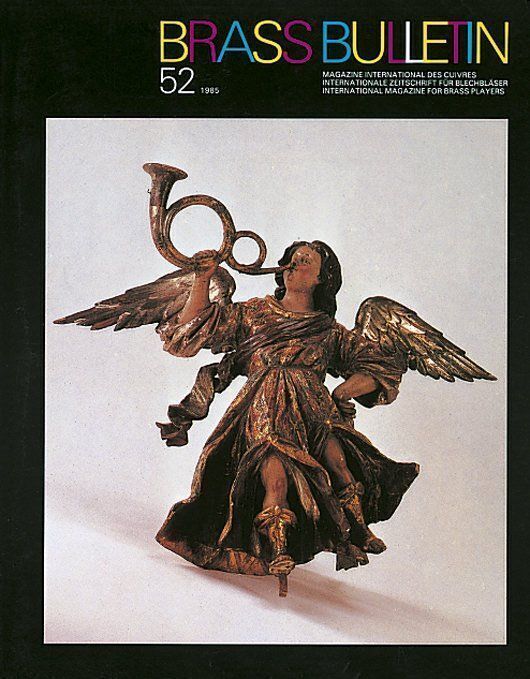
Brass Bulletin 52 - 4 / 1985
Issue
Brass Bulletin No. 52
Date
IV / 1985
Pages
108
Contents
14 articles

Original inserts

World News Journal

Out of print

All issues

Brass Bulletin No. 52

IV / 1985

Contents

14 articles
Free

Editorial

Jean-Pierre Mathez

pp. 13–14 Technique

Instrumental technique meets personal reflection as Jean-Pierre Mathez argues that artistic growth depends less on definitive answers than curiosity, exchange and individual paths.

Part 4

Instrument Makers in USA

Lawson Horns

Stephan Suter

pp. 15–19 Horn Equipment Instrument Makers

Walter Lawson built horns by testing alloys, valves and leadpipes with unusual precision, while keeping craftsmanship, musicians and acoustics closely connected.

Part 3 – End

The trombone in Jazz and Popular Music

Pluralism of expression since 1945

Michel Laplace

pp. 20–28 Trombone History Technique

Bebop, cool jazz, free jazz and neo-classicism transformed the trombone after 1945, as new players, techniques and instruments pushed its boundaries.

Free

Salvation Army in Japan

Taku Satoh

pp. 30–34 History Society

Western-style brass music entered a once-isolated Japan through unexpected channels, with Salvation Army bands becoming part of a remarkable cultural transformation.

Valsalva Maneuver - Why?

William F. Cramer

pp. 36–38 Technique Health

A familiar breathing technique becomes a source of resistance and tension, as William F. Cramer argues instead for an open throat and freer airflow.

Part 3

How and why I became a musician

Edouard Gros

pp. 39–46 Tuba Professional life History

As cinema orchestras vanished and radio reshaped musical life, Edouard Gros learned that survival could mean changing instruments, cities and expectations.

Good intonation on the trombone

Raymond Fonseque

pp. 47–52 Trombone Technique Acoustics

The trombone’s fixed positions meet the compromises of natural harmonics, as Raymond Fonsèque proposes a different logic for pitch across major and minor keys.

Free
Part 1

The Art of the Musical Instrument Maker

Encyclopédie méthodique — Paris 1795

Anonyme

pp. 57–59 History Instrument Makers

A 1795 encyclopedia captures brass and wind instruments at a moment when their language, character and expressive roles were understood rather differently.

Jazz and the Horn Series • Part 7

John Clark

Jeffrey Agrell

pp. 61–65 Horn Encounters Technique

John Clark made the horn a jazz voice on its own terms, balancing improvisation, studio realities and an instrument still fighting to escape classical expectations.

Free

Trombone workshops

Benny Sluchin

pp. 67–69 Trombone Report Event

In Nashville, Copenhagen and Metz, trombone workshops took strikingly different forms, exposing the artistic ambitions and practical tensions behind a growing movement.

Free

The Unusual Trumpet in the Nürnberg Transport Museum

Albert Hiller

pp. 72–73 Trumpet Equipment

A mysterious three-coil trumpet in Nuremberg defies familiar instrument types, with no maker, date or clear explanation of how it entered a postal collection.

Individuality and Uniformity in Brass Players

Hans-Joachim Drechsler

pp. 74–78 Society Professional life

As international standards reshape brass playing, musical individuality risks giving way to imitation, leaving tradition, ensemble work and personal conviction at stake.

The powdered tuba or the strange illness of Stanley Cooper¹

Jean-Pierre Mathez

pp. 81–82 Short story

A gifted tubist develops an alarming appetite for his instrument, as Jean-Pierre Mathez turns orchestral life into a darkly absurd tale of musical solidarity.

Part 5

Instrument Makers in USA

S. W. Lewis Orchestral Horns

Stephan Suter

pp. 90–94 Horn Instrument Makers Equipment

For Steven Lewis, building a horn begins with playing it: craftsmanship, acoustic compromise and observation shape instruments made for musicians rather than theory.

Loading…

Questions & Answers

How the Digital Edition works

What does the Digital Edition include?

The Digital Edition brings together the articles already digitized as searchable online texts—not simply as scans or PDF files—along with their original illustrations, notes, authorship, issue information, and available translations. Related-article suggestions currently include only this digitized material.

Are the digital articles identical to the originals?

We preserve the original text, language, illustrations, captions, footnotes, and editorial context as faithfully as possible. The presentation is adapted for comfortable online reading, and obvious transcription or scanning errors may be corrected. The substance and character of the published article remain unchanged.

Which languages are available?

Brass Bulletin was published in English, French, and German throughout its history. Italian and Spanish translations were added from issue No. 60 onward.

On the Italian and Spanish sites, articles from issues 1–59 are therefore shown in English by default.

How often are new articles added?

New articles are added almost daily, with approximately one complete issue digitized each week. The pace may vary depending on the preparation, image work, and editorial checking required.

Why aren’t all articles available digitally?

The complete Brass Bulletin collection contains 1,246 articles published between 1971 and 2003. The full index is already available online, allowing readers to discover every article in the collection, including those whose complete text has not yet been digitized.

Digitization began in February 2026. Each article is carefully prepared for online reading, checked, and connected to its issue, authors, subjects, and illustrations. At the current pace of digitization, the complete collection is expected to be available online by February 2028.

Why do some references mention articles that are not available yet?

References in the original articles are preserved even when the material they point to has not yet been digitized. This keeps the historical and editorial record intact. As more issues are added to the Digital Edition, an increasing number of these references will lead to articles that can be read online.

Can I suggest an article or report a transcription error?

Yes. If there is an article you would particularly like to see digitized, or if you notice a possible transcription error or missing detail, please contact us. Reader feedback helps us improve the Digital Edition and prioritize useful connections within the archive.

How can I support Brass Bulletin?

Your support helps fund the preparation, verification, and online publication of the complete collection.

Subscribe to the Digital Edition

Prefer to support us without subscribing?

Make a donation

How is the digitization progressing?

We’re gradually making the Brass Bulletin available online, article by article. You can read newly digitized articles as soon as they’re ready, even before an entire issue is complete.

Visit our Digitization Roadmap to browse recent additions and see estimated availability for upcoming issues. These estimates follow our recent pace and may change.

Search Brass Bulletin.