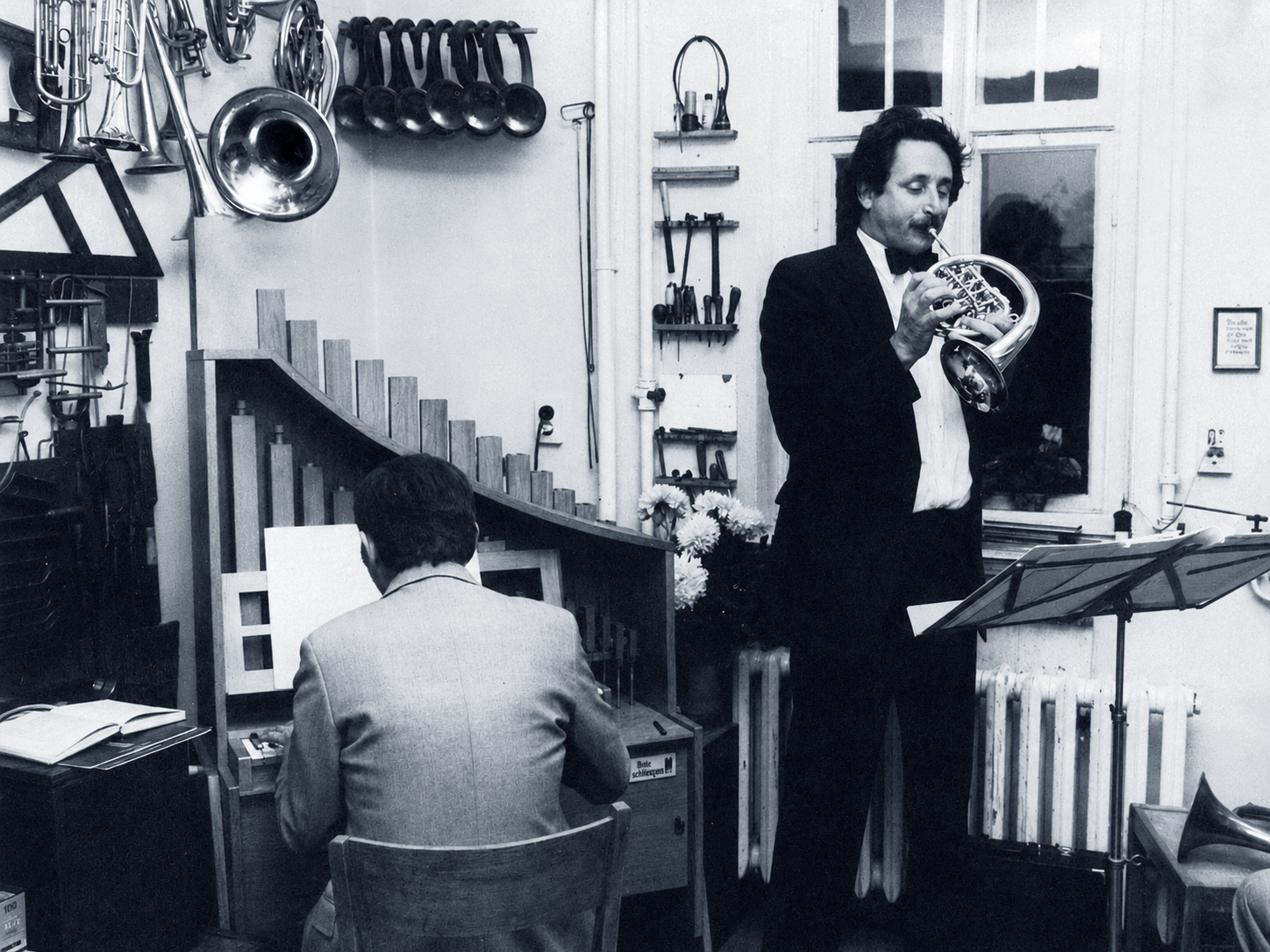
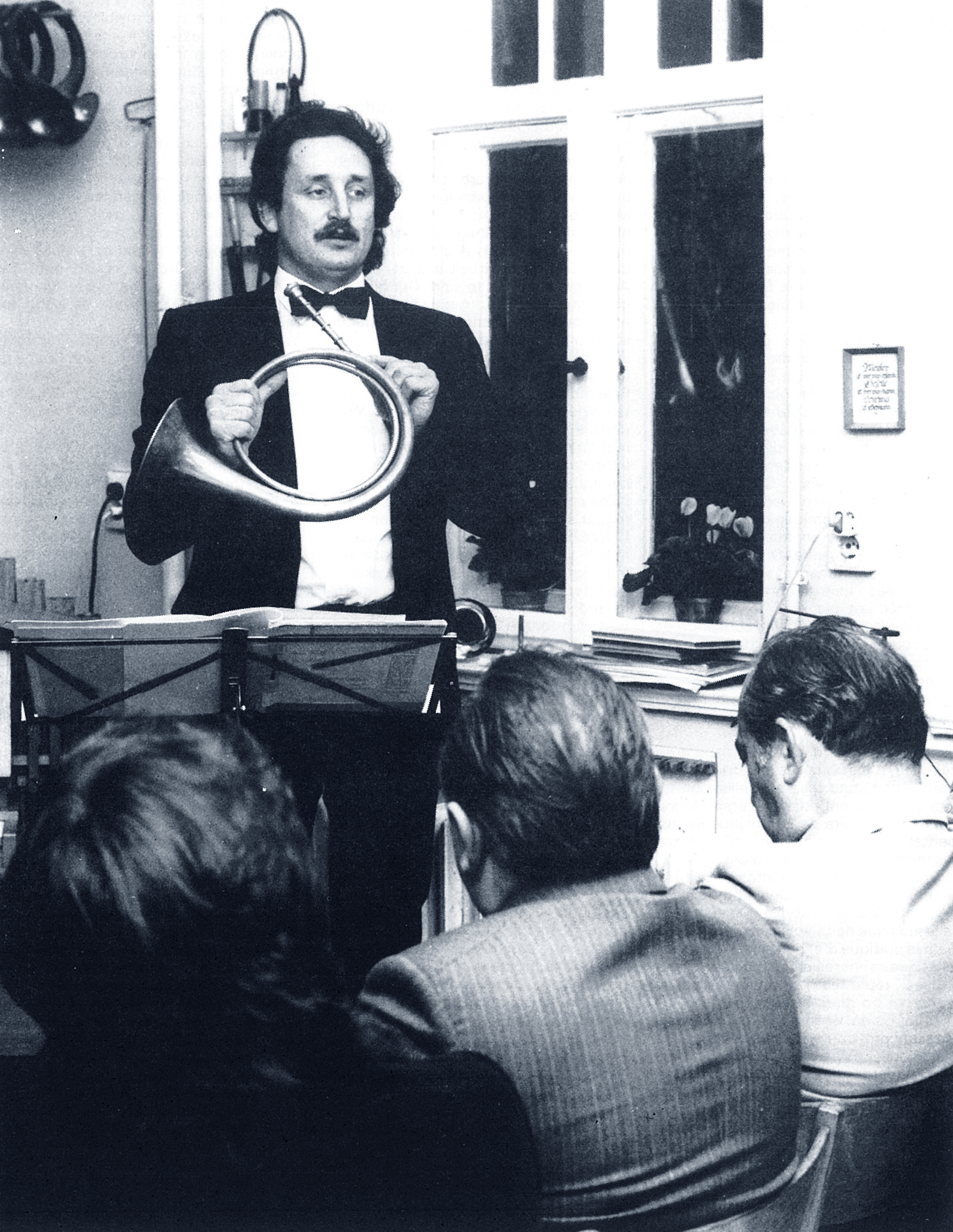
Ludwig Güttler during Friedbert Syhre’s 2nd Music Workshop.
But parts for descant horn in D cannot be played even on this. At this point the impetus for developing yet another instrument came from the trumpet soloist Ludwig Güttler, professor of trumpet at the Dresden College of Music and associated primarily with the Dresden Philharmonic and the New Bach Collegium Musicum in Leipzig. He has made an intensive study of the 17th and 18th century repertoire for trumpet and horn as well as of performance practice and the instruments themselves. The fact that 18th-century brass players were usually as competent on the valveless corno da caccia at the written pitch as they were on the valveless trumpet played an important part in his considerations. Surviving works prove that, particularly in that part of the German-speaking world corresponding to the GDR today — in Dresden, Leipzig, Halle and Weissenfels — the art of trumpet playing and that of horn playing were equally developed. In addition to Bach other composers including Zachow, Keiser and Neruda wrote parts for trumpet and horn in the high register.
As far as the practice in Leipzig was concerned, Bach’s scores and his “Brief but essential outline of duly appointed church music” indicate that the trumpet and horn parts were performed by the same players; for the two instruments are never used simultaneously and the names of the two town musicians permanently employed to play them are given in the “Outline”: the famous Gottfried Reiche and Johann Cornelius Genther. The facts also indicate that these players used the same mouthpieces, cup mouthpieces, for both instruments.
For his experiments in sound and playing technique Ludwig Güttler first had a valveless natural horn built by the instrument maker Thein. On this he was able to play the high horn parts of Bach and his contemporaries with fine sound and surprising security. Going on from there he next asked the Leipzig master instrument maker Friedbert Syhre to build a new descant horn in D corresponding to the tonal character of the corno da caccia but benefiting from the much greater technical security of the valve horn, with right-hand valves as on the modern trumpet. For playing other parts Syhre also made Güttler a descant horn in B♭ with four right-hand valves.
Güttler explained and demonstrated the results of his investigations and experiments at Friedbert Syhre’s 2nd Music Workshop during the Leipzig Fair in the presence of instrumentalists, conductors, instrument makers and musicologists. The great tonal differences between the former corno da caccia and the modern orchestral horn immediately became clear, as did also the great tonal similarities between the reconstructed valveless horns and the new descant horn in D developed by Syhre.
These descant horns in D and in B♭ had already been used for disc recordings with VEB Deutsche Schallplatten of East Berlin in collaboration with Ariola Eurodisc. In the new recording of Bach’s “B minor Mass”, with the radio chorus and the New Bach Collegium Musicum of Leipzig, conducted by Peter Schreier, Ludwig Güttler plays the Quoniam horn part (bass: Theo Adam) for the first time at Bach’s original pitch and then the 1st trumpet part in “Cum sancto spiritu”. The features mentioned above become compellingly clear in this recording. In the recordings of the “Pentecost Cantata, no. 68”, Also Gott die Welt geliebt, and the “Reformation Cantata, no. 79”, Gott, der Herr, ist Sonn’ und Schild, with the choir of St. Thomas and the New Bach Collegium Musicum of Leipzig, conducted by Hans-Joachim Rotzsch, the 1st horn parts are played by Güttler on the new B♭ horn. The sound of these instruments suits the character and structure of the works, especially in “Cantata, no 68” where the horn joins the chorus sopranos, the 1st violins and the 1st oboe.
Friedbert Syhre’s instrument and Ludwig Güttler’s artistic playing prove that it is both possible and sensible to combine the sound of early instruments with the achievements in construction and performance technique made since the 19th century. Nor is there any problem in producing right-handed horns for trumpeters and left-handed ones for horn players. The question of whether these high horn parts should be played by trumpeters or horns players, in view of the long-standing “demarcation” between the two groups, will certainly be solved in practice and this will of course be due above all to the personal desire and ability of the players. If both 1st trumpets and 1st horns master the descant horn, that can only be good for music.
With their construction of the first right-handed descant horns in D and B♭ and of left-handed double horns in high B♭ and high F the Syhre workshop has made a pioneering contribution, the value of which it would be difficult to overestimate, to stylistically correct and therefore much livelier performance of music from before 1760 and in particular of the music of Bach. It is easy to foresee the artistic and of course economic significance this work has, and the requests which may be expected. The path chosen here — that of producing new instruments on the tonal model of historical ones, but incorporating recently developed improvements in construction and performance technique — seems to me the most sensible. Ensembles using historical instruments, such as the Vienna Concentus Musicus and the Capella Fidicinia at the Musical Instrument Museum of Karl Marx University in Leipzig, must remain exceptions since, for one thing, few historical instruments are available and, for another, such specialisation will only rarely be possible, given the comprehensive repertoire of instrumental music and the corresponding increase in musicians’ obligations.
And yet it is a deeply felt requirement of our cultural heritage to grasp the spirit and the stylistic and tonal essence of the music of early centuries. Study of the performance practice and the tonal characteristics of every age and their reproduction for today’s audiences make this music come much more alive than did the practice, still common in the first half of the 20th century, of adapting it to modern performing practices. Instrument makers have something important to say in all this. After this example set by Friedbert Syhre the next task will be to develop instruments corresponding to the former oboe da caccia and cornetto. This call is directed to woodwind makers, and woodwind players and instrument historians should work closely together with them.