4 min. read
Instrument Makers in USA
Lawson Horns
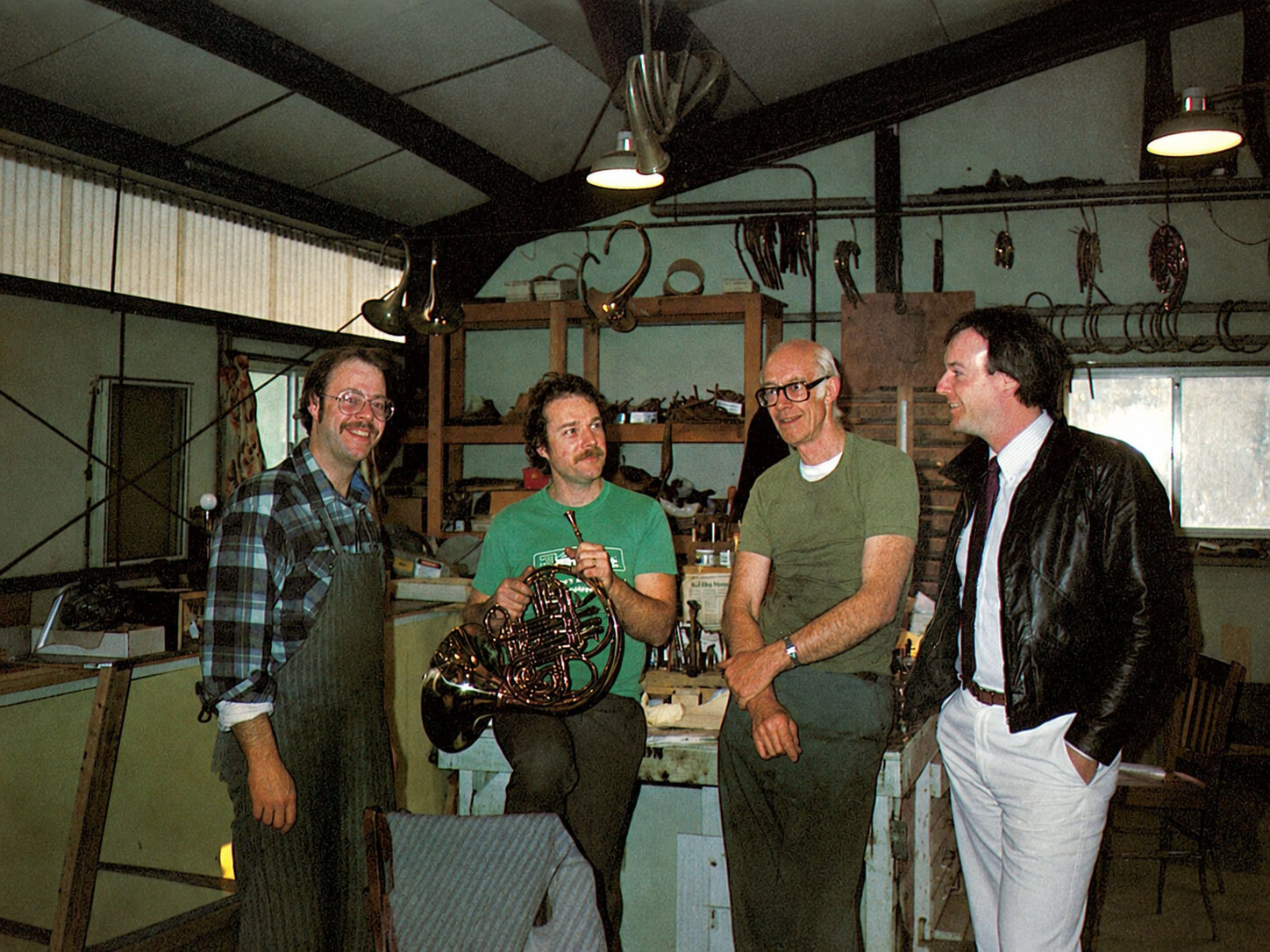
Paul, Bruce, Walter and Duane Lawson
Everything that Walter A. Lawson does is the result of long and thorough preparation and that is how it was in 1980 when he presented his first horn to the public.
From 1949 to 1975 Lawson was 2nd horn at the Baltimore Symphony orchestra and so has first-hand knowledge of everything that has to do with horn playing. At the same time — the playing season was very short in those days and provided only a very meagre income — he worked for some time in a Baltimore music shop, where he had the opportunity to learn brass instrument repairing.
Soon he began to make horn mouthpieces. Above all else, however, he was fascinated by everything concerning the development of horn mouthpipes, or leadpipes. In the course of his years of study he examined mouthpipes from the best known makers — Alexander, Conn, Holton, King, Kruspe etc. — made castings of them with a special alloy and took very precise measurements of them. The results of this work — which varied widely by maker — were followed by mouthpipe variants, new prototypes mouthpipes, those whose characteristics had seemed the most promising. Lawson distributed these prototypes, along with printed evaluation sheets, among well known orchestras and musicians, asking them for their opinions. These results were reevaluated and gradually the present-day Lawson mouthpipes came into being.
His special interest was not limited to mouthpipes, however. Since the founding of Lawson Brass Instruments in 1956 every part of the horn had been systematically examined and its design reconsidered. The effects of normal and screw bells were compared and there were experiments on the influence on sound quality of different alloys and their treatment and investigations of the suitability of lacquer and silver plate as protective coatings for the instrument. “The player literally corrodes the materiel”, says Lawson, “and the leadpipe and the hand support in the bell are the worst affected.” He tested all alloys to arrive at a conclusion which in its aggressiveness matches human sweat and saliva. The most resistant turned out to be the brass alloys with a low zinc content, like nickel silver. “The barely perceptible loss of sound which protective lacquering causes in the instrument is often exaggerated. To me that slight disadvantage doesn’t matter at all. Much more important, for example, is whether you have a good or bad position in the orchestra and that is hardly ever mentioned! A water key can also affect a tone but, here again, it is far more important for a soloist to be able to empty his instrument unobtrusively during a short rest in a performance.”
Brass Bulletin 52, IV / 1985 pages 15–19
All content is protected by copyright © Brass Bulletin 1985–2026