Explore institutional access Explore institutional access
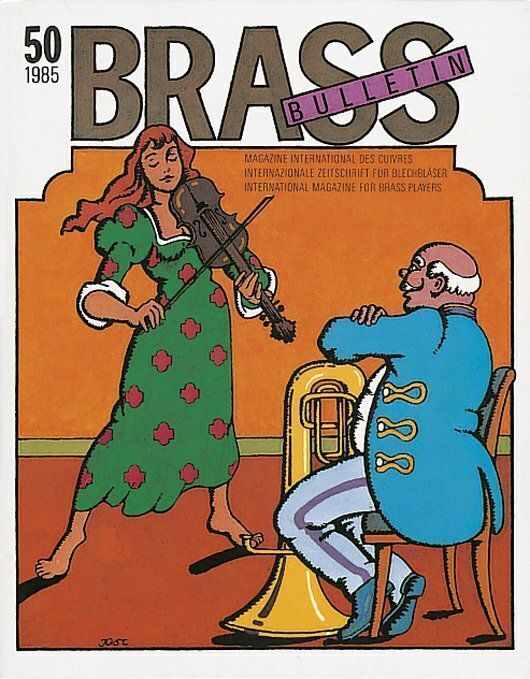
Brass Bulletin 50 - 2 / 1985
Issue
Brass Bulletin No. 50
Date
II / 1985
Pages
108
Contents
12 articles

Original inserts

World News Journal

Out of print

All issues

Brass Bulletin No. 50

II / 1985

Contents

12 articles

Editorial

Jean-Pierre Mathez

pp. 6–7

What began modestly in 1971 became a worldwide network, shaped by respect for brass players, shared knowledge, history and professional solidarity.

Michel Becquet

Interview

Benny Sluchin

pp. 11–16 Trombone Encounters Repertoire

A young Michel Becquet challenges orchestral habits, champions the trombone as a solo voice and reflects on competitions, repertoire, teaching and sound.

Instrument Makers in USA

Part 1

Stephan Suter

pp. 18–21 Instrument Makers

American brass making in the mid-1980s stood between workshop tradition and industrial change, with ten firms offering a striking cross-section of the trade.

Aimé Barelli

Trumpet crooner

Michel Laplace

pp. 22–29 Trumpet History

French jazz, wartime Paris and changing styles shaped a trumpeter whose playing balanced virtuosity, melody and expression across several musical worlds.

Jazz and the Horn

Part 6

Peter Gordon

Jeffrey Agrell

pp. 31–34 Horn Encounters

Classically trained but drawn elsewhere, Peter Gordon made the horn at home in jazz, studios and popular music without abandoning its orchestral foundations.

The trombone in Jazz and Popular Music

Part 1

Michel Laplace

pp. 36–40 Trombone History Technique

Jazz did not invent the modern trombone: early virtuosos, New Orleans players and changing techniques reveal a more complex path toward flexibility and legato.

Joannès Rochut (1881-1952)

Trombonist of the Boston symphony Orchestra

David Fetter

pp. 41–49 Trombone History

Behind a cornerstone of trombone teaching lies Rochut’s path between Paris and Boston, lost manuscripts, orchestral life and the enduring Bordogni legacy.

The posthorn of the 19th-century Royal Post Office in the service of folk music

Albert Hiller

pp. 52–65 Horn History Equipment

Once a tool of postal signalling, the posthorn became part of Bavaria’s popular musical life, caught between official regulation, practical invention and folk tradition.

How and why I became a musician

Part 1

Edouard Gros

pp. 69–73 Tuba Professional life

A father determined to keep his son from music unwittingly gives him the foundations for a life shaped by orchestras, discipline and an irresistible vocation.

Friedemann Immer

A new Trumpet

Jean-Pierre Mathez

pp. 76–79 Trumpet Encounters

Baroque tradition and modern trumpet playing converge in Friedemann Immer’s unusual double career, shaped by Bach, natural trumpet and early music.

A Little Trumpet Music

Jean-Pierre Mathez

pp. 81–83 Short story

Stage fright, high A’s and a D trumpet turn an orchestral concert into an intimate account of the moment anxiety finally gives way to music.

Gravestone of the field trumpeter Johann Kauffmann (1585-1634?)

Wolfgang G. Haas

pp. 106–107 Trumpet History

A chance visit near Giebelstadt brings a seventeenth-century field trumpeter back into view, leaving a gravestone—and a musical life still largely unknown.

Loading…

Questions & Answers

How the Digital Edition works

What does the Digital Edition include?

The Digital Edition brings together the articles already digitized as searchable online texts—not simply as scans or PDF files—along with their original illustrations, notes, authorship, issue information, and available translations. Related-article suggestions currently include only this digitized material.

Are the digital articles identical to the originals?

We preserve the original text, language, illustrations, captions, footnotes, and editorial context as faithfully as possible. The presentation is adapted for comfortable online reading, and obvious transcription or scanning errors may be corrected. The substance and character of the published article remain unchanged.

Which languages are available?

Brass Bulletin was published in English, French, and German throughout its history. Italian and Spanish translations were added from issue No. 60 onward.

On the Italian and Spanish sites, articles from issues 1–59 are therefore shown in English by default.

How often are new articles added?

New articles are added almost daily, with approximately one complete issue digitized each week. The pace may vary depending on the preparation, image work, and editorial checking required.

Why aren’t all articles available digitally?

The complete Brass Bulletin collection contains 1,246 articles published between 1971 and 2003. The full index is already available online, allowing readers to discover every article in the collection, including those whose complete text has not yet been digitized.

Digitization began in February 2026. Each article is carefully prepared for online reading, checked, and connected to its issue, authors, subjects, and illustrations. At the current pace of digitization, the complete collection is expected to be available online by February 2028.

Why do some references mention articles that are not available yet?

References in the original articles are preserved even when the material they point to has not yet been digitized. This keeps the historical and editorial record intact. As more issues are added to the Digital Edition, an increasing number of these references will lead to articles that can be read online.

Can I suggest an article or report a transcription error?

Yes. If there is an article you would particularly like to see digitized, or if you notice a possible transcription error or missing detail, please contact us. Reader feedback helps us improve the Digital Edition and prioritize useful connections within the archive.

How can I support Brass Bulletin?

Your support helps fund the preparation, verification, and online publication of the complete collection.

Subscribe to the Digital Edition

Prefer to support us without subscribing?

Make a donation

Search Brass Bulletin.