
Ofrezca Brass Bulletin en su universidad, conservatorio o biblioteca Descubra el acceso institucional

2 min de lectura

Parte 1

Instrument Makers in USA

Instrument Makers in USA

I had the opportunity, as part of a student visit to the United States, to visit a number of brass instrument makers. I visited all the firms I had planned to (with the exception of the King Music Co. of Eastlake, Ohio, which was closed temporarily) in January and February of this year and I would like to express my deepest thanks for the friendly reception I got everywhere.

My questions were answered by the proprietors or by a manager and I was able to see and photograph the various production departments. The businesses ranged in their number of employees from one to 700. In general the machinery and production methods differ less than one might think. This sector of the economy, when compared with others, has changed relatively little in the last hundred years. There does seem to be some change in the last few years, however, especially in the area of student instruments. The time it takes to produce an instrument is getting shorter all the time, mainly as a result of new developments in the production of valves and bells. Soldering, bending, tube-making and lacquering processes are being modified and, as 95% of the market apparently consists of band instruments, further changes lie ahead. Most of the instruments are made by workers who have little contact with the finished product. As a rule they are trained only in making one particular component or in one limited process and many stay only a few years in the same business.

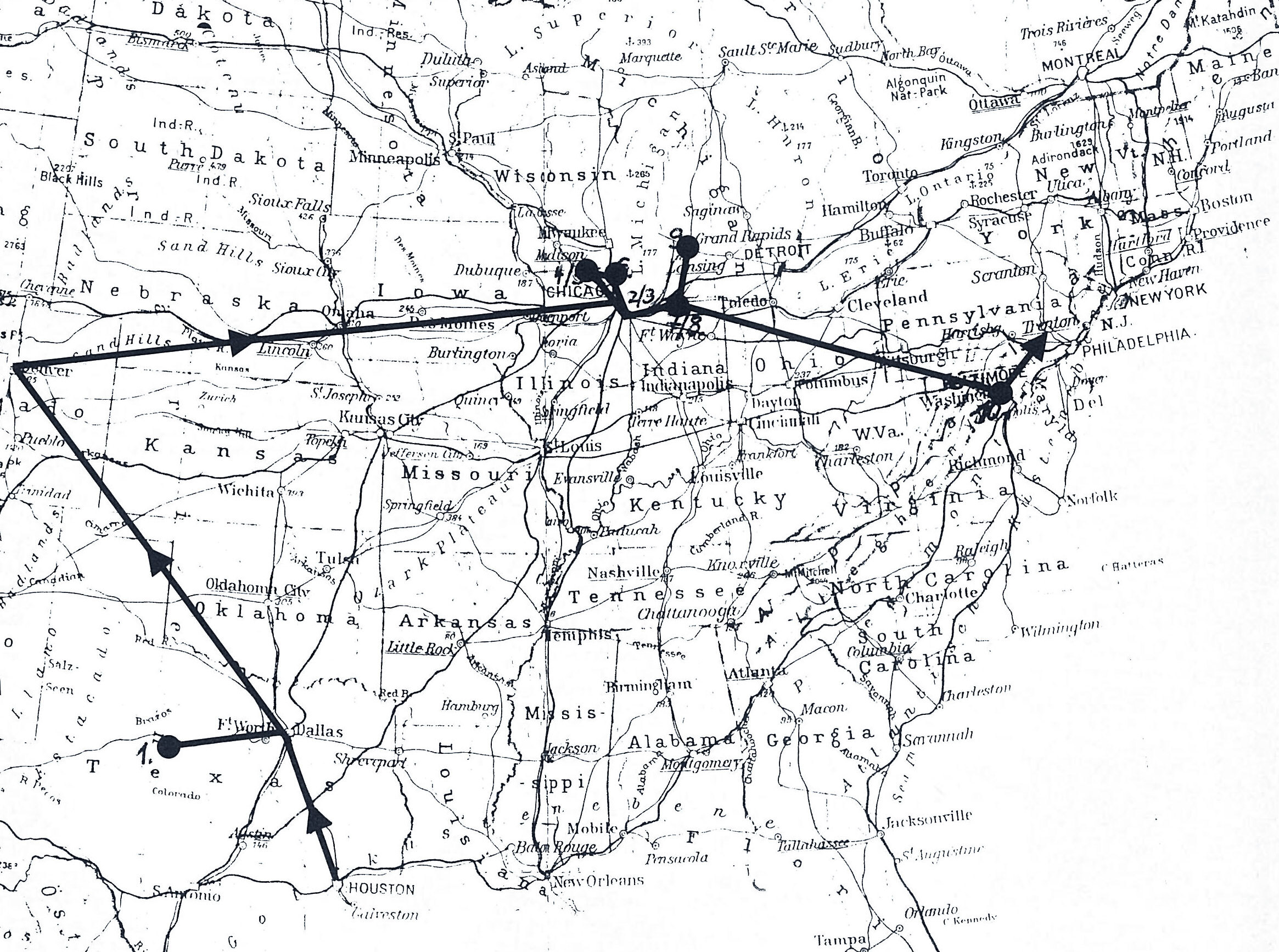
Most brass instruments are produced around Lake Michigan. Elkhart, Indiana, still the most important centre of US instrument making, lies there. As pay rates are higher here than in the southern states, production may be moved southwards. Semi-finished parts are already produced in Mexico, where the pay differential vis-à-vis the parent factories is even greater.

Abilene/ConnChicago/LewisChicago/SchilkeElkhorn/GetzenElkhorn/HoltonKenosha/MartinElkhart/BlessingElkhart/BachGrand Rapi...
  1. Abilene/Conn
  2. Chicago/Lewis
  3. Chicago/Schilke
  4. Elkhorn/Getzen
  5. Elkhorn/Holton
  6. Kenosha/Martin
  7. Elkhart/Blessing
  8. Elkhart/Bach
  9. Grand Rapids/Yamaha
  10. Boonsboro/Lawson

Woodwind instruments were in demand long before brass instruments. A New York document of 1786, for instance, shows a comprehensive import order of various instruments: violins, spinets, clarinets etc., but no brass. These were not yet sufficiently developed to be used in a band. The European invention of keyed instruments at the end of the 18th century and of valves at the beginning of the 19th considerably increased their usefulness. The Dodworth Band of New York, probably the first of its kind, was founded in 1834 and the Boston Brass Band a year later. The first brass instruments were built in the United States in those same years.

The most important early instrument maker was Samuel Graves, who founded Graves + Co. in 1824. At first he made only woodwind and started to make brass instruments only in 1837 with the help of James Keat, a very good instrument maker from London.

Four more 19th-century makers may be mentioned:

  • Joseph Lathrop Allen (active 1839-1869), inventor of a efficient rotary valve;
  • E.G. Wright (active 1839-1869) who, among other things, made gold and silver keyed bugles for bandleaders; together with Samuel Graves he founded the Boston Musical Instrument Manufactory in 1869;
  • Thomas D. Paine (active 1841-1881), inventor of a string mechanism for rotary valves;
  • Isaac Fiske (active 1842-1887), who took out several valve patents; Fiske's Cornet Band, which played only his instruments, was founded in the 1850's; in 1887 he sold the business to C.G. Conn + Co.

[Robert E. Eliason: “Early American Brass Makers” (Nashville, 1979); and Virginia Redway: “Music directory of early New York city” (New York, 1941)]

I plan a series of reports on my visits, beginning in the next issue with C.G. Conn + Co. and Schilke Musical Products.

* Stephan Suter (*1961): 1968-1980: Rudolf Steiner School, Basle; 1980-1984: apprenticeship with A. Egger Co., instrumentmaker in Basle (ended with mastership); 1981-1983: playing the horn with the Youth Symphony Orchestra; 1984-1985: student visit to the U.S.; 1985: working with Egger in Basle again.

Brass Bulletin 50, II / 1985 páginas 18–21

Todo el contenido está protegido por derechos de autor © Brass Bulletin 1985–2026

Compartir este artículo

Facebook LinkedIn
Cargando…

Preguntas y respuestas

Cómo funciona la edición digital

¿Qué incluye la edición digital?

La edición digital reúne los artículos ya digitalizados como textos legibles y consultables en línea —no simplemente como escaneos o archivos PDF— junto con sus ilustraciones originales, notas, autoría, información del número y traducciones disponibles. Las sugerencias de artículos relacionados incluyen actualmente solo este material digitalizado.

¿Los artículos digitales son idénticos a los originales?

Conservamos con la mayor fidelidad posible el texto original, el idioma, las ilustraciones, los pies de imagen, las notas y el contexto editorial. La presentación se adapta para facilitar la lectura en línea y pueden corregirse errores evidentes de transcripción o escaneado. El contenido y el carácter del artículo publicado permanecen inalterados.

¿Qué idiomas están disponibles?

Brass Bulletin se publicó en inglés, francés y alemán a lo largo de toda su historia. Las traducciones al italiano y al español se añadieron a partir del número 60. Por este motivo, en los sitios italiano y español los artículos de los números 1 a 59 se muestran en inglés de forma predeterminada.

¿Con qué frecuencia se añaden nuevos artículos?

Se añaden nuevos artículos casi a diario, con aproximadamente un número completo digitalizado cada semana. El ritmo puede variar según el trabajo de preparación, tratamiento de imágenes y revisión editorial necesario.

¿Por qué no están disponibles todos los artículos en formato digital?

La colección completa de Brass Bulletin contiene 1.246 artículos publicados entre 1971 y 2003. El índice completo ya está disponible en línea y permite descubrir todos los artículos de la colección, incluidos aquellos cuyo texto íntegro todavía no ha sido digitalizado.

La digitalización comenzó en febrero de 2026. Cada artículo se prepara cuidadosamente para la lectura en línea, se revisa y se vincula con su número, sus autores, sus temas y sus ilustraciones. Al ritmo actual de digitalización, se prevé que la colección completa esté disponible en línea en febrero de 2028.

¿Por qué algunas referencias mencionan artículos que todavía no están disponibles?

Las referencias de los artículos originales se conservan aunque el material al que remiten aún no haya sido digitalizado. De este modo se mantiene intacto el contexto histórico y editorial. A medida que se incorporen más números a la edición digital, un número creciente de estas referencias conducirá a artículos que podrán leerse en línea.

¿Puedo sugerir un artículo o informar de un error de transcripción?

Sí. Si hay algún artículo que le gustaría especialmente ver digitalizado, o si detecta un posible error de transcripción o algún dato que falta, póngase en contacto con nosotros. Los comentarios de los lectores nos ayudan a mejorar la edición digital y a establecer prioridades útiles dentro del archivo.

¿Cómo puedo apoyar a Brass Bulletin?

Su apoyo ayuda a financiar la preparación, verificación y publicación en línea de la colección completa.

Suscríbase a la Edición Digital

¿Prefiere apoyarnos sin suscribirse?

Haga una donación

¿Cómo avanza la digitalización?

Estamos poniendo Brass Bulletin a disposición de los lectores en línea, artículo por artículo. Pueden leer los artículos recién digitalizados en cuanto estén listos, incluso antes de que se complete un número entero.

Consulten nuestro calendario de digitalización para descubrir las últimas novedades y las fechas estimadas de disponibilidad de los próximos números. Estas estimaciones se basan en nuestro ritmo reciente y pueden cambiar.

Busca en Brass Bulletin.