Discoveries for brass players, once a month. Join our free newsletter →

10 min. read

This article is for subscribers.

Part 3 – End

The trombone in Jazz and Popular Music

Pluralism of expression since 1945

Bebop, cool jazz, free jazz and neo-classicism transformed the trombone after 1945, as new players, techniques and instruments pushed its boundaries.
The trombone in Jazz and Popular Music

In the mid forties bebop flowered with a saxophonist who was a genius (Charlie Parker), drummers who were “different” (K. Clarke, M. Roach) and trumpeters who played fast (Gillespie, McGhee, Navarro). J.J. Johnson (*1924) was inspired by the bop trumpeters to develop his innovative style based on fast playing. His bright sound and precise articulation were to be influential for a long time; indeed, until the advent of the free-jazz movement.

Some part of the public always reacts to modernism by returning to tradition; in this case the reaction favoured the blues (rhythm and blues) and the New Orleans style. The veteran Clyde Bernhardt⁵, a devoted disciple of Teagarden and Mole (for technique) and of Harrison and Morton (for musical language), tried to dominate the former while the New Orleans revival, after a timid start in 1938, really took off after 1944-1945 with Kid Ory, Jim Robinson (1892-1976) and Preston Jackson. This was the good old tailgate although Jackson sometimes showed himself capable of more sound-oriented playing, as did Louis Nelson (*1902), another New Orleans beneficiary of this return to basics. In terms of popularity Ory rated as highly as the trumpet player Bunk Johnson. These re-creations, often clumsy (aging musicians, some of whom had not played for many years) but always honest, gave birth to a commercial variant known as Dixieland. This variant, while questionable from the musical point of view, has the redeeming feature that it enables us to hear good recordings of people like Miff Mole, Vic Dickenson, Benny Morton, Wilbur de Paris (1900-1973), Jack Teagarden and Trummy Young.
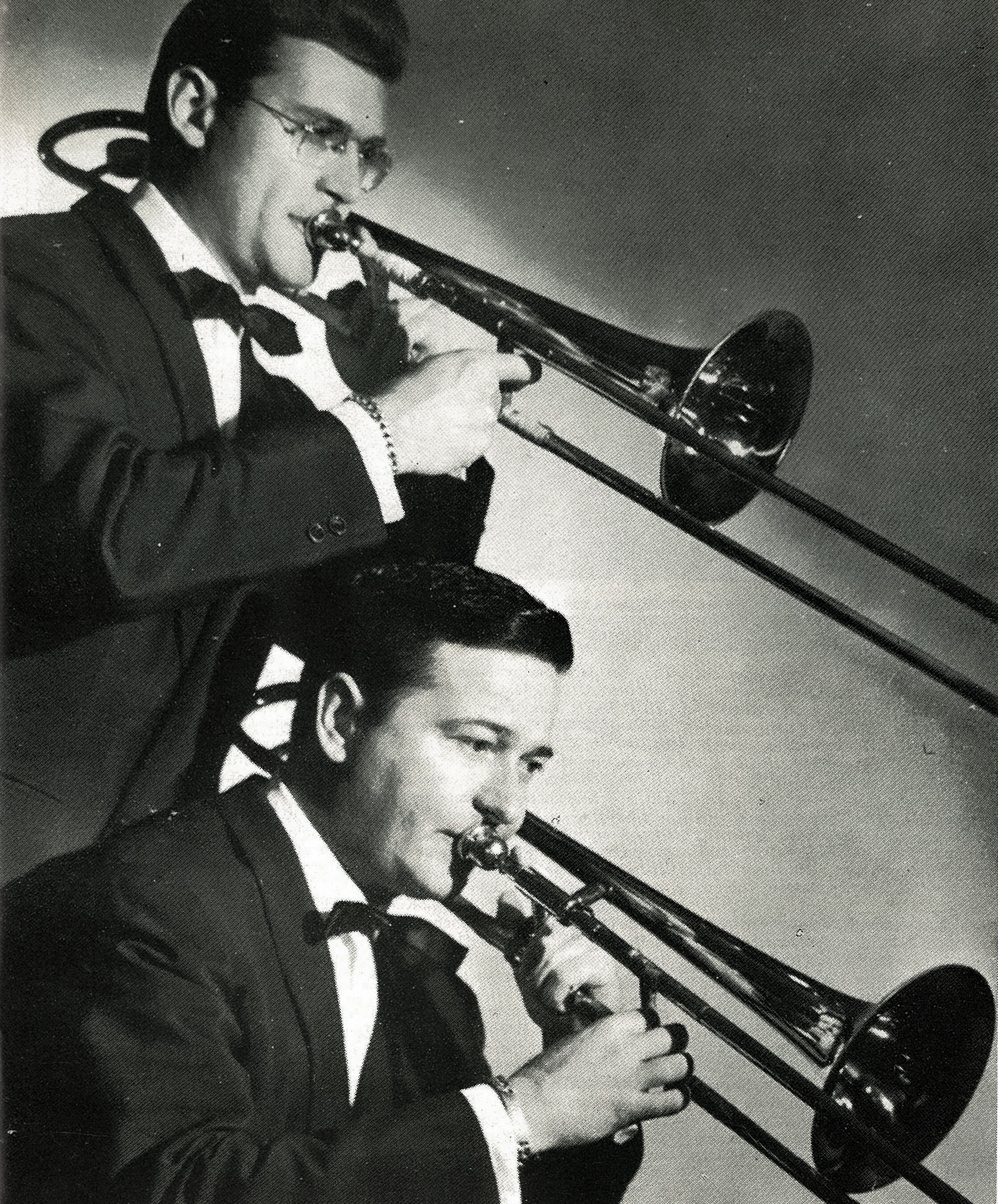
Benny Vasseur (above) and André Paquinet (below), 1959. (Courtesy of Guy Paquinet)
Benny Vasseur (above) and André Paquinet (below), 1959. (Courtesy of Guy Paquinet)

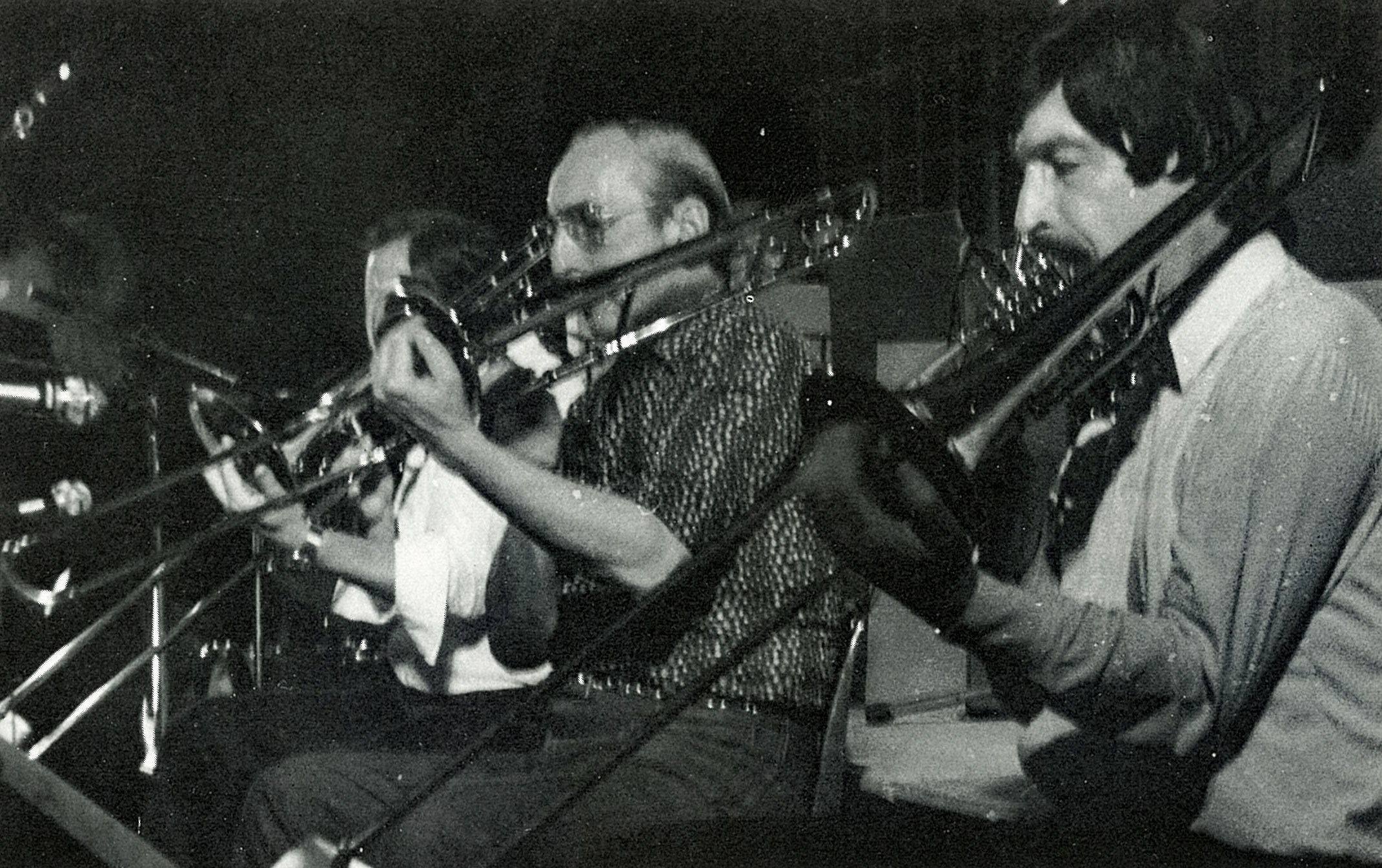
➜ Marc Steckar (hidden), Charles Verstraete, Raymond Fonsèque – 1984. (photo M. Laplace)

➜ Marc Steckar (hidden), Charles Verstraete, Raymond Fonsèque – 1984. (photo M. Laplace)

Originating in these diverse styles, and often involved in diverse forms of light music, many talents have appeared in France since the forties: Gaby Masson (1911-1975), Charles Verstraete (Ray Ventura band), Guy Destanque (Jacques Hélian band), Michel Camicas etc. Benny Vasseur and André Paquinet (*1926) recorded many amusing duets, the formula coming, of course, from the United States with the famous duo of J.J. Johnson and Kai Winding. The Dane Kai Winding (1922-1983) remained faithful to trombone ensembles throughout his career. The real event in the trombone world, however, was the arrival on the scene of J.J. Johnson.

This article is for subscribers.

CHF 5.00 per month · Cancel auto-renewal anytime.

Enjoy unlimited access to all digitized Brass Bulletin articles.

Brass Bulletin 52, IV / 1985 pages 20–28

All content is protected by copyright © Brass Bulletin 1985–2026

Share this article

Facebook LinkedIn
Loading…

Questions & Answers

How the Digital Edition works

What does the Digital Edition include?

The Digital Edition brings together the articles already digitized as searchable online texts—not simply as scans or PDF files—along with their original illustrations, notes, authorship, issue information, and available translations. Related-article suggestions currently include only this digitized material.

Are the digital articles identical to the originals?

We preserve the original text, language, illustrations, captions, footnotes, and editorial context as faithfully as possible. The presentation is adapted for comfortable online reading, and obvious transcription or scanning errors may be corrected. The substance and character of the published article remain unchanged.

Which languages are available?

Brass Bulletin was published in English, French, and German throughout its history. Italian and Spanish translations were added from issue No. 60 onward.

On the Italian and Spanish sites, articles from issues 1–59 are therefore shown in English by default.

How often are new articles added?

New articles are added almost daily, with approximately one complete issue digitized each week. The pace may vary depending on the preparation, image work, and editorial checking required.

Why aren’t all articles available digitally?

The complete Brass Bulletin collection contains 1,246 articles published between 1971 and 2003. The full index is already available online, allowing readers to discover every article in the collection, including those whose complete text has not yet been digitized.

Digitization began in February 2026. Each article is carefully prepared for online reading, checked, and connected to its issue, authors, subjects, and illustrations. At the current pace of digitization, the complete collection is expected to be available online by February 2028.

Why do some references mention articles that are not available yet?

References in the original articles are preserved even when the material they point to has not yet been digitized. This keeps the historical and editorial record intact. As more issues are added to the Digital Edition, an increasing number of these references will lead to articles that can be read online.

Can I suggest an article or report a transcription error?

Yes. If there is an article you would particularly like to see digitized, or if you notice a possible transcription error or missing detail, please contact us. Reader feedback helps us improve the Digital Edition and prioritize useful connections within the archive.

How can I support Brass Bulletin?

Your support helps fund the preparation, verification, and online publication of the complete collection.

Subscribe to the Digital Edition

Prefer to support us without subscribing?

Make a donation

How is the digitization progressing?

We’re gradually making the Brass Bulletin available online, article by article. You can read newly digitized articles as soon as they’re ready, even before an entire issue is complete.

Visit our Digitization Roadmap to browse recent additions and see estimated availability for upcoming issues. These estimates follow our recent pace and may change.

Search Brass Bulletin.