4 min. read
This article is for subscribers.
Part 6
How and why I became a musician
By Edouard Gros
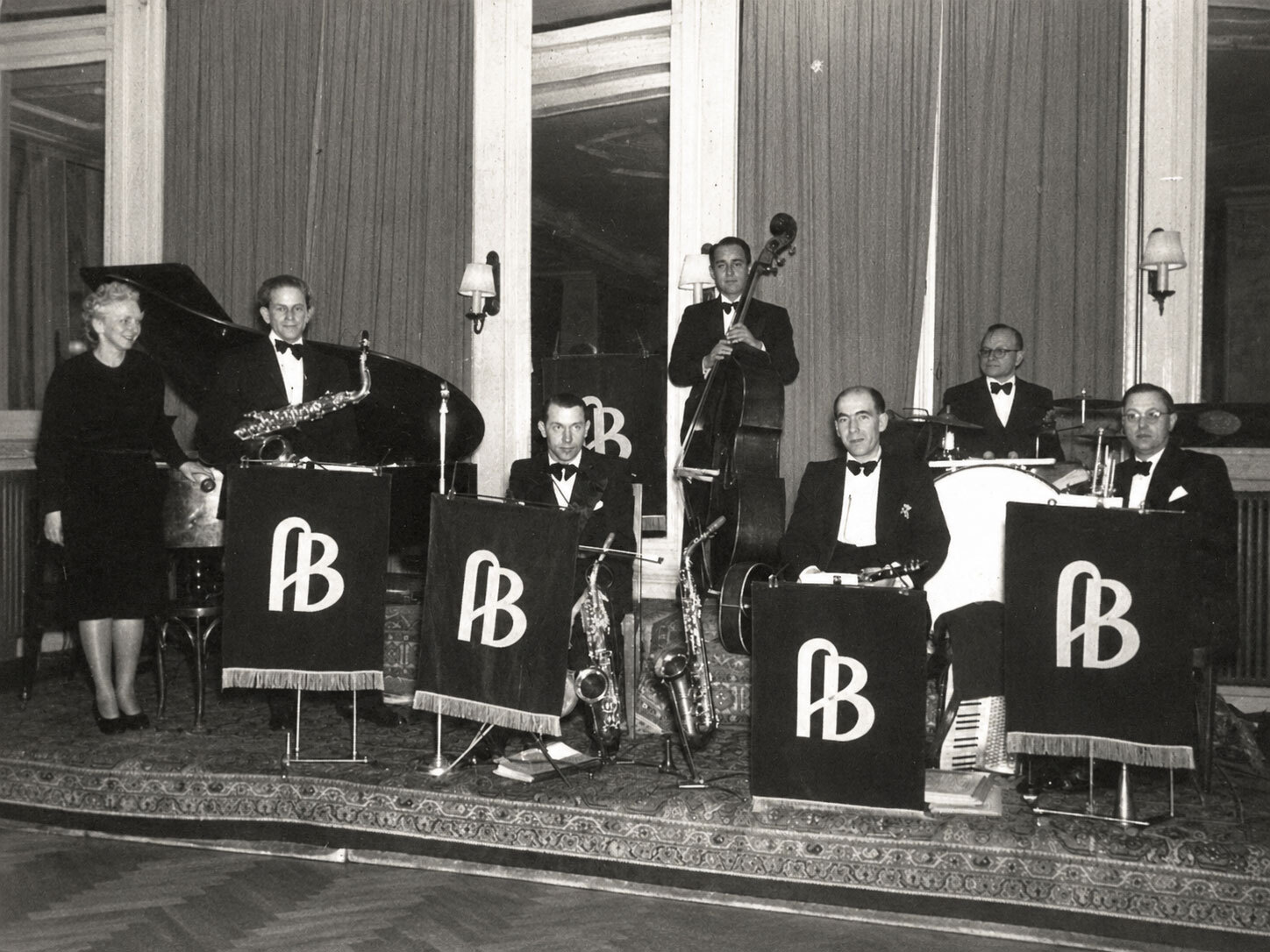
Winter 1941–1942, Moulin-Rouge, Geneva
Here is the sixth episode of Edouard Gros’s intriguing story of his life as a musician. “It’s time I wound this story up. Seems to me it’s gone on long enough.” That’s what he thinks. For our enjoyment the story will continue in the next two issues.
Seriously though
So it was in Geneva, thanks to the “City set on a hill”, that I first blew into a tuba; and it was in Basle, our next stop, an old man’s infinite kindness put me on the track of something more serious. I was warming up in the band room at the Grand Theatre long before the performance, as was my wont, when an old man with a big white beard came in, a real Father Christmas in city clothes, walked up and stopped in front of me, listened for a few seconds and then asked me point-blank, “Was spielen Sie da für ein Instrument?” (“What kind of instrument is that you’re playing?”) Without giving me time to answer, he went on, “Das ist keine Tuba! Das ist ja ein Baryton!” (“That’s not a tuba! That’s a baritone!”) “Blow me!” I thought. “Here’s someone who sounds as if he knows what he’s talking about!” Whereupon he introduced himself: “Backhaus, tuba at the B.O. [Basle Symphony Orchestra], chairman of the orchestral representatives there and central president of the Swiss musicians’ union.” ... no more, no less! And here he was, a real human being.
The tuba in F
I gave him a brief account of the unusual circumstances of my presence in this orchestra — with this instrument which he so disapproved of. Of course I knew that in the German orchestras they would not dream of having anything but an F tuba, a fifth lower, with a warmer, broader and rounder sound than the French C. Ansermet himself preferred it. But — all the borders were completely closed, Germany was using all the available copper for less agreeable purposes than making musical instruments and I had not the faintest idea what might be available in Switzerland. So how was I to get hold of such a precious object? No problem. I was sitting on a case; Father Christmas ordered me to get up, took a bunch of keys out of his pocket, opened the case and pulled out a superb F tuba: his own! He placed it in my arms and ordered me to play him a few notes, a scale, anything at all.
Visibly satisfied with my modest improvisation he encouraged me and strongly advised me to persevere with this endeavour while assuring me that he could soon find the instrument I needed. After carefully noting my name and address, he took his leave, not without wishing me success the way musicians do (easier in German than in French). I stood there, my head buzzing with contradictory ideas, amazed by this generous concern for a young man who was a complete stranger. Not daring to believe it all, I thanked him warmly — and soon forgot about the whole conversation.
Everything ends in time, even shows staged by the Swiss army. And so, from badly heated village halls, from dormitories with worn-out straw mattresses to disused hotels, from school classrooms to gymnasiums, we were demobbed at last. I was back home, with never a thought in my head of Father Christmas from Basle, when there was a ring at my doorbell. It was a carrier, holding out a delivery note for me to sign — and to pay.
Imagine, 150.- francs!
150 francs he wanted. Imagine, 150 francs! I hadn’t seen a 100-franc note for months. Yes, said the carrier, a parcel from Basle. Good Lord! What was I to do? “Do you have any other deliveries nearby? Could you come back, let’s see, in an hour? Yes! OK!”
This article is for subscribers.
CHF 5.00 per month · Cancel auto-renewal anytime.
Enjoy unlimited access to all digitized Brass Bulletin articles.
Brass Bulletin 55, III / 1986 pages 15–19
All content is protected by copyright © Brass Bulletin 1986–2026