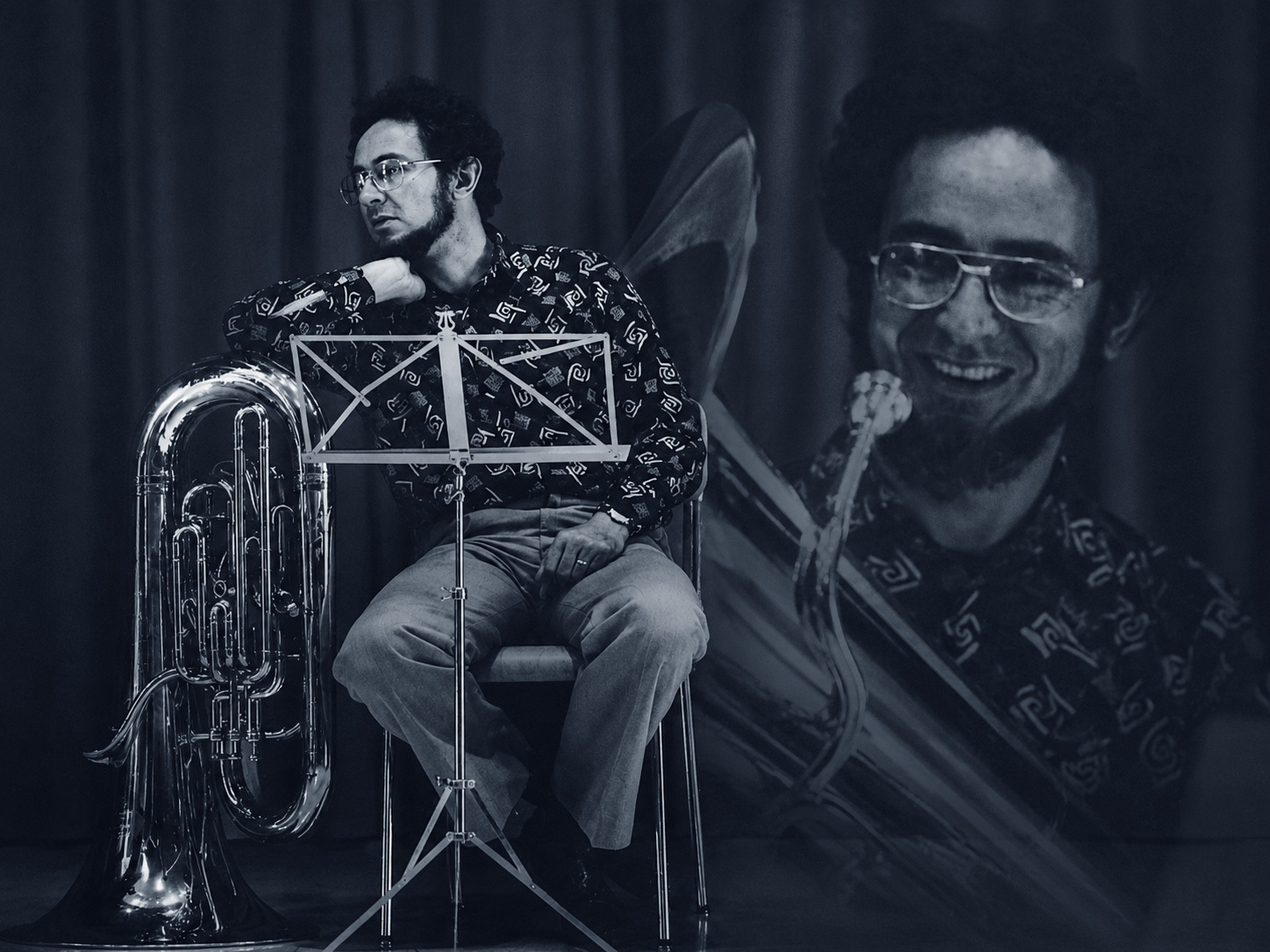
J.-P. M.: How do you explain this explosion?
J. F.: It is very difficult to explain it in England. In the United States I can explain it very easily. There have been, I would think, starting maybe twenty years ago or before, very great virtuosi of the tuba. William Bell being perhaps the most famous in the States and after William Bell we have had a number of virtuoso players, people like Harvey Phillips, Roger Bobo, who have done a great deal of solo playing and a great deal to bring the tuba to people's attention, and it's the example of virtuoso players of this calibre that has caused what I call the tuba explosion.
In England it is very much more difficult to explain and I think it has a great deal to do with economics. When I was a boy, it was unheard of to play the tuba for a number of reasons, the most important being perhaps that the tuba is very heavy and difficult to carry and most people didn't own motor-cars, and also tubas were very expensive and people could not afford to buy them. One could only play a tuba, or a bass, as we call it in a brass band, if one's school owned one, which was then quite rare or if one borrowed one from the brass band and practised it in the band headquarters.
But Britain's economic development as we all know has been slower than elsewhere and, I think, only in the last five or ten years can one take it for granted that people have motor cars with which to run their children around to play in different places and also even to buy instruments. It's only a very recent thing and it's an interesting thing that people forget.
J.-P. M.: Let's take your case. I mean you started before this explosion?
J. F.: Yes, but you see I was a freak. For two reasons. My father was a music master and we had a very large school orchestra and I attended the school where he taught. He was given, during the war, a very good tuba which did nothing for many years because no boy could learn it because he couldn't carry it home on the tram.
And he then asked me to play it and I was very lucky; not only did I have the use of a very good tuba but he could carry it for me in his very, very old car to and from school. And this is how I began and in those days, even nowadays this is true, but in those days, if you played the tuba and you could play anything on it, people would not allow you to stop because you were the only one in the district usually. Once you started you were not allowed to stop.
I think another fact, too, that has contributed to the tuba explosion has been... (I think that what people forget is that outside England there has actually always been a great deal of tuba activity) Gerard Hoffnung the famous cartoonist was also a pretty good tuba player and always brought the tuba very much to the educated public's consciousness with his famous drawings.
It has always been something a little bit of a joke instrument, and I think, rightly. It has never been taken as seriously as it now is in the United States, and I think still not, even though many, many more people are playing it. We have a slightly different attitude towards it in Great Britain and I think this has a great deal to do with the English sense of humour and also the English habit of supporting the underdog as we say and the tuba is the underprivileged person so everyone is kind to it.
People have always played tuba solos. Very often in concerts one will slip in a tuba solo to give the tuba player something to do and it always gets a good round of applause because everybody says, "Bravo, and very well done! Fancy a tuba being able to play a solo!"
It is of course more humorous and condescending than in the United States, but I think the movement just suddenly and in a short space of time has made the instrument important and serious. It's very risky because if one takes away the humour, people find it very difficult to respond in any other way because of course the sound the tuba makes, even in the hands of the very greatest player is still rather amusing and so I think that humour must remain a very important part of the tuba explosion. But I think that in England we will not lose the humour.
J.-P. M.: Yes this may be so, but I was thinking, while you were speaking that this is also to do with the type of music played.
J. F.: Yes. That's a very important point, and in fact Philip Jones has had a great deal to do with this. The tuba up to fifteen years ago, ten years ago, was a commodity which was used in the brass band or in the symphony orchestra, and really nowhere else, occasionally as a soloist.
I remember that the first important concerto was written by Vaughan Williams and this is played quite often in Britain by many tuba players. But the appearance of the brass ensemble, Philip Jones, or the Gabrieli and various other outfits, the Hallé, have given the tuba a new role which has increased serious interest from young tuba players and I suppose this has contributed a great deal towards the increased interest.
A lot of young players who come to me tell me that they want to study brass quintet literature and that they want to play brass quintets and this is what they ultimately want to do. And I encourage this because I think it gives a tuba player something quite different over and above the brass band and the orchestra.
But I am also very interested, although I never came from a brass band, in giving the bass section more to do, either in the context of the band or as a soloist in band concerts. The euphonium is of course the very, very important soloist in the band movement and is the prima donna. The bass, the principal E flat bass, is very rarely considered soloistic, and I would like to see more solo pieces written for English brass bands with solo part and/or performances remade.
As a start Edward Gregson has written a very good concerto and Michael Brand has written pieces, and I hope that this will continue within the traditional brass band context. It will have to, because there are now young E flat bass players in our bands who are far too good to be playing the music they have to play. They will get bored and they will do something else.