Explore institutional access Explore institutional access

7 min. read

How and why I became a musician

Part 2

By Edouard Gros

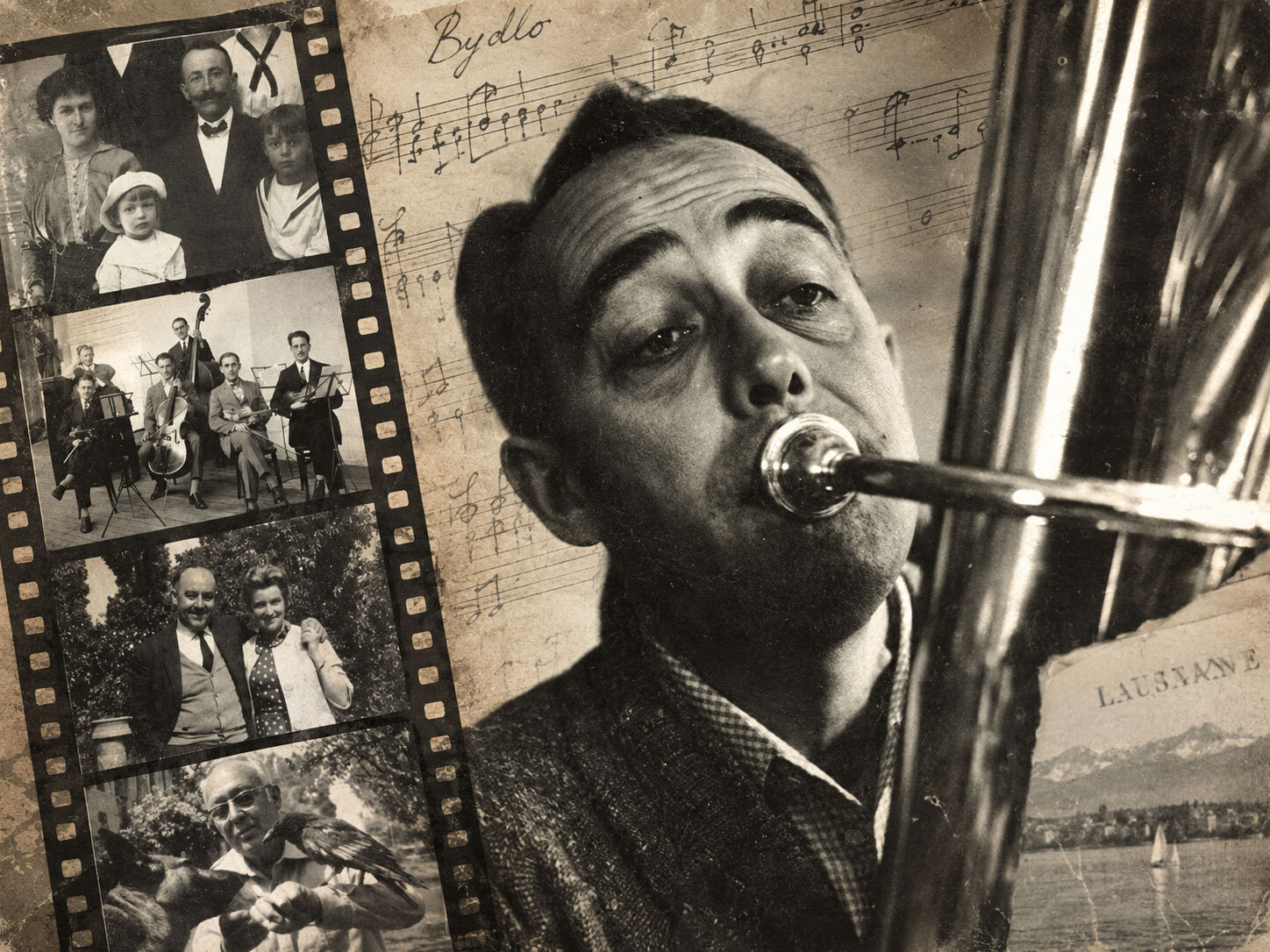
A teenage double bassist in 1920s Lausanne turns family resistance, scout orchestras and hard-earned engagements into the beginnings of a professional life.
How and why I became a musician

Edouard Gros

Edouard Gros has had a remarkable career in Switzerland playing double bass and tuba. (His reputation as a tuba player was exceptional.) In BB50 he started to tell us about his beginnings. Here he enters the profession.

In 1921 I was eleven years old. From being a brilliant pupil in the early classes of primary school I suddenly became bad enough, and unbearable enough, for the secondary school headmaster to write in my annual report: ‘‘A lazy and dissolute pupil! Will eventually exhaust his teachers’ patience!’’ So a paternal outburst was imminent and it was no doubt in an attempt to bring me back to the straight and narrow that he made me join the Boy Scouts.

You may well wonder what belonging to the Boy Scouts has to do with becoming a musician. Well, unlikely as it may seem, it is thanks to them that I became a double-bass player rather than a cellist or a pianist — or a civil servant — and this is how it happened. One a year the Scout leader organised an evening’s entertainment. This consisted of interminable bad sketches and, to play while the curtain went up and during the intervals, he had started a little orchestra where he himself was the pianist and which, of course, had no double bass. Remember that in those days even modest families got their offspring to learn the piano, the violin, the cello, occasionally some other instrument but never — God forbid! — the double bass. And that is why, without asking me, the conductor in question knocked on our door one day and said to my father without further ado, ‘‘It would be marvellous if you could give your son some lessons. Just a few, just so that he can manage the bass part in our little orchestra.’’ Of course, like ignoramuses who think they are funny, he thought that bass playing amounted to no more than plonk, plonk, plonk. Dad, who was no fool and was getting worried about the future of his no-good son, finally agreed with good grace, telling himself that I would soon lose interest and there would be no future in it. He went straight out to look for a small instrument, took the spike off and — E, A, D, G — there we were. First position, F♯, B, E, A. That’s how I started, perched on my stool from the word go.

Continue reading

Access the full Digital Edition.

Brass Bulletin 51, III / 1985 pages 5–13

All content is protected by copyright © Brass Bulletin 1985–2026

Share this article

Facebook LinkedIn
Loading…

Questions & Answers

How the Digital Edition works

What does the Digital Edition include?

The Digital Edition brings together the articles already digitized as searchable online texts—not simply as scans or PDF files—along with their original illustrations, notes, authorship, issue information, and available translations. Related-article suggestions currently include only this digitized material.

Are the digital articles identical to the originals?

We preserve the original text, language, illustrations, captions, footnotes, and editorial context as faithfully as possible. The presentation is adapted for comfortable online reading, and obvious transcription or scanning errors may be corrected. The substance and character of the published article remain unchanged.

Which languages are available?

Brass Bulletin was published in English, French, and German throughout its history. Italian and Spanish translations were added from issue No. 60 onward.

On the Italian and Spanish sites, articles from issues 1–59 are therefore shown in English by default.

How often are new articles added?

New articles are added almost daily, with approximately one complete issue digitized each week. The pace may vary depending on the preparation, image work, and editorial checking required.

Why aren’t all articles available digitally?

The complete Brass Bulletin collection contains 1,246 articles published between 1971 and 2003. The full index is already available online, allowing readers to discover every article in the collection, including those whose complete text has not yet been digitized.

Digitization began in February 2026. Each article is carefully prepared for online reading, checked, and connected to its issue, authors, subjects, and illustrations. At the current pace of digitization, the complete collection is expected to be available online by February 2028.

Why do some references mention articles that are not available yet?

References in the original articles are preserved even when the material they point to has not yet been digitized. This keeps the historical and editorial record intact. As more issues are added to the Digital Edition, an increasing number of these references will lead to articles that can be read online.

Can I suggest an article or report a transcription error?

Yes. If there is an article you would particularly like to see digitized, or if you notice a possible transcription error or missing detail, please contact us. Reader feedback helps us improve the Digital Edition and prioritize useful connections within the archive.

How can I support Brass Bulletin?

Your support helps fund the preparation, verification, and online publication of the complete collection.

Subscribe to the Digital Edition

Prefer to support us without subscribing?

Make a donation

Search Brass Bulletin.