Explore institutional access →

1 min. read

Part 2

The Art of the Musical Instrument Maker

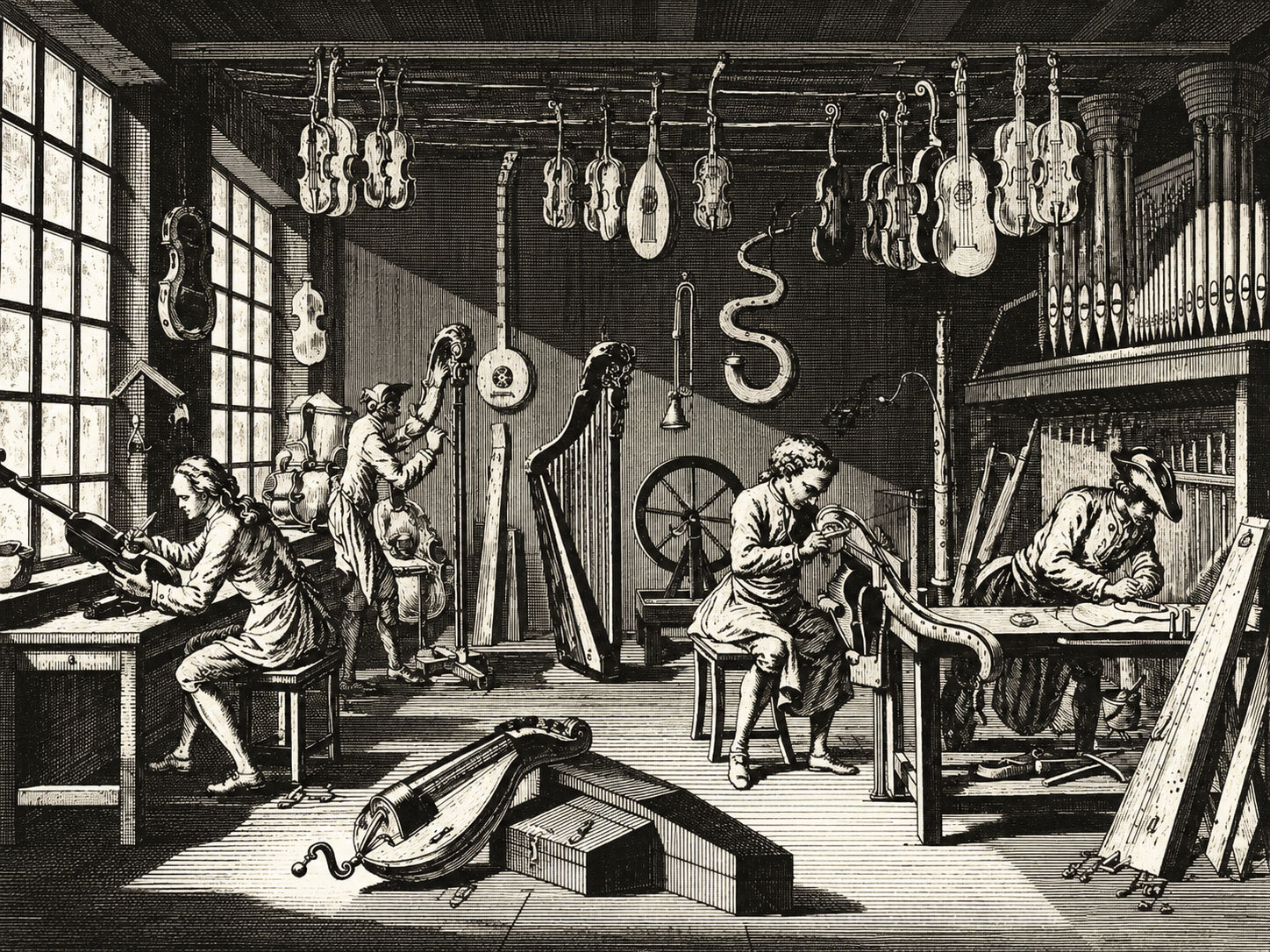
Encyclopédie méthodique, Paris 1795

The Art of the Musical Instrument Maker

This "Methodical encyclopedia — arts and crafts" was published in Paris in 1795. In 1984 Editions Minkoff of Geneva rescued from oblivion and published in facsimile Volume IV, which concerns particularly the "Art of the musical instrument maker" (ISBN 2-8266-0295-0). The author — anonymous, unfortunately — describes the instruments in irresistible style.

Extract 2*

Who among us is familiar with what I shall gladly call the musical outlook? Instruments are no longer being invented for there are enough already; but many are the discoveries which remain to be made concerning their manufacture.

Material and form are the object of manufacture. How many experiments there are to be made on both!

[...]

The form includes the proportion of solid to void, contours, openings, thicknesses, lengths, widths and depths, chords, strings, keys etc.

[...]

The nomenclature of instruments can also be divided into ancient, modern and foreign. Amongst the ancient instruments are those of the Hebrews, Greeks, Egyptians and Romans. The Hebrew instruments were from the string, wind and percussion families; most are described in a work by Rabbi Abraham Arie de Mutina, a physician by profession. Kircher made use of his research and it is primarily him that we have consulted for this section.

A very great number of depictions of Greek, Egyptian and Roman instruments is to be found on ancient monuments; and it is in accordance with the copies made or brought back by historians and artists that we make these known. [1]


* Our extracts contain the following symbols: the number of the page from which the extract is taken — [23]; phrases or paragraphs omitted — [...].

Brass Bulletin 55, III / 1986 pages 20–21

All content is protected by copyright © Brass Bulletin 1986–2026

Share this article

Facebook LinkedIn
Loading…

Questions & Answers

How the Digital Edition works

What does the Digital Edition include?

The Digital Edition brings together the articles already digitized as searchable online texts—not simply as scans or PDF files—along with their original illustrations, notes, authorship, issue information, and available translations. Related-article suggestions currently include only this digitized material.

Are the digital articles identical to the originals?

We preserve the original text, language, illustrations, captions, footnotes, and editorial context as faithfully as possible. The presentation is adapted for comfortable online reading, and obvious transcription or scanning errors may be corrected. The substance and character of the published article remain unchanged.

Which languages are available?

Brass Bulletin was published in English, French, and German throughout its history. Italian and Spanish translations were added from issue No. 60 onward.

On the Italian and Spanish sites, articles from issues 1–59 are therefore shown in English by default.

How often are new articles added?

New articles are added almost daily, with approximately one complete issue digitized each week. The pace may vary depending on the preparation, image work, and editorial checking required.

Why aren’t all articles available digitally?

The complete Brass Bulletin collection contains 1,246 articles published between 1971 and 2003. The full index is already available online, allowing readers to discover every article in the collection, including those whose complete text has not yet been digitized.

Digitization began in February 2026. Each article is carefully prepared for online reading, checked, and connected to its issue, authors, subjects, and illustrations. At the current pace of digitization, the complete collection is expected to be available online by February 2028.

Why do some references mention articles that are not available yet?

References in the original articles are preserved even when the material they point to has not yet been digitized. This keeps the historical and editorial record intact. As more issues are added to the Digital Edition, an increasing number of these references will lead to articles that can be read online.

Can I suggest an article or report a transcription error?

Yes. If there is an article you would particularly like to see digitized, or if you notice a possible transcription error or missing detail, please contact us. Reader feedback helps us improve the Digital Edition and prioritize useful connections within the archive.

How can I support Brass Bulletin?

Your support helps fund the preparation, verification, and online publication of the complete collection.

Subscribe to the Digital Edition

Prefer to support us without subscribing?

Make a donation

How is the digitization progressing?

We’re gradually making the Brass Bulletin available online, article by article. You can read newly digitized articles as soon as they’re ready, even before an entire issue is complete.

Visit our Digitization Roadmap to browse recent additions and see estimated availability for upcoming issues. These estimates follow our recent pace and may change.

Search Brass Bulletin.