14 min. read
Henri Renart (1887-1979)
Interview
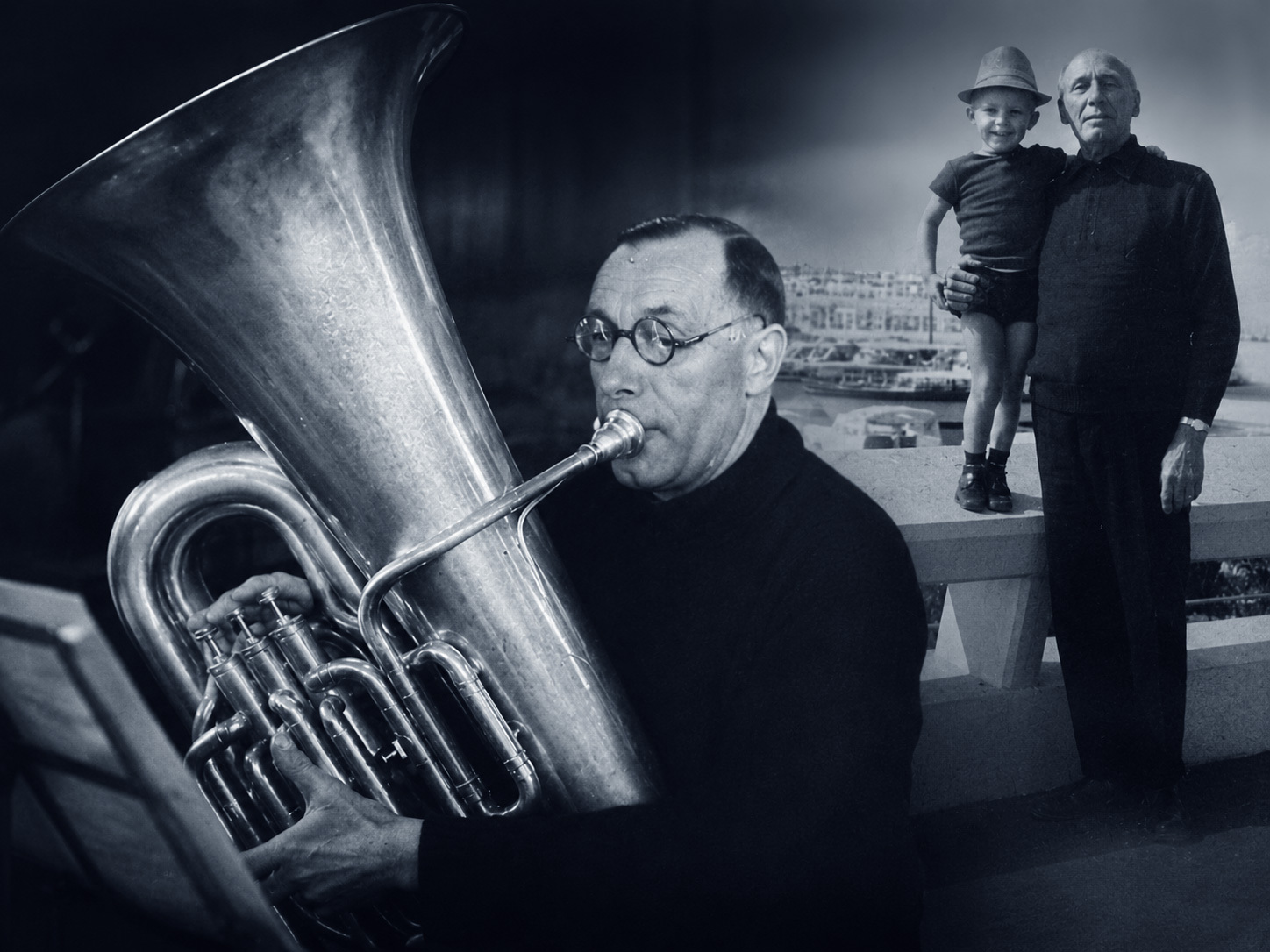
From 1960 Monsieur Henri Renart and his wife lived in Cannes, where they enjoyed a quiet retirement, after Monsieur Renart had had a very active musical career. He was born on 16th August 1887 in Roubaix (in the French département of Nord), and this discussion followed his whole life, which had been placed at the service of music.
Unfortunately Monsieur Renart died suddenly in December 1979, and I still had many things to ask him.
Robert Coutet: How did you get involved with music, Monsieur Renart?
Henri Renart: In the simplest possible way — in a wind band in Roubaix, because at that time there were a lot of wind bands; in Roubaix alone there were three and each one comprised 80 to 100 musicians. Before 1900 there was little entertainment in the north of France, where there were a lot of workers because of the mills and the mines. So people made music for their entertainment, and during the summer we would appear in the nearby towns; for us it was an excellent way of passing our free time.
I played a 3-valve B♭ baritone (euphonium) when I was 10. My brother, who was nine years older, played a 5-valve B♭ bass saxhorn. He had lessons at the Roubaix Academy of Music, where there was already a tuba class in 1898, and won a first prize. It was then up to me to take over and I was surprised by the range of the instrument (practically 4 octaves). I worked with the Clodomir tutor and won a first prize for bass saxhorn in 1905 — this was thanks to a superb teacher who had got the job by competition around 1900–1901; there were twelve of us in the class. The teacher's name, just a minute... yes, I remember, Victor Topp, formerly tuba at the Garde Républicaine in Paris.
Between 1902 and 1905 I often went to Paris and it was then that I decided to take up music seriously. My daytime job in a mill left me plenty of time to practise the little French tuba, the string bass and the trombone. When I was 18, I was offered a job as conductor of an amateur choir, which I naturally accepted.
In 1908 I was appointed to the band of the 104th Regiment in Paris as solo bass — exactly what I wanted. My time off enabled me to work with country orchestras but also with the bands of Duffayel, the Bon Marché, the Petit Parisien and the Métro. I was able to study the tuba with professionals, and above all listen to them, because there were no courses at the Paris Conservatoire.
We gave important concerts, with transcriptions of symphonic works. I also copied out several volumes of extracts of difficult passages.
Brass Bulletin 32, IV / 1980 pages 43–51
All content is protected by copyright © Brass Bulletin 1980–2026