4 min. read
This article is for subscribers.
Part 5
How and why I became a musician
By Edouard Gros
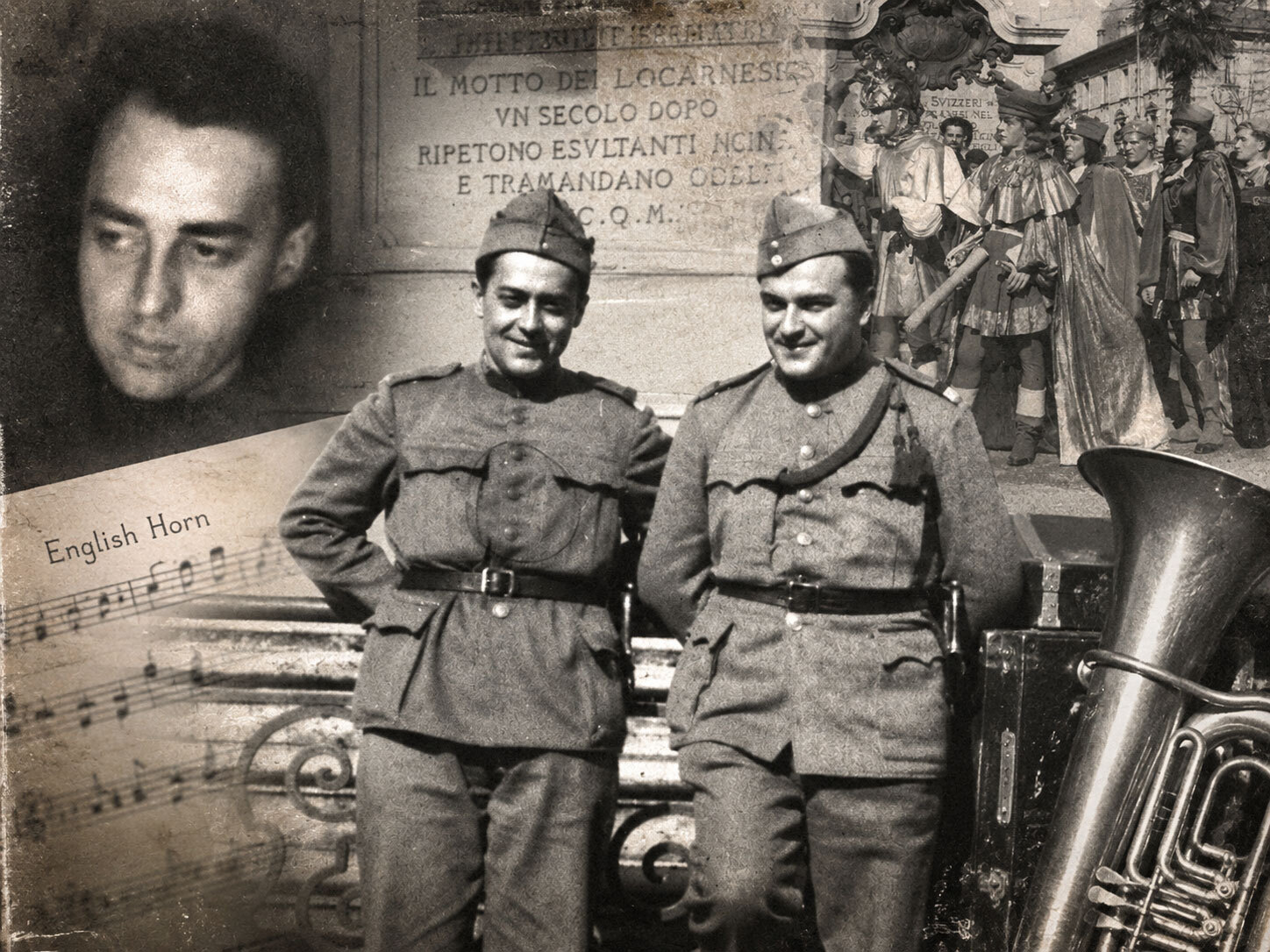
Edouard Gros, Paolo Longinotti
Since no. 50 of BRASS BULLETIN Edouard Gros has been telling us with skill and humour about his early days as a musician in the troubled times of the first half of this century. Here is the crucial episode concerning his transformation to tuba player.
Quick march!
I think it was at the end of 1940 (a bad winter) that I received new and rather unusual marching orders. To my surprise the army was appealing not to my talent as a gunner but to my standing as a brass player. The orders stipulated that I had to turn up at the Geneva Grand Theatre for a first rehearsal, in uniform of course, with reduced kit — and my instrument. I wasn't too keen on that last point. Well! We would see!
The Swiss army, well known for dispensing with excessive and unnecessary explanations, accompanied these novel marching orders with a most charming explanatory note. I learned that our authorities, anxious to maintain the morale of civilians and soldiers, had commissioned a great spectacle in the form of a historical pageant from our venerable historian Gonzague de Reynold, who had previously written "La gloire qui chante" ("The singing glory"), a dramatic poem recalling the finest hours of Swiss serving abroad.
This time it was a question of heightening the spirit of defence among the sinewy-armed Swiss by beseeching Almighty God, the undoubted protector of all shepherding peoples, to accord them His divine assistance, the whole thing set to some rather conventional music put together by the conductor of the Zurich Tonhalle, Volkmar Andrea. This military super-show, involving lots of actors, a big male voice choir and some nuns, was to be called "La Cité sur la Montagne" ("A city set on a hill").
Some of my Swiss colleagues from the OSR were also involved, including my inseparable friend Paolo Longinotti. I had the feeling that we would not regret getting involved in this and that we would have a few good laughs.
On the dilemmas of a horn
Rather than select a professional conductor — when the orchestra consisted mostly of professionals — the army (with an eye to discipline and hierarchy) picked instead a school singing teacher who held the rank of captain. Poor man! Quite a good musician, by the way, but he had probably never been so close to a symphony orchestra in his life.
At the first encounter, with one finger on the score, he made a tally of those present and declared that he was missing a horn. He said he could only see four and he needed five. Five horns? While this was by no means impossible, it seemed sufficiently unusual for the leader to get up and have a look at the score for himself. Positive that he was right, the captain, so imprudently promoted to the rank of conductor, pointed triumphantly to the line in the score marked "English Horn". Ouch! Not a good sign. And immediately after the ill concealed laughter he asked, "Is there someone here who plays the tuba? I need a bass tuba."
Split-second decision
There was a heavy silence and every one of us looked at his neighbour. No answer. The silence continued. Then suddenly, in less than a second, all these things flashed before my eyes:
For a long time I had admired the OSR tuba player, a German by the name of Vester who played his instrument superbly... That the trumpet was no longer of any use to a symphony orchestra bass player... that the mouthpiece should be the only thing to cause me serious problems since the technique was no different from that of the trumpet... that this was an "assigned duty", bringing an allowance of two francs a day and that, if I couldn't hack it, the worst that could happen to me was that I would be given a discharge — which, for once, would be welcome. Furthermore, the conductor being what he was, he was not likely to notice that I was a hoax, an imposter.
This article is for subscribers.
CHF 5.00 per month · Cancel auto-renewal anytime.
Enjoy unlimited access to all digitized Brass Bulletin articles.
Brass Bulletin 54, II / 1986 pages 69–73
All content is protected by copyright © Brass Bulletin 1986–2026