Discoveries for brass players, once a month. Join our free newsletter →
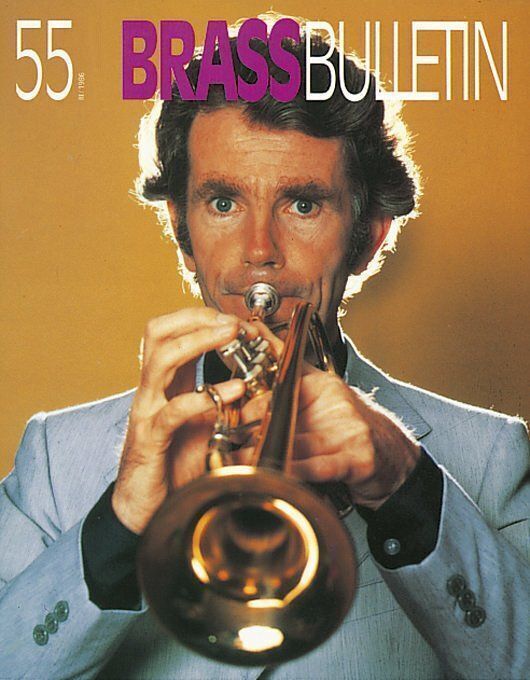
Brass Bulletin 55 - 3 / 1986
Issue
Brass Bulletin No. 55
Date
III / 1986
Pages
112
Contents
15 articles

Original inserts

World News Journal

Out of print

All issues

Brass Bulletin No. 55

III / 1986

Contents

15 articles
Free

Editorial

In Recognition of the Philip Jones Brass Ensemble

Jean-Pierre Mathez

pp. 3–5 Professional life

At the height of his career, Philip Jones hands over his brass ensemble, prompting wider reflections on musical excellence, stage presence and the changing role of musicians.

Part 1

From musical wallpaper to the twelve-note row

The trombone in the chamber ensemble at the beginning of modern music (1913-1934)

Michael Struck-Schloen

pp. 6–14 Trombone Repertoire History

Between 1913 and 1934, the trombone gained an unexpected place in chamber music as Satie, Milhaud and Stravinsky challenged orchestral traditions with jazz and new sounds.

Part 6

How and why I became a musician

Edouard Gros

pp. 15–19 Tuba Encounters History

In wartime Switzerland, an unexpected encounter in Basel gives Edouard Gros his first F tuba, opening a new musical path amid military service and orchestral rivalries.

Free
Part 2

The Art of the Musical Instrument Maker

Encyclopédie méthodique, Paris 1795

Anonyme

pp. 20–21 History Instrument Makers

In 1795, musical instruments were thought to need no further invention, yet their materials, construction and acoustic possibilities remained open to experimentation.

Free

The Newcomer

Jean-Pierre Mathez

pp. 23–24 Short story

After 25 years as an undisputed orchestral authority, a German trombonist faces a new generation whose virtuosity unsettles the familiar hierarchy of his section.

Free

Markneukirchen 1986

International Brass Competitions

Jean-Pierre Mathez, Roland Schnorhk

pp. 25–27 Horn Trumpet Trombone Competition Report

In 1986, young brass players from East and West met in Markneukirchen, where exceptional talent, demanding juries and musical traditions crossed political borders.

Brass Techniques Series • Part 2

The Body

Jean-Pierre Mathez

pp. 30–32 Health

A brass player's physical condition depends on more than muscular strength, with sleep, nutrition and recovery shaping the balance between technical control and fatigue.

Free

Narbonne 1986

1st International Brass Quintet Competition

Jean-Pierre Mathez

pp. 33–37 Report Competition

In 1986, Narbonne became a meeting place for the brass world, where an ambitious international competition brought emerging quintets alongside established masters.

Free

Anonymous Brass Quintet Budapest

1st prize at the Narbonne International Brass Quintet Competition 1986

Jean-Pierre Mathez

pp. 39–40 Competition

Founded by Budapest music students in 1981, the Anonymous Brass Quintet emerged as a distinctive Hungarian ensemble, combining individual artistry with remarkable unity.

Horns and Huntmen's trumpets

Herbert Heyde

pp. 42–56 Horn Trumpet History

In the 17th and 18th centuries, bore profiles, mouthpieces and musical functions blurred the boundaries between hunting horns, trumpets and emerging orchestral instruments.

Free

Doc Severinsen

Talent, will and glory

Jean-Pierre Mathez

pp. 58–63 Trumpet Encounters

Trumpet virtuoso and nightly television star, Doc Severinsen combined immense popularity with concerts, big bands and iron discipline.

Understanding the mouthpiece

John Stork

pp. 64–68 Equipment

A brass player's limitations may have less to do with technique than equipment, as subtle changes in mouthpiece design can transform comfort, response and performance.

George Swift, You see who I mean?

Michel Laplace

pp. 69–73 Trumpet History

In the 1930s, George Swift brought cornet virtuosity and jazz influences to the concert trumpet, building a remarkable reputation through just a handful of recordings.

Free

Georgiy Antonovich Orvid

Portrait of a distinguished Soviet trumpeter

Yuri Usov

pp. 75–79 Trumpet History

A Soviet trumpet virtuoso who shaped generations of musicians, Georgiy Orvid combined an international concert career with teaching, research and cultural leadership.

Free
Part 9

Instrument Makers in USA

Yamaha Music Products

Stephan Suter

pp. 81–84 Instrument Makers

In Grand Rapids, Japanese precision met American manufacturing, as Yamaha balanced imported components, skilled craftsmanship and the demands of a growing brass instrument market.

Loading…

Questions & Answers

How the Digital Edition works

What does the Digital Edition include?

The Digital Edition brings together the articles already digitized as searchable online texts—not simply as scans or PDF files—along with their original illustrations, notes, authorship, issue information, and available translations. Related-article suggestions currently include only this digitized material.

Are the digital articles identical to the originals?

We preserve the original text, language, illustrations, captions, footnotes, and editorial context as faithfully as possible. The presentation is adapted for comfortable online reading, and obvious transcription or scanning errors may be corrected. The substance and character of the published article remain unchanged.

Which languages are available?

Brass Bulletin was published in English, French, and German throughout its history. Italian and Spanish translations were added from issue No. 60 onward.

On the Italian and Spanish sites, articles from issues 1–59 are therefore shown in English by default.

How often are new articles added?

New articles are added almost daily, with approximately one complete issue digitized each week. The pace may vary depending on the preparation, image work, and editorial checking required.

Why aren’t all articles available digitally?

The complete Brass Bulletin collection contains 1,246 articles published between 1971 and 2003. The full index is already available online, allowing readers to discover every article in the collection, including those whose complete text has not yet been digitized.

Digitization began in February 2026. Each article is carefully prepared for online reading, checked, and connected to its issue, authors, subjects, and illustrations. At the current pace of digitization, the complete collection is expected to be available online by February 2028.

Why do some references mention articles that are not available yet?

References in the original articles are preserved even when the material they point to has not yet been digitized. This keeps the historical and editorial record intact. As more issues are added to the Digital Edition, an increasing number of these references will lead to articles that can be read online.

Can I suggest an article or report a transcription error?

Yes. If there is an article you would particularly like to see digitized, or if you notice a possible transcription error or missing detail, please contact us. Reader feedback helps us improve the Digital Edition and prioritize useful connections within the archive.

How can I support Brass Bulletin?

Your support helps fund the preparation, verification, and online publication of the complete collection.

Subscribe to the Digital Edition

Prefer to support us without subscribing?

Make a donation

How is the digitization progressing?

We’re gradually making the Brass Bulletin available online, article by article. You can read newly digitized articles as soon as they’re ready, even before an entire issue is complete.

Visit our Digitization Roadmap to browse recent additions and see estimated availability for upcoming issues. These estimates follow our recent pace and may change.

Search Brass Bulletin.