Discoveries for brass players, once a month. Join our free newsletter →
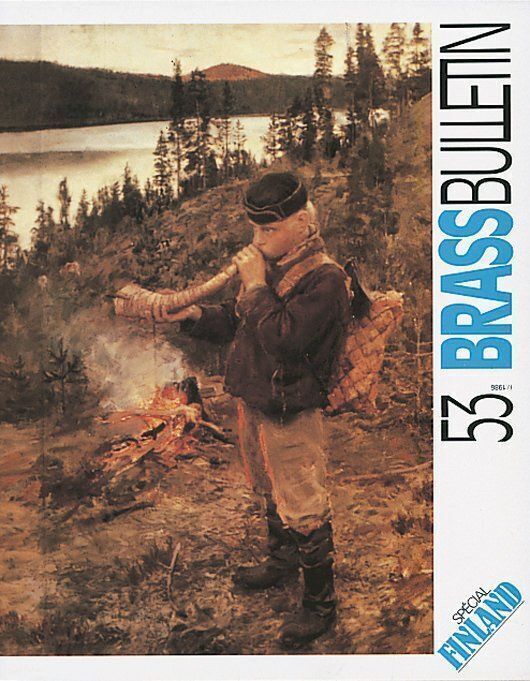
Brass Bulletin 53 - 1 / 1986
Issue
Brass Bulletin No. 53
Date
I / 1986
Pages
116
Contents
13 articles

Original inserts

World News Journal

Out of print

All issues

Brass Bulletin No. 53

I / 1986

Contents

13 articles
Free

Editorial

Homage to James Stamp

Jean-Pierre Mathez, Thomas Stevens

pp. 3–5

Behind James Stamp’s legendary teaching stood something harder to preserve: an uncommon way of listening, diagnosing and giving musicians room to rebuild themselves.

Bad Säckingen, Trumpet museum

Jean-Pierre Mathez

pp. 17–27 Trumpet History Equipment

A romantic legend, a remarkable private collection and Edward H. Tarr’s scholarship converged in Bad Säckingen to give the trumpet a museum of its own.

Free

Special Finland

Editorial

Jean-Pierre Mathez

pp. 29–35 Report Teaching

In 1980s Finland, distance and long summers helped turn brass education into a national network, with Lieksa emerging as an unlikely meeting point.

Special Finland

Brass achieves academic respectability

Kauko Karjalainen

pp. 36–39 History Society

Once treated as marginal, Finland’s brass septet tradition entered academic research, challenging where folk practice ends and music history begins.

Special Finland

Lauri Ojala

Finnish trumpet virtuoso

Timo Mäkinen

pp. 40–48 Trumpet Encounters

A Finnish trumpet legend recalls orchestral life, the Geneva Competition, teaching, instruments and the cool-headed musicianship behind a remarkable career.

Free

Special Finland

The brass band tradition in Finland

Holger Fransman

pp. 49–51 History

Finland’s brass-band tradition grew from imperial reform into a nationwide phenomenon, before an equally systematic transformation brought the era to an end.

Special Finland

A brief survey of the history of the Finnish brass music

Simo Kanerva

pp. 52–55 History

Finland’s brass identity grew between Russian military traditions and Western orchestral models, turning competing influences into a distinctive national voice.

Special Finland

Holger Fransman

Finnish Horn Player and Teacher

Jean-Pierre Mathez

pp. 56–65 Horn Encounters

Holger Fransman remembers the Vienna that shaped his horn playing, the rise of musical education in Finland, and encounters with Sibelius.

Free

Special Finland

The national brass associations in Finland

Jean-Pierre Mathez

pp. 67–68 Society

Finland’s horn and trumpet associations show how small national networks connect musicians, competitions, teaching and international exchange.

Modern editions of original 17th-century brass ensemble music

Klaus Winkler

pp. 69–80 Repertoire

Seventeenth-century brass music regained its place in the repertoire, but modern editions often altered the original keys, instrumentation and balance between voices.

Part 4

How and why I became a musician

Edouard Gros

pp. 81–85 Tuba Professional life History

In Geneva on the eve of war, Edouard Gros navigates Ansermet’s demanding orchestra, summer trumpet engagements and the sudden upheaval of military mobilisation.

Free
Part 6

Instrument Makers in USA

Holton (G. Leblanc Corporation)

Stephan Suter

pp. 109–112 Instrument Makers

In Elkhorn, Wisconsin, traditional craftsmanship meets industrial production, while Holton confronts the delicate balance between innovation and musicians’ conservatism.

Part 7

Instrument Makers in USA

Martin (G. Leblanc Corporation)

Stephan Suter

pp. 113–115 Instrument Makers

In 1970s Wisconsin, industrial efficiency transformed brass instrument production, yet traditional craftsmanship still had a place on the factory floor.

Loading…

Questions & Answers

How the Digital Edition works

What does the Digital Edition include?

The Digital Edition brings together the articles already digitized as searchable online texts—not simply as scans or PDF files—along with their original illustrations, notes, authorship, issue information, and available translations. Related-article suggestions currently include only this digitized material.

Are the digital articles identical to the originals?

We preserve the original text, language, illustrations, captions, footnotes, and editorial context as faithfully as possible. The presentation is adapted for comfortable online reading, and obvious transcription or scanning errors may be corrected. The substance and character of the published article remain unchanged.

Which languages are available?

Brass Bulletin was published in English, French, and German throughout its history. Italian and Spanish translations were added from issue No. 60 onward.

On the Italian and Spanish sites, articles from issues 1–59 are therefore shown in English by default.

How often are new articles added?

New articles are added almost daily, with approximately one complete issue digitized each week. The pace may vary depending on the preparation, image work, and editorial checking required.

Why aren’t all articles available digitally?

The complete Brass Bulletin collection contains 1,246 articles published between 1971 and 2003. The full index is already available online, allowing readers to discover every article in the collection, including those whose complete text has not yet been digitized.

Digitization began in February 2026. Each article is carefully prepared for online reading, checked, and connected to its issue, authors, subjects, and illustrations. At the current pace of digitization, the complete collection is expected to be available online by February 2028.

Why do some references mention articles that are not available yet?

References in the original articles are preserved even when the material they point to has not yet been digitized. This keeps the historical and editorial record intact. As more issues are added to the Digital Edition, an increasing number of these references will lead to articles that can be read online.

Can I suggest an article or report a transcription error?

Yes. If there is an article you would particularly like to see digitized, or if you notice a possible transcription error or missing detail, please contact us. Reader feedback helps us improve the Digital Edition and prioritize useful connections within the archive.

How can I support Brass Bulletin?

Your support helps fund the preparation, verification, and online publication of the complete collection.

Subscribe to the Digital Edition

Prefer to support us without subscribing?

Make a donation

How is the digitization progressing?

We’re gradually making the Brass Bulletin available online, article by article. You can read newly digitized articles as soon as they’re ready, even before an entire issue is complete.

Visit our Digitization Roadmap to browse recent additions and see estimated availability for upcoming issues. These estimates follow our recent pace and may change.

Search Brass Bulletin.