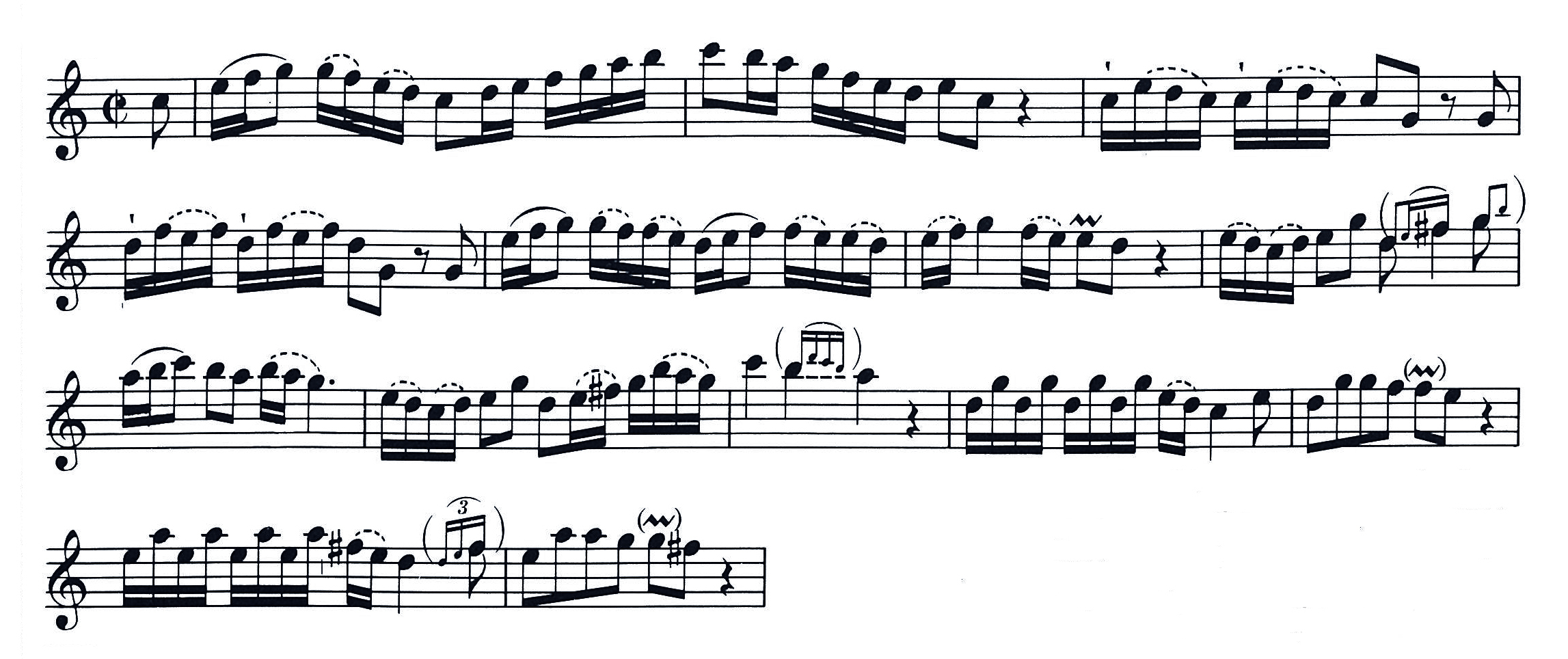
In the slow movement, where the solo instrument is accompanied only by violins and viola, some elements of diminution and ornamentation may be used sparingly for embellishment. Using violin or flute ornaments as a model for a horn concerto is unacceptable because of the limited technical capabilities and would sound, on a modern instrument, like empty virtuoso display (Ex. 2).
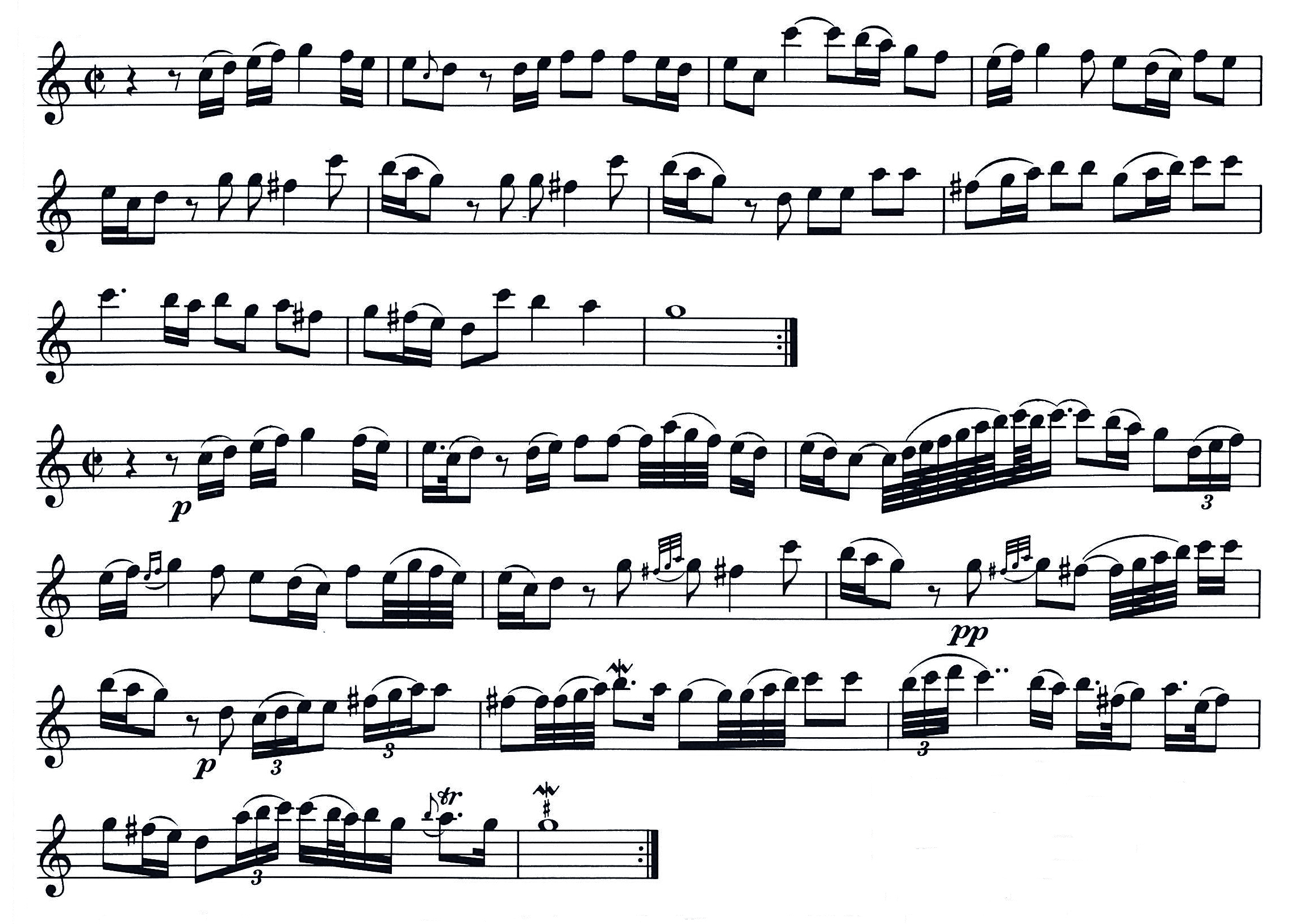
Example 2
P.J. Fick, Concerto, Larghetto bars 1-11, unornamented; bars 1-11, ornamented.
Particularly noteworthy, towards the end of the movement, is the pause on the dominant seventh on B♭ — an opportunity for a cadenza, which according to Quantz should be “played in a single breath” (Ex. 3).

Example 3
P.J. Fick, Concerto, Larghetto bar 18, unornamented and ornamented.
A cadenza is a “deliberate ornament played by a solo part at the close of a piece over the penultimate note of the bass, namely the fifth of the key in which the piece is written, freely and at the pleasure of the performer.”⁴¹ There are no general rules for playing cadenzas and they cannot even be derived from the textbooks in a way which will suit all occasions. Out of the ornamenting of a chord there developed “between 1710 and 1716 the now usual cadenzas in which the bass must stop [...] The pauses or ad libitum stops in the middle of a piece may however be earlier in origin.”⁴² The latter are to be found mainly in vocal pieces, less often in instrumental ones. Quantz characterises the essence of pre-classical cadenzas as follows: “The intention of the cadenza is none other than to give the listener an unexpected surprise at the end and to leave yet another special impression in his mind.”⁴³
Cadenzas must flow from the main mood of the piece and contain a brief repetition or imitation of its most pleasing phrases.”⁴⁴ “One should not stray into keys too far removed and should not play any notes which are quite unrelated to the keynote. A short cadenza should not leave its own key at all.”⁴⁵ This point is particularly important for a horn concerto cadenza; it is all too easy for the modern valve horn to tempt the player into a stylistic compromise and to allow cadenzas quite foreign in character to the work. The content of a cadenza is determined by the mood of the movement: “Just as a cheerful cadenza consists of wide leaps, happy phrases, combinations of triplets, trills, etc., so a sad one, on the other hand, consists almost entirely of small intervals combined with dissonances. The first is appropriate to a happy piece, the second to a very sad one.”⁴⁶
Before I turn to the horn concerto by Telemann, I would like to let the composer speak for himself about the performance of his works. In 1725, in the preface to his *“Harmonischer Gottesdienst [...]”*⁴⁷, he gave performance directions which are also valid for the horn concerto. Thus we read of unmarked dynamics, “that the beginning of every piece belongs to the f unless the p is expressly marked below it.” The first movement of his horn concerto is marked Vivace, which has led to many a discussion on the subject of tempo. In modern music dictionaries Vivace is usually given as meaning “lively” (e.g. “faster than Allegro”⁴⁸). The 1967 edition of Riemann’s “Musiklexikon” gives a more exact definition; Vivace is regarded as primarily an indication of mood and character: “a Vivace is distinguished from an Allegro not in tempo but in accentuation”. Telemann himself gives the following tempo indications: “Presto, allegro, vivace, etc. very fast, fast, cheerful, etc.” Thus Vivace, coming only in third place, indicates a cheerful, not too fast tempo for the first movement of the horn concerto. Telemann gives the slow markings “Adagio, largo, affettuose, etc. very slow, slow, ‘nimble’, etc.”
Quantz gives more detailed advice on tempo: “What I find the most useful guideline for tempo [...] is the pulse-beat in a healthy man’s hand” — which as a standard tempo corresponds to MM = 80.⁴⁹ He divides tempos into three main groups: “They are in common time or 4/4 and are as follows: 1) the allegro assai, 2) the allegretto, 3) the adagio cantabile, 4) the adagio assai.”⁵⁰ This would give the following classification:
A
C = ♩ = 160 MM, ¢ = ♩ = 160 MM Allegro assai
C = ♩ = 80 MM, ¢ = ♩ = 80 MM Allegretto
C = ♪ = 80 MM, ¢ = ♪ = 80 MM Adagio cantab.
C = ♪ = 40 MM, ¢ = ♪ = 80 MM Adagio assai
In the first group Quantz includes “the allegro di molto, the presto, etc. In the second the allegro ma non tanto, non troppo, non presto, moderato etc. In the third the cantabile, arioso, larghetto, soave, dolce, poco andante, affettuoso, pomposo, maestroso, alla siciliana, adagio spiritoso etc. The fourth includes adagio pesante, lento, largo assai, mesto, grave etc.”⁵¹
As a subgroup, Quantz describes as “a kind of moderate allegro, coming as it were between the allegro assai and the allegretto” the tempo which is marked as “poco allegro, vivace or usually just allegro alone”.⁵² According to his information this would give ♩ = 120 MM in common time.
Corresponding breakdowns are given for the other time signatures.⁵³ In the first group, 3/4, when only quavers (eighth notes) are present, ♩. = 107 MM and corresponding in 3/8, ♪. = 107 MM. For the intermediate group (“moderate allegro”) we have
- in 2/4 or fast 6/8 ♩ or ♩. = 160 MM,
- in 12/8 “when there are no semiquavers (16th notes)” ♩. = 160 MM,
- in 3/4 “when the passages consist of semiquavers (16th notes) or [...] triplets [...]” ♩ = 160 MM, “when only six fast notes occur in each bar in the passages” ♩. = 80 MM.
For an “adagio cantabile in 3/4, where the movement [...] is in quavers (8th notes)” we have ♪ = 80 MM. “But if the movement is only in crotchets (quarter notes)” ♩ = 80 MM. Adagio assai, mesto or lento ♪ = 80 MM, and the same tempo holds for an “arioso in 3/8”. An alla siciliana in 12/8 is played at ♪. = 160.
Also of interest are the definitions of Johann Gottfried Walther who in his “Musikalisches Lexikon” of 1732 described vivace as “lively” and largo as “very slow, as if extending the bar [...] In some composers it indicates a rather faster movement than adagio.”
Leopold Mozart⁵⁴ regards the tempo vivace as “the mean between fast and slow”. His tempo indications range from prestissimo, which “indicates the fastest tempo”, through eleven intermediate steps to grave, “really slow”.
I would like to conclude my observations with a few examples. The prime example of a fully written out movement is the Largo from the concerto in D major by Telemann. Very few places in this movement are suitable for either ornamentation or diminutions. I have used appoggiatura, mordent, slide and — particularly easy to play on the natural horn — the tirata, which I used in bars 6 and 7 in place of the 6th leaps (Ex. 4).
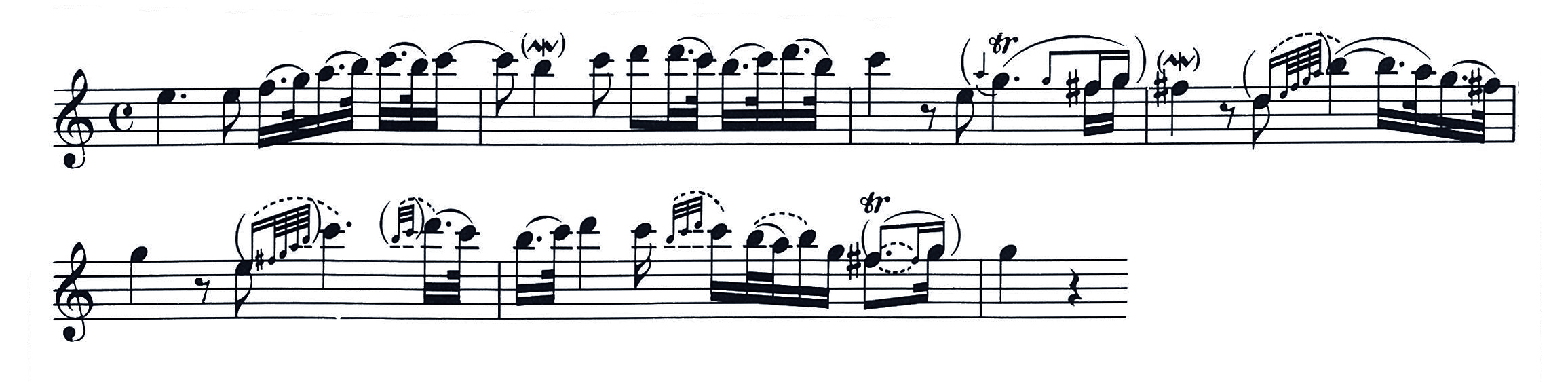
Example 4
G.Ph. Telemann, Concerto, Largo, in D bars 3-8.
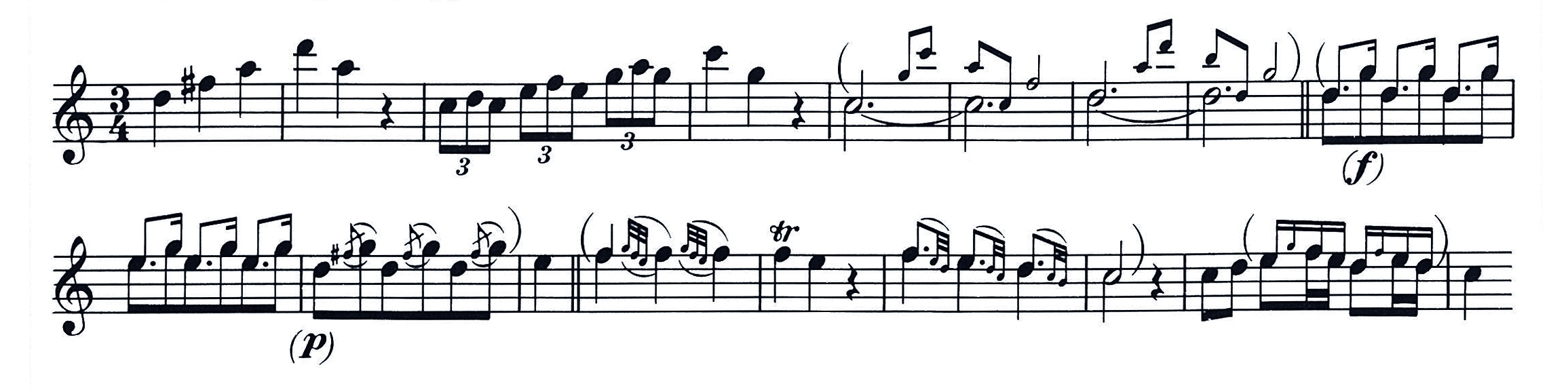
We find diminutions written out by Telemann in the third movement where the rising triad in the orchestra gives rise to triplet groups in the solo part. “Deliberate divisions” and “essential ornaments” may be used, however, in the repeats in the same movement (Ex. 5).
Example 5
G.Ph. Telemann, Concerto, Allegro.
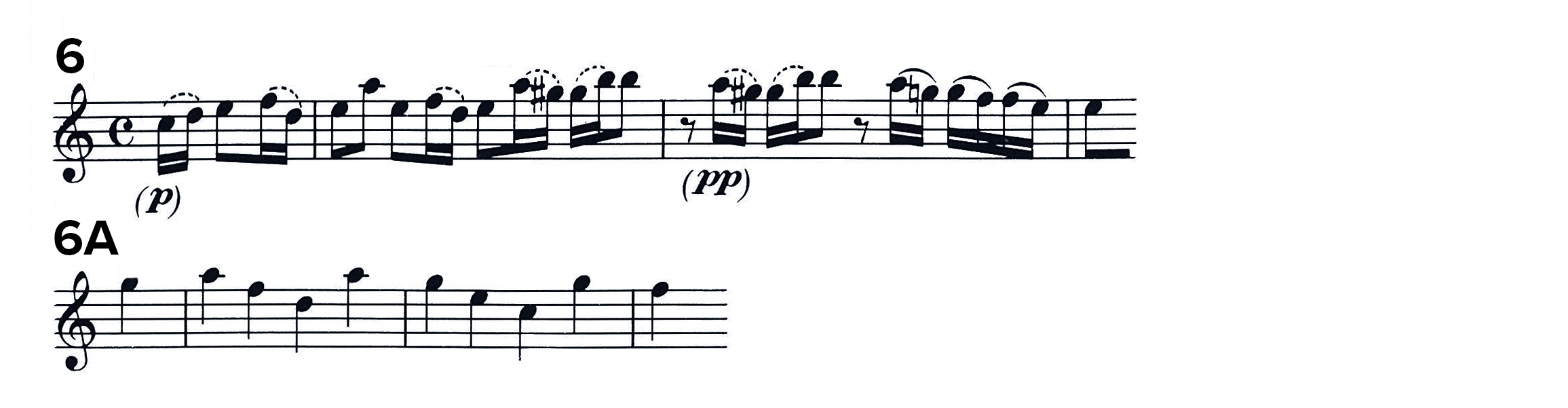
In the first movement of the horn concerto (no. 1) by Christoph Förster we find “deliberate divisions” and a few ornaments already written in by the composer. An extended sequential triad phrase, whose original form is probably (Ex. 6A) becomes, when the thirds are filled in with slides “in the Lombard taste”, a trill and a fast tirata (Ex. 7).
Example 6 & 6A
Ch. Förster, Concerto, Adagio bars 6ff.

Example 7
Ch. Förster, Concerto, Adagio bars 6ff.
In the following bars we find written out diminution (Ex. 8).

Example 8
Ch. Förster, Concerto, Adagio bars 6ff.
In bar 70, in order to soften the dissonance between the first violin and the solo, the written out mordent is preceded by a short appoggiatura and in the following bar there are diminutions in broken chords (Ex. 9).

Example 9
Ch. Förster, Concerto, Adagio bars 6ff.
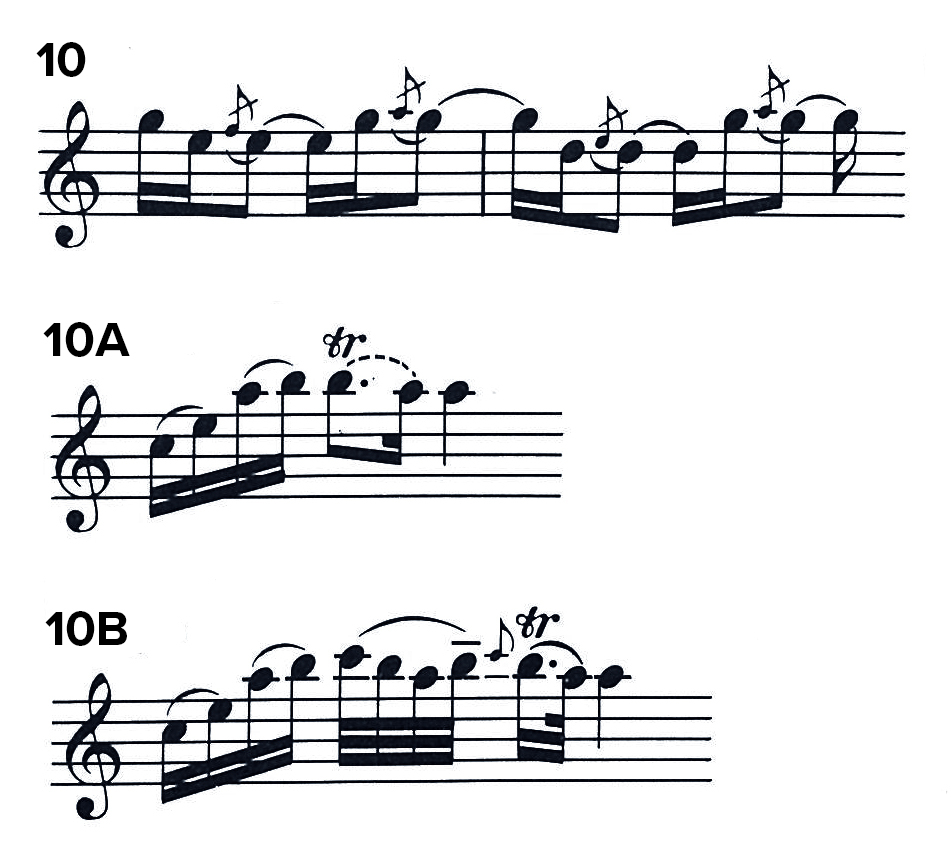
In bars 80 and 81 a short appoggiatura can be added to the syncopes (Ex. 10).
Example 10, 10A, 10B
In the second movement, adagio, “all the notes must be, as it were, caressed and fondled, but never tongued hard, unless the composer wanted some notes to be short and detached”⁵⁵. Usually “the tender nature of the adagio is conveyed in sustained and slurred notes”⁵⁶, and it must at all costs be played “cantabile”. For this reason it was necessary to add a few slurs. In the final bars two slides can be used (Ex. 6). The penultimate note, which carries only a trill sign (Ex. 10A) can delay the trill by means of a turn or gruppetto (Ex. 10B).
© Copyright by Peter Damm