3 min. read
Ornaments in 18th-century Horn Concertos?
By Peter Damm
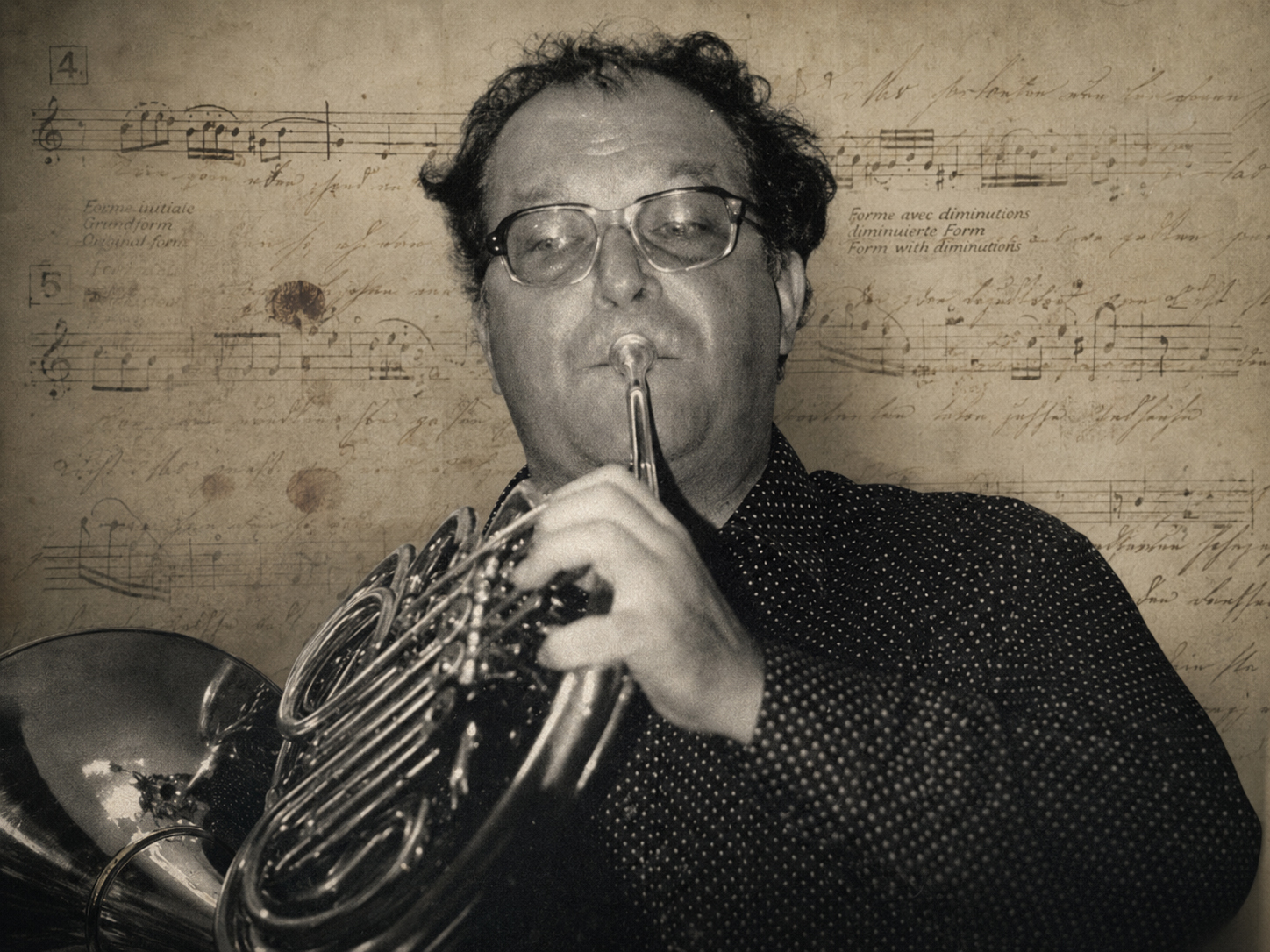
This question, although perhaps slightly provocative, is not unreasonable. Too little is known about the subject.
The ignorance of a music critic who, in a performance of the concerto by Peter Johann Fick, expected more "virtuoso decoration" (which had actually been played, stylistically closely adapted to the piece and to the technical capabilities of the Baroque horn); and the question, directed at a student, "Where do the trills and so on come from which aren't in the music?" — these things were the reason for a lecture, with demonstration on a natural horn, given at the Eighth Scientific Work Conference in 1980 in Blankenburg, in the Harz mountains (East Germany).
The problems of performance and interpretation of 18th-century music are frequently discussed at symposiums and conferences. The fact that the horn has never been at the centre of such discussions is because it found its way into art music relatively late, at a time when keyboard, woodwind and string instruments held the field. Similarly, there were high-quality textbooks for these instruments whereas J.E. Altenburg's Experimental Introduction to the [...] Art of the Trumpeter appeared quite late as a brass instrument textbook of the time, based on other teaching works. Most of the very detailed textbooks are described as "experimental". They make no claim to completeness for the subject is inexhaustible. It was my intention to give some stimulus to discussion of the material, and hints on the much more basic sources.
Whereas present-day musicians are accustomed to transforming the printed notes conscientiously, without additions or alterations, into music, this detailed fixing of music did not exist until the 18th century. It was only after the middle of the 18th century that composers began to an increasing extent to specify the interpretation of their works by giving precise performance instructions. Until then the text had served as a framework or skeleton which the musician could fill out in an individual and creative way thanks to his comprehensive knowledge of performance possibilities. Such performing practice is a kind of improvisation. The art of ornamenting a piece of music shows a musician's skill and ability. Aids to ornamentation are the so-called "essential ornaments" and "deliberate divisions" («wesentliche Manieren» and «Willkürliche Veränderungen»). In his Essay on the true art of keyboard playing, C.P.E. Bach says of ornaments, "They link the notes together; they bring them alive [...] give them [...] weight and emphasis [...] make them pleasant; [...] a mediocre composition can be improved by their use."¹
Being able to ornament a word satisfactorily requires, in addition to great technical skill on the instrument, comprehensive theoretical knowledge: things which to some extent can be taught, and learned. Plenty of imagination and a thorough knowledge of style are also necessary, however, for the latter largely determines when and where ornaments can be used.
"Trying to decorate a work with ornaments and variations before one has learned to play in time and in tune is like trying to paint before one has mastered the principles of draughtmanship."²
Eighteenth-century students found valuable advice on the "art of ornamentation" in the textbooks of Johann Joachim Quantz, Carl Philipp Emanuel Bach and Leopold Mozart, to mention the most influential.
Brass Bulletin 42, II / 1983 pages 12–15
All content is protected by copyright © Brass Bulletin 1983–2026