10 min. read
The Trumpet and the Cornet in Jazz and Popular Music
The instrument for jazz
The instrument for jazz
Standard equipment is the B♭ trumpet and the flugelhorn. The cornet is rarely used, and the piccolo trumpet only occasionally. The C trumpet has no place in jazz (it was played by Boyd Senter in the twenties) but gave good service in the music hall (because of the ease of transposing parts written in various keys; Robert Fassin and Fred Gérard at the beginning of his career). The models usually chosen are those of the top American makers. For jazz and light music, as elsewhere, the important thing is to find the right ratio between volume and sound quality. Choice of mouthpiece, however, often differs between jazz and “classics”, but all kind of exceptions can be observed.
We have considered the subject briefly as it concerned early players. A mouthpiece with a large diameter and a deep cup produces a good volume of sound in the immediate vicinity but because of its lack of tonal clarity it has poor projection. Since the forties lead trumpets like Snooky Young and, in France, Robert Fassin, have not had a “big sound” — quite the contrary — but they “projected” well.
The choice of mouthpiece is determined by the kind of sound and effect desired. Here too there are fashions, since musical styles evolve with time. A studio musician, for example, knows that, in order to earn his living, he must be able to do certain things and he equips himself accordingly. In rock the current fashion is for strident mouthpieces rather than for those which bring the trumpet sound closer to that of the cornet or flugelhorn. I might point out in passing that this fashion is based on modern sound-recording techniques which mean that it is no longer necessary to produce much volume. The so-called “compact” sound is preferred, i.e.: very pointed, instead of very broad. The important thing is to convey the idea of the trumpet — the recording will do the rest. One other thing which must be understood is that nowadays, when people get up on the stand, they are trying to recreate the conditions of studio work whereas formerly it was quite the reverse: people tried to reproduce the sound of live music in the studio!
(Roger Guérin: Jazz Magazine, no. 281, 1979).
“The human instrument”
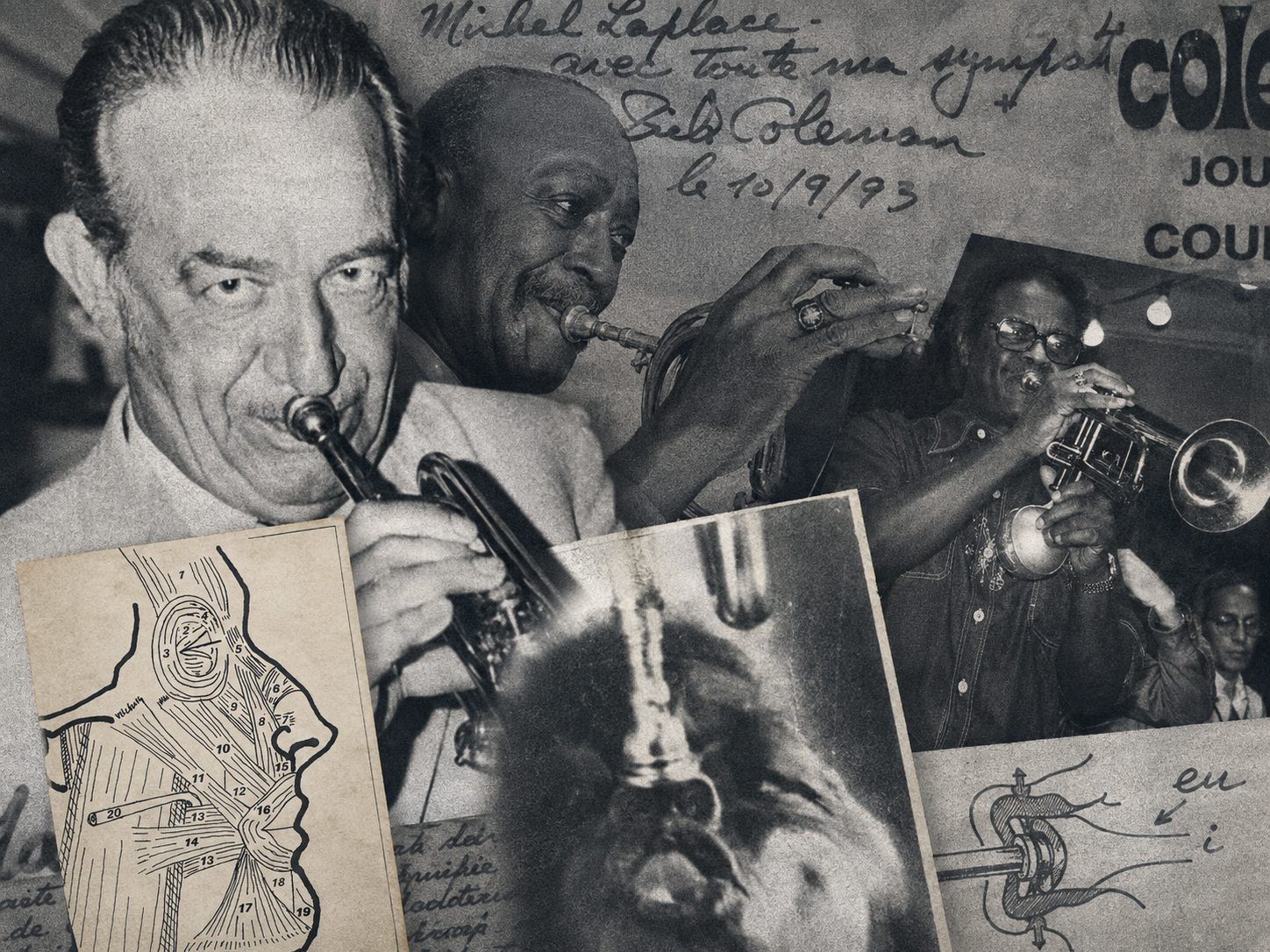
These remarks by Timofey Dokshitser give a good description of everything that leads the trumpet towards musical expression, which is the ultimate goal. Although some jazz players, especially some of the whites, were self-taught (Bix Beiderbecke, Ruby Braff), none of the leaders (Armstrong, Miles Davis, Wynton Marsalis) did without the advice of one or more teachers, well known or otherwise. On the other hand less conservative ideas became established very early on in jazz and light-music circles, arising from the players’ thoughts about problems experienced and from a confrontation of ideas. The basic technique for a cup-mouthpiece instrument in this context, according to Fred Gérard, consists in having:
- resistance
- a wide range
- sound
the last being the most neglected today. This requires mastering the different aspects in a logical order. Tony Russo, like Charles Colin, talks about “intelligent concentration every instant”. The difficulties are, in order:
- your embouchure
- your articulation
- the way you blow
This plan of priorities is roughly the same as that set up by Roy Stevens, Charles Colin and Fred Gérard.
Brass Bulletin 45, I / 1984 pages 38–44
All content is protected by copyright © Brass Bulletin 1984–2026