There is no perceptible deviation from the manuscript in the print. We find articulations which have been changed arbitrarily and performance instructions not used by Mozart in the concertos such as "espressivo", "con espressione", "dolce" or "poco ritenuto e dim." and changes in the text (e.g. KV 417, 1st movement, bar 33; Rondo, bar 26).
Problematical for the soloist of the horn concertos is the omission of details of articulation in the solo part of the sources. Ernst Rudorff writes in the revision report of the AMGA (Series XII): "It is not usual for the principal part to contain performance notes; it is assumed that the performer will possess sufficient judgement and taste to find the correct way." In Mozart's time the musician possessed "sufficient judgement and taste". His training did not just consist of technical accomplishment, but also comprehensive theoretical education. Today the detailed methods of Quantz (1752), C. Ph. E. Bach (1753), L. Mozart (1756), later Türk (1789) are still important sources in questions of correct stylistic interpretations. All these works provided knowledge which enabled a musician to employ articulations which corresponded to the character of the composition as well as attaining a good musical performance.
Roland Horvath, horn player and member of the Vienna Philharmonic sees in the omission of articulation and dynamic markings as the typical example of the soloist "knowing well Mozart's style and as a result knowing exactly how the work was to be played".
How should we set about it nowadays, when we have to deal with an unmarked part?
A good way of getting to know Mozart's style is to keep on listening. One can never listen to enough good performances, good singers, good instrumentalists and learn from them. To complete missing articulations requires much artistic tact, feeling for style, knowledge of rules and instrumental technique, in our case, of the natural horn. The same applies to varied dynamics, where Mozart writes at the most "p" or "f".
Articulation marks should neither be added which are contrary to the character of the movement, nor should they cause lack of clarity or veiling. This is particularly applicable to fast passages and scales.
Mozart's contemporary Christian Friedrich Daniel Schubart (1739–1791) allocates great importance to musical performance in his "Ideas on aesthetics in music". One of its characteristics is "clarity". Here Schubart means both phrasing and articulation: "Every musical comma, yes every individual note must have sharp contours, and the staccato must be well practised (nothing is clearer than a staccato movement), never mutter".
Leopold Mozart advises in Chapter XII, §§ 7 & 11 of his Thorough Violin Method under the title "About the correct reading of notes and good performance in general": "Before starting to play, the piece must be looked at closely. One must look for the character, the tempo and the kind of movement, as the piece demands..." (§ 7), "...if nothing is indicated in a composition; then one must know how to employ slurs and detached notes, and to use them with good taste and in the right place." (§ 11).
On the practice of completing articulation
A comparison of my recordings of the horn concertos with the Kling edition will show some differences in articulation. The first prerequisite of completion of articulation is the thorough study of the score of the work in question. The horn concertos are available in pocket scores by the Eulenburg edition as well as in large scores by Breitkopf & Härtel, Leipzig. The latter are identical with the text of the AMGA, only the score to KV 495 is an edited edition.
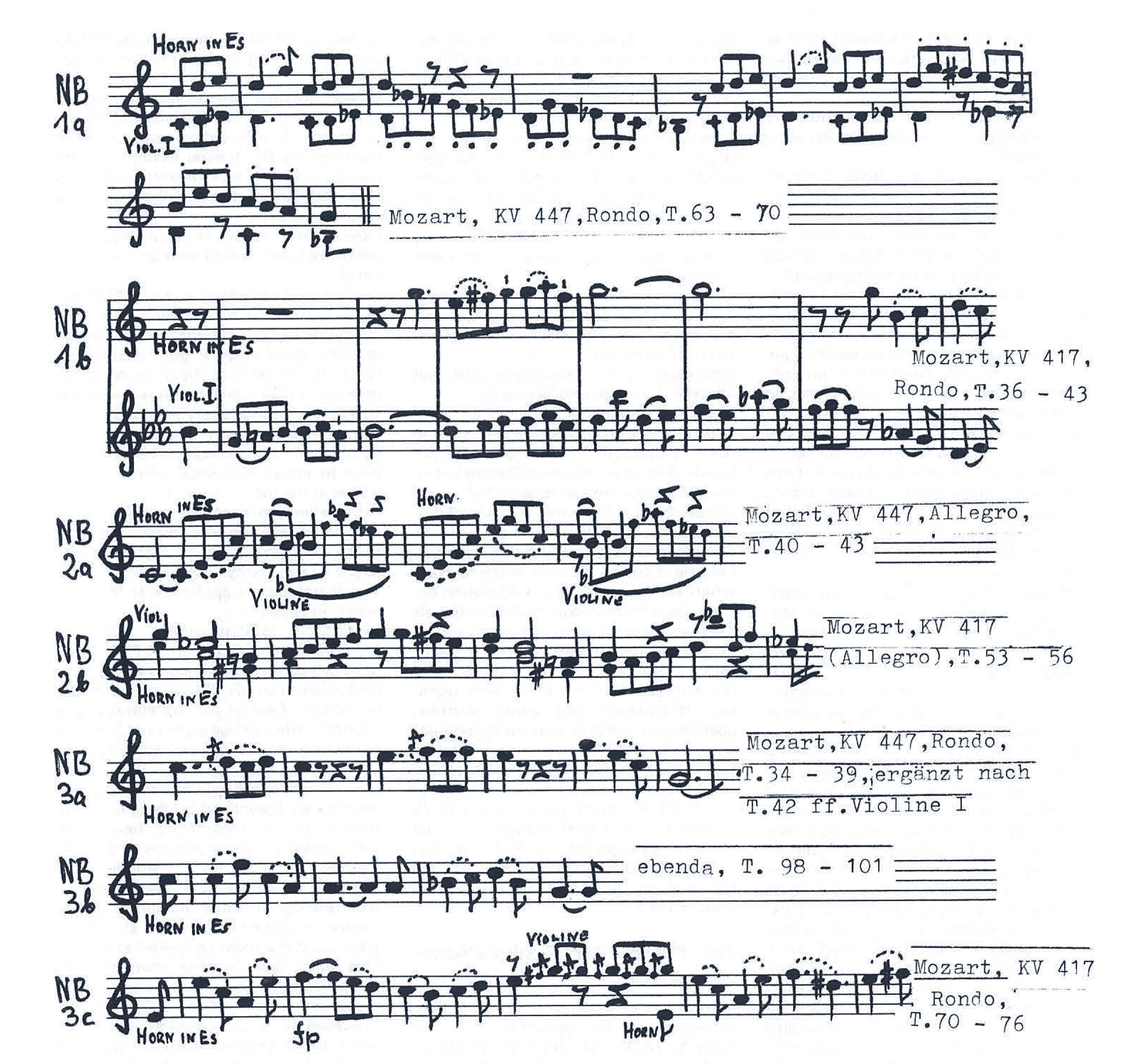
The first thing is to check through the solo part according to the score. We only find very sparse indications. Mozart took more care over the articulation in the orchestral parts. We therefore fill in analogous passages between orchestra and solo whilst paying attention to the instrumental characteristics (Ex. 1a and 1b).
We complete other passages considering the articulation in the accompanying parts or the melodic line (Ex. 2a and 2b).
Of course the character of the movement and the theme to be articulated must not be overlooked. In the rondo movements the interludes are marked according to the articulation of the orchestral accompaniment as well as the opposition to the rondo theme (Ex. 3a). I would particularly like to point out the reminiscence of the romance theme in the rondo of KV 477 (Ex. 3b), in KV 417 the minor section (rondo form: part C). Here the ridiculed Leutgeb takes trouble to fashion the section with particular expressiveness, which is the cause of much amusement for the orchestra. This passage must be played legato. Kling's tongued version is alien to this whole passage (Ex. 3c).
An articulation which has been added should never upset the musical continuity of a phrase. If used sensibly it supports the phrasing ("what am I saying") through its expressiveness ("how do I say something") and clarifies the musical construction of a phrase, irrespective of the fact whether it is a complete theme in itself or only a part of it or just a motif.
Here are a few words on the types of articulation used. Staccato dots or strokes/wedges are relatively seldom in the solo part, to be found in the autographs. Where they are to be found, they definitely have a different intention from the dot. In the AMGA all strokes were unfortunately simplified and changed to dots, therefore we only find dots in all the following editions.
Staccato is not the same as playing short! In the scales as well as 2 slurred, 2 tongued 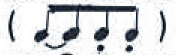 , the tongued notes should not be hard and awkward but the notes should rather be smooth and light. In the rondo themes we find articulations of 2 slurred notes and one with a stroke
 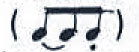 . Here the notes with a stroke should be detached and played rather shorter. (Examples in rondo KV 417, bar 9; in the rondo theme KV 412).
Motifs with call or hunting characteristics should not be played too broadly or smoothly, cf. the "hunting calls" in the rondo of KV 447, which are all tongued. In the romances the tongued notes are played more non-legato, i.e. the notes are tongued, held out but detached also. I would like to compare this articulation with the coherence of words in singing. No-one would sing the individual words or syllables in a chopped manner, they are combined in a sensible way, even when no legato is prescribed.
A mistake which is often heard is a staccato which is too short, as in the exposition of the first movement of KV 447, bar 104 ff., also in the Romance of the same concerto, bar 17 & 24. All unmarked passages and other tongued sections demand in Mozart an extremely well differentiated and graded attack.
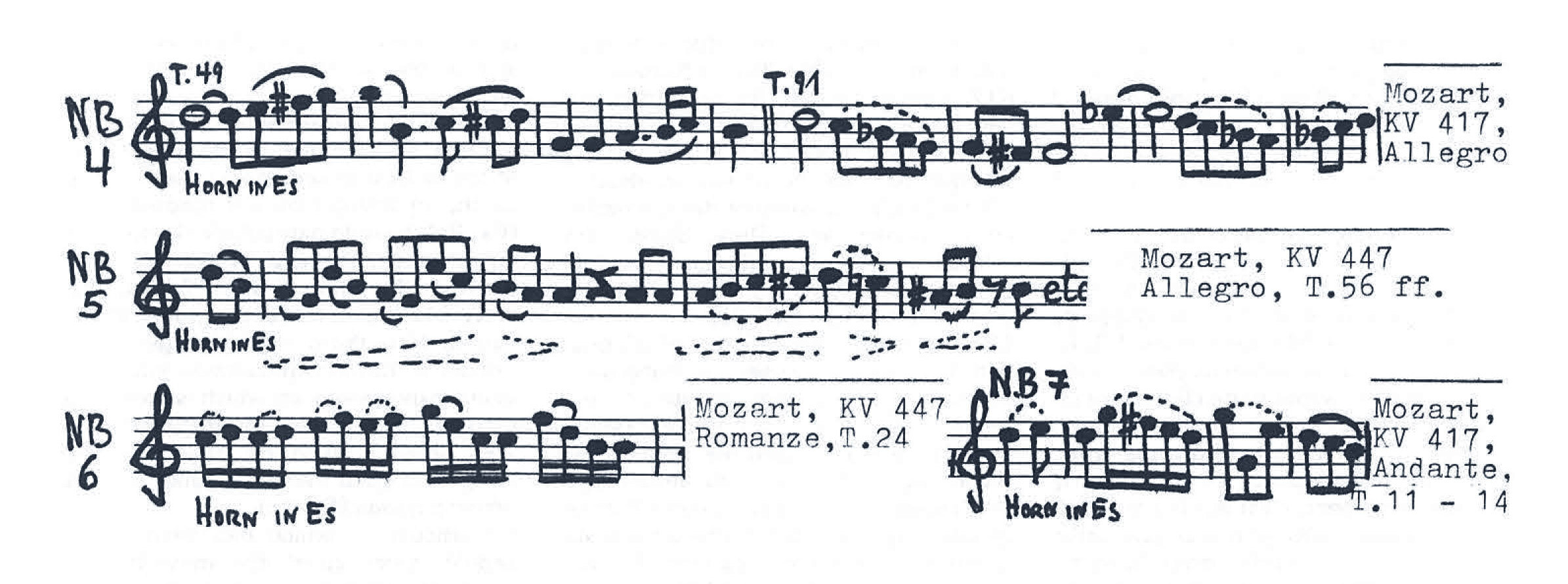
Slur marks in the classical era were taken over from the strings. We therefore hardly ever find longer slurs over the bar line. The legato is executed very smoothly, whereby the arrangement of the phrases must be given close attention. The following example 4 must not be destroyed through playing it too disconnectedly. Only together with the crotchets (quarter notes) which are played portato is the phrase properly rounded off. Also one often hears the second theme of KV 447 played very detached and split up into motifs 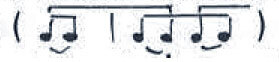 without the unity of the phrase being maintained (Ex. 5).
A clear "bow-change", I use this term from string technique in order to make this light separation clear, must be audible in example 6. The slurred notes are somewhat shortened. Large intervals played legato intensify the unity of the phrase and round it off (Ex. 7).
Horizontal strokes (tenuto) do not appear in the horn concertos.
These annotations are the result of over 20 years occupation with the Mozart horn concertos. They are in no way meant as the non plus ultra, and cannot be this in any case. They are meant to stimulate on the basis of the written notes. In 20 years’ time these will bring new aspects and knowledge.
I would like to recommend most warmly to those who wish to concern themselves further with this theme the book Mozart — Interpretation by Eva and Paul Badura-Skoda (Wancura Edition, Vienna) as the most important source. It offers the researcher time and again extremely valuable hints and suggestions.