Explore institutional access Explore institutional access
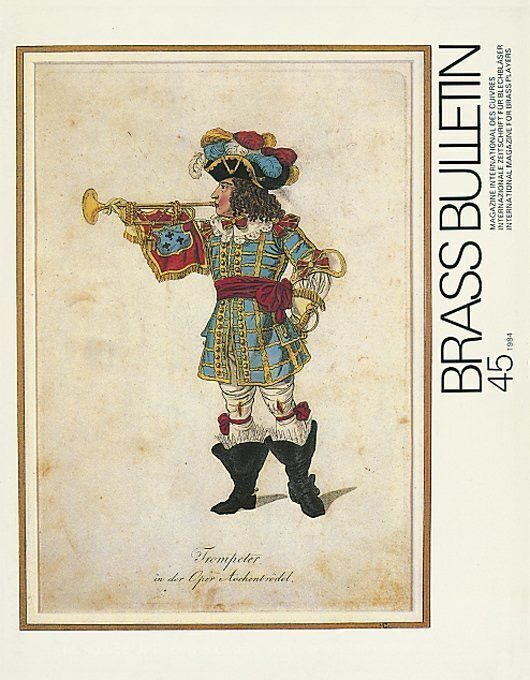
Brass Bulletin 45 - 1 / 1984
Issue
Brass Bulletin No. 45
Date
I / 1984
Pages
88
Contents
10 articles

Out of print

All issues

Brass Bulletin No. 45

I / 1984

Contents

10 articles

Editorial

Jean-Pierre Mathez

pp. 8–9 Teaching Technique

Between disciplined practice and creative folly, musicianship emerges where scales and systems give way to imagination, instinct and the unsettling freedom to think.

On the Sackbut or Harmonic Trumpet

From Pierre Trichet’s Traité des Instruments de Musique (c. 1640)

Pierre Trichet

pp. 10–12 Trombone History Equipment

A seventeenth-century description of the sackbut captures its moving slide, chromatic freedom and bass role at a moment when the instrument was still being defined.

Harry James (1916-1983)

Young Man With A Horn

Michel Laplace

pp. 14–17 Trumpet Cornet à pistons Encounters History

Harry James stood between jazz virtuosity and popular showmanship, turning the trumpet into a mass-audience voice without losing the respect of classical players.

Brass in the Operas of Berlioz

Benjamin Perl

pp. 18–30 History Repertoire

Berlioz turned a changing brass section into a dramatic force, using horns, trombones, cornets and saxhorns to shape colour, distance, ceremony and fear.

The Polyphonic Trombone

A suggested notation system

Klaus-K. Hübler

pp. 31–33 Trombone Repertoire Technique

When trombone slide, overtones, breath and valves become independent musical voices, conventional notation reaches its limits and a new system becomes necessary.

Jazz and the Horn

Part 4

Thomas Bacon

Jeffrey Agrell

pp. 34–37 Horn Encounters

Classical discipline meets jazz-rock freedom as Thomas Bacon confronts improvisation, stylistic crossover and the physical demands placed on the horn.

The Trumpet and the Cornet in Jazz and Popular Music

Part 4

The instrument for jazz

Michel Laplace

pp. 38–44 Trumpet Cornet à pistons History

Jazz trumpet playing balances equipment, embouchure and articulation, as changing sound ideals reshape mouthpieces, technique and the physical approach to playing.

Ornaments in 18th-century Horn Concertos?

Part 4 – End

Changes and modifications of tempo

Peter Damm

pp. 46–54 Horn History Repertoire

Tempo, dynamics and cadenzas expose how much an 18th-century horn concerto once depended on choices that modern notation and instruments can easily obscure.

Albert Calvayrac

Portrait

Jean-Pierre Mathez

pp. 58–60 Trumpet Encounters

A career nearly abandoned after a disastrous switch from cornet to trumpet became a lesson in self-knowledge, persistence and an unexpected return to music.

A major chamber music work for brass?

Quintet, by Peter Maxwell Davies

Thomas Aitken

pp. 62–65 Repertoire Backstage

A BBC studio session turns Maxwell Davies’s brass quintet into a test of virtuosity, balance and whether brass could claim a new place in chamber music.

Loading…

Questions & Answers

How the Digital Edition works

What does the Digital Edition include?

The Digital Edition brings together the articles already digitized as searchable online texts—not simply as scans or PDF files—along with their original illustrations, notes, authorship, issue information, and available translations. Related-article suggestions currently include only this digitized material.

Are the digital articles identical to the originals?

We preserve the original text, language, illustrations, captions, footnotes, and editorial context as faithfully as possible. The presentation is adapted for comfortable online reading, and obvious transcription or scanning errors may be corrected. The substance and character of the published article remain unchanged.

Which languages are available?

Brass Bulletin was published in English, French, and German throughout its history. Italian and Spanish translations were added from issue No. 60 onward.

On the Italian and Spanish sites, articles from issues 1–59 are therefore shown in English by default.

How often are new articles added?

New articles are added almost daily, with approximately one complete issue digitized each week. The pace may vary depending on the preparation, image work, and editorial checking required.

Why aren’t all articles available digitally?

The complete Brass Bulletin collection contains 1,246 articles published between 1971 and 2003. The full index is already available online, allowing readers to discover every article in the collection, including those whose complete text has not yet been digitized.

Digitization began in February 2026. Each article is carefully prepared for online reading, checked, and connected to its issue, authors, subjects, and illustrations. At the current pace of digitization, the complete collection is expected to be available online by February 2028.

Why do some references mention articles that are not available yet?

References in the original articles are preserved even when the material they point to has not yet been digitized. This keeps the historical and editorial record intact. As more issues are added to the Digital Edition, an increasing number of these references will lead to articles that can be read online.

Can I suggest an article or report a transcription error?

Yes. If there is an article you would particularly like to see digitized, or if you notice a possible transcription error or missing detail, please contact us. Reader feedback helps us improve the Digital Edition and prioritize useful connections within the archive.

How can I support Brass Bulletin?

Your support helps fund the preparation, verification, and online publication of the complete collection.

Subscribe to the Digital Edition

Prefer to support us without subscribing?

Make a donation

Search Brass Bulletin.