Ofrezca Brass Bulletin en su universidad, conservatorio o biblioteca Descubra el acceso institucional

9 min de lectura

Ornaments in 18th-century Horn Concertos?

Changes and modifications of tempo

Parte 4 – Fin

Por Peter Damm

Ornaments in 18th-century Horn Concertos?

Peter Damm

Changes and modifications of tempo include rubato, a “reshaping or anticipation of the notes”. This includes the broadening at the end of a movement which can vary “from a slight hesitation before the final note to a pronounced ritardando...” The “slight hesitation” “gives the final note a particular accent which makes it clear to the listener that this is the end of the movement, and ‘places’ the conclusion”.³⁴

The lengthening of small note-values, notated as equal, in unequal pairs also functions as an accent; an example is the so-called Lombardic rhythm or Scotch snap, where two quavers are changed into a semiquaver and a dotted quaver (two eighth notes into a sixteenth and a dotted eighth note). This characteristic ornament of ‘inequality’ is called in French inégalité. “In the sense of the principle of general ‘inequality’ [...] it was [...] normal everywhere [...] to double-dot dotted notes and so ‘get rid’ to the short note(s) as quickly as possible [...]”³⁵ The corresponding upbeats are also covered by the same rule.

Dynamic markings are rarely encountered in Baroque works. The alternation between tutti and solo already constitutes an audible dynamic change. In terms of dynamics Hans-Peter Schmitz considers the Baroque period to be a “forte age”.

The forte must not, however, be regarded as the equivalent of the usual modern volume. The substantially narrower bore of the early instruments must also be borne in mind. Quantz writes of the use of volume levels: “The precise expression of forte and piano is one of the most necessary parts of performance. The alternation of piano and forte is one of the most suitable means not only of representing the passions but also of bringing light and shade into the music.”³⁶

Forte and fast tempo are linked, as are piano and slow tempo. Probably the most popular and most over-used effect of the age is that of the echo in exact repetitions of individual motifs from the melody. Terraced dynamics are characteristic of 18th-century music but one should beware of too strict an application of this principle. Witness Quantz: “In repetitions or similarity of ideas consisting of half or whole bars, whether in the same notes or transposed, the repetition [...] can be played [...] rather softer.”³⁷ Within these dynamic steps crescendo and decrescendo were used, however, primarily the dynamics of tension and relaxation. For individual long notes a messa di voce is sufficient ornament. Rising lines are played with an imperceptible rise in volume, falling ones with a reduction. Trills too are dynamically reinforced with increasing speed.

Quantz does not want the dynamic limits to be stretched too wide: “The alternating piano and forte must be used with great judgment so that one does not pass too abruptly from one to the other but rather rises and falls imperceptibly.”³⁸ And elsewhere, on changing volume levels: “Here one must proceed as in painting. For here, in order to express light and shade, one uses the so-called mezzetinte or half-shades which unite dark with light. Thus in singing and playing one must use the dying piano, and growing volume, in the same way as the half-shades, for this variety is indispensable for good musical performance.”³⁹

After these theoretical considerations we will now pass on to a few practical examples from the horn concertos of Fick, Förster and Telemann.

I would like to begin with the “Concerto ex Dis” by the copyist and composer P. J. Fick who died in Schwerin (now in East Germany) in 1743. His three movements are in the three-movement Venetian solo-concerto form developed around 1700 but the musical expression is the “German idiom”.⁴⁰

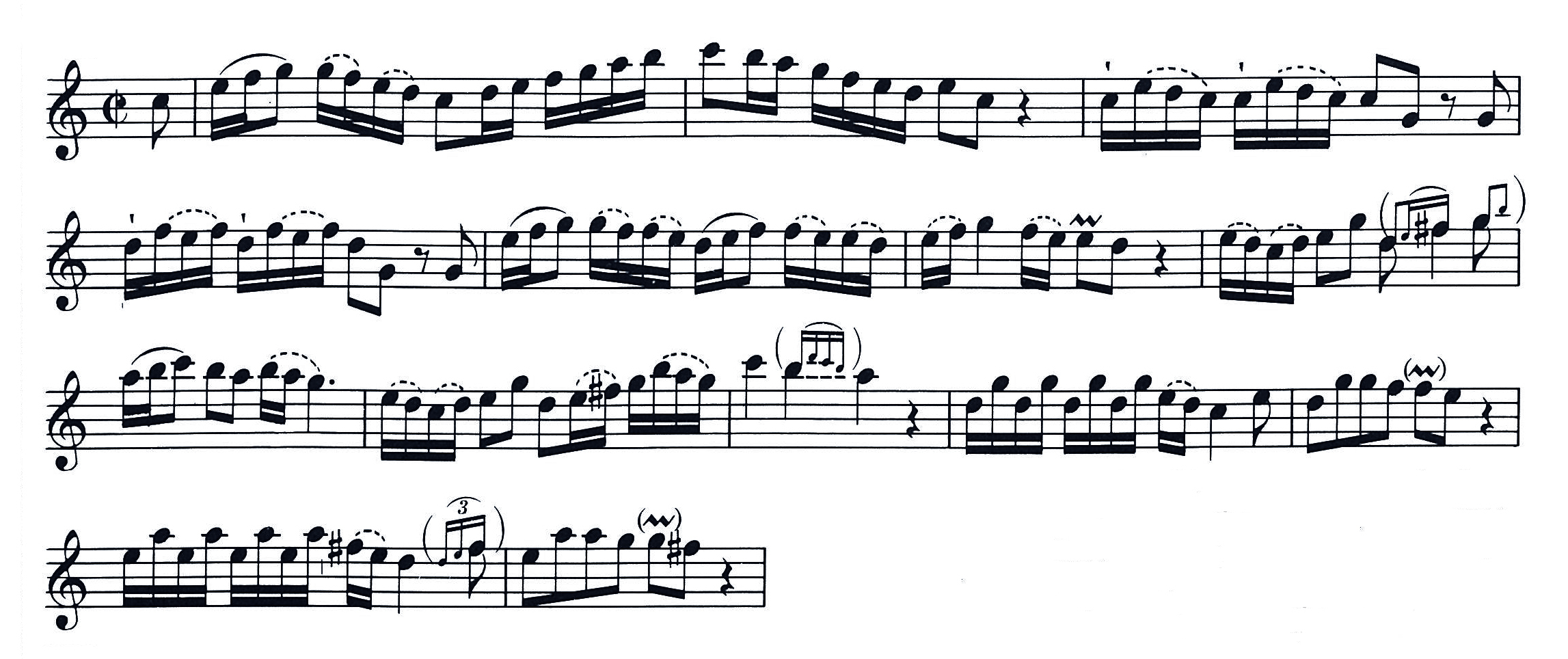
In the outer movements, in view of the mostly rapid figuration, I have limited myself to some careful “essential ornaments”. What was more important was to add some extra legato slurs to those already marked (Ex. 1).

Example 1P.J. Fick, Concerto, Allegro moderato bars 21-34, added slurs; ornaments ( ) and in small notes.

Example 1

P.J. Fick, Concerto, Allegro moderato bars 21-34, added slurs; ornaments ( ) and in small notes.

In the slow movement, where the solo instrument is accompanied only by violins and viola, some elements of diminution and ornamentation may be used sparingly for embellishment. Using violin or flute ornaments as a model for a horn concerto is unacceptable because of the limited technical capabilities and would sound, on a modern instrument, like empty virtuoso display (Ex. 2).
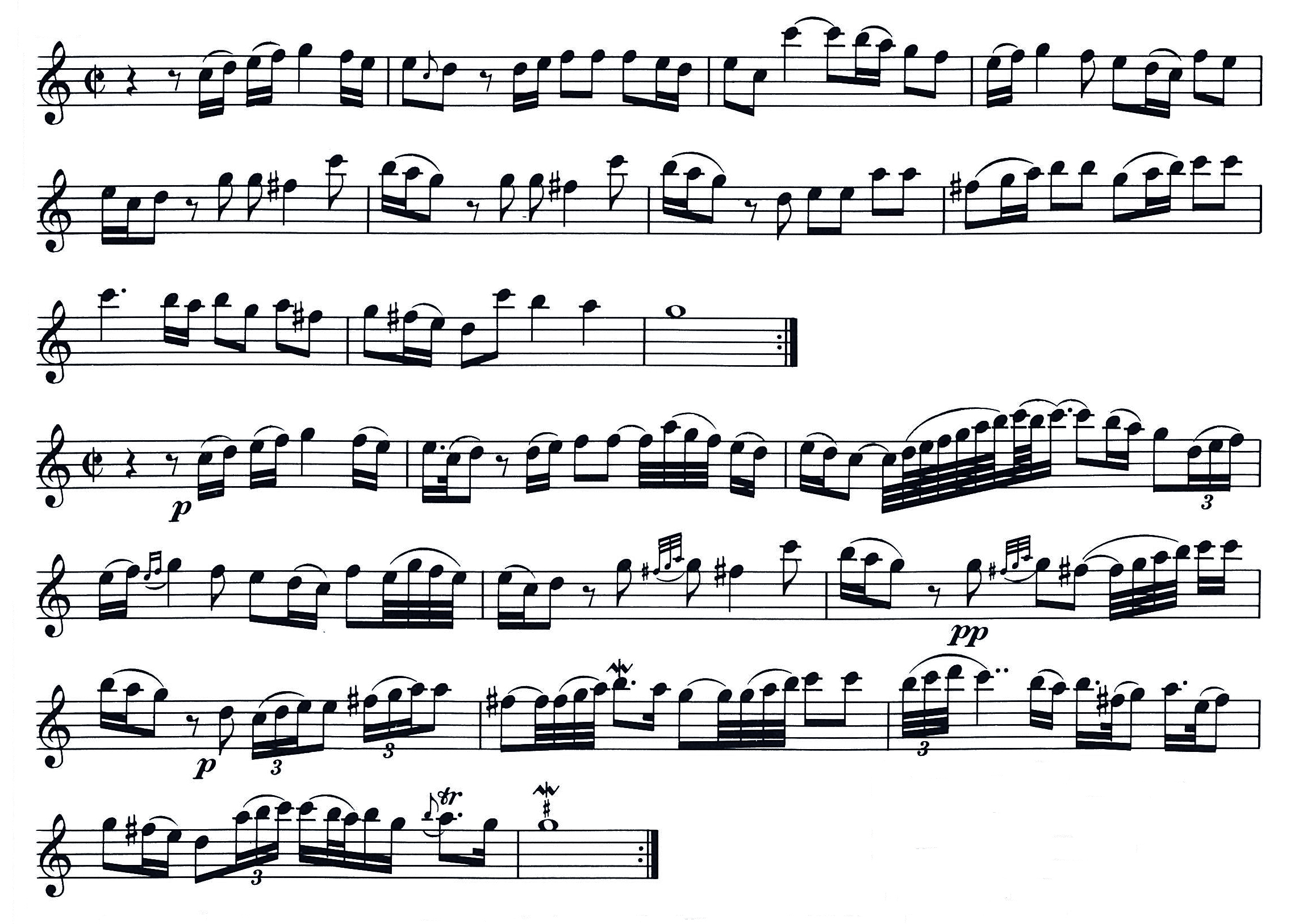
Example 2P.J. Fick, Concerto, Larghetto bars 1-11, unornamented; bars 1-11, ornamented.

Example 2

P.J. Fick, Concerto, Larghetto bars 1-11, unornamented; bars 1-11, ornamented.

Particularly noteworthy, towards the end of the movement, is the pause on the dominant seventh on B♭ — an opportunity for a cadenza, which according to Quantz should be “played in a single breath” (Ex. 3).

Example 3P.J. Fick, Concerto, Larghetto bar 18, unornamented and ornamented.

Example 3

P.J. Fick, Concerto, Larghetto bar 18, unornamented and ornamented.

A cadenza is a “deliberate ornament played by a solo part at the close of a piece over the penultimate note of the bass, namely the fifth of the key in which the piece is written, freely and at the pleasure of the performer.”⁴¹ There are no general rules for playing cadenzas and they cannot even be derived from the textbooks in a way which will suit all occasions. Out of the ornamenting of a chord there developed “between 1710 and 1716 the now usual cadenzas in which the bass must stop [...] The pauses or ad libitum stops in the middle of a piece may however be earlier in origin.”⁴² The latter are to be found mainly in vocal pieces, less often in instrumental ones. Quantz characterises the essence of pre-classical cadenzas as follows: “The intention of the cadenza is none other than to give the listener an unexpected surprise at the end and to leave yet another special impression in his mind.”⁴³

Cadenzas must flow from the main mood of the piece and contain a brief repetition or imitation of its most pleasing phrases.”⁴⁴ “One should not stray into keys too far removed and should not play any notes which are quite unrelated to the keynote. A short cadenza should not leave its own key at all.”⁴⁵ This point is particularly important for a horn concerto cadenza; it is all too easy for the modern valve horn to tempt the player into a stylistic compromise and to allow cadenzas quite foreign in character to the work. The content of a cadenza is determined by the mood of the movement: “Just as a cheerful cadenza consists of wide leaps, happy phrases, combinations of triplets, trills, etc., so a sad one, on the other hand, consists almost entirely of small intervals combined with dissonances. The first is appropriate to a happy piece, the second to a very sad one.”⁴⁶

Before I turn to the horn concerto by Telemann, I would like to let the composer speak for himself about the performance of his works. In 1725, in the preface to his *“Harmonischer Gottesdienst [...]”*⁴⁷, he gave performance directions which are also valid for the horn concerto. Thus we read of unmarked dynamics, “that the beginning of every piece belongs to the f unless the p is expressly marked below it.” The first movement of his horn concerto is marked Vivace, which has led to many a discussion on the subject of tempo. In modern music dictionaries Vivace is usually given as meaning “lively” (e.g. “faster than Allegro”⁴⁸). The 1967 edition of Riemann’s “Musiklexikon” gives a more exact definition; Vivace is regarded as primarily an indication of mood and character: “a Vivace is distinguished from an Allegro not in tempo but in accentuation”. Telemann himself gives the following tempo indications: “Presto, allegro, vivace, etc. very fast, fast, cheerful, etc.” Thus Vivace, coming only in third place, indicates a cheerful, not too fast tempo for the first movement of the horn concerto. Telemann gives the slow markings “Adagio, largo, affettuose, etc. very slow, slow, ‘nimble’, etc.”

Quantz gives more detailed advice on tempo: “What I find the most useful guideline for tempo [...] is the pulse-beat in a healthy man’s hand” — which as a standard tempo corresponds to MM = 80.⁴⁹ He divides tempos into three main groups: “They are in common time or 4/4 and are as follows: 1) the allegro assai, 2) the allegretto, 3) the adagio cantabile, 4) the adagio assai.”⁵⁰ This would give the following classification:


A

C = ♩ = 160 MM, ¢ = ♩ = 160 MM Allegro assai
C = ♩ = 80 MM, ¢ = ♩ = 80 MM Allegretto
C = ♪ = 80 MM, ¢ = ♪ = 80 MM Adagio cantab.
C = ♪ = 40 MM, ¢ = ♪ = 80 MM Adagio assai


In the first group Quantz includes “the allegro di molto, the presto, etc. In the second the allegro ma non tanto, non troppo, non presto, moderato etc. In the third the cantabile, arioso, larghetto, soave, dolce, poco andante, affettuoso, pomposo, maestroso, alla siciliana, adagio spiritoso etc. The fourth includes adagio pesante, lento, largo assai, mesto, grave etc.”⁵¹

As a subgroup, Quantz describes as “a kind of moderate allegro, coming as it were between the allegro assai and the allegretto” the tempo which is marked as “poco allegro, vivace or usually just allegro alone”.⁵² According to his information this would give ♩ = 120 MM in common time.

Corresponding breakdowns are given for the other time signatures.⁵³ In the first group, 3/4, when only quavers (eighth notes) are present, ♩. = 107 MM and corresponding in 3/8, ♪. = 107 MM. For the intermediate group (“moderate allegro”) we have

  • in 2/4 or fast 6/8 ♩ or ♩. = 160 MM,
  • in 12/8 “when there are no semiquavers (16th notes)” ♩. = 160 MM,
  • in 3/4 “when the passages consist of semiquavers (16th notes) or [...] triplets [...]” ♩ = 160 MM, “when only six fast notes occur in each bar in the passages” ♩. = 80 MM.

For an “adagio cantabile in 3/4, where the movement [...] is in quavers (8th notes)” we have ♪ = 80 MM. “But if the movement is only in crotchets (quarter notes)” ♩ = 80 MM. Adagio assai, mesto or lento ♪ = 80 MM, and the same tempo holds for an “arioso in 3/8”. An alla siciliana in 12/8 is played at ♪. = 160.

Also of interest are the definitions of Johann Gottfried Walther who in his “Musikalisches Lexikon” of 1732 described vivace as “lively” and largo as “very slow, as if extending the bar [...] In some composers it indicates a rather faster movement than adagio.”

Leopold Mozart⁵⁴ regards the tempo vivace as “the mean between fast and slow”. His tempo indications range from prestissimo, which “indicates the fastest tempo”, through eleven intermediate steps to grave, “really slow”.

I would like to conclude my observations with a few examples. The prime example of a fully written out movement is the Largo from the concerto in D major by Telemann. Very few places in this movement are suitable for either ornamentation or diminutions. I have used appoggiatura, mordent, slide and — particularly easy to play on the natural horn — the tirata, which I used in bars 6 and 7 in place of the 6th leaps (Ex. 4).
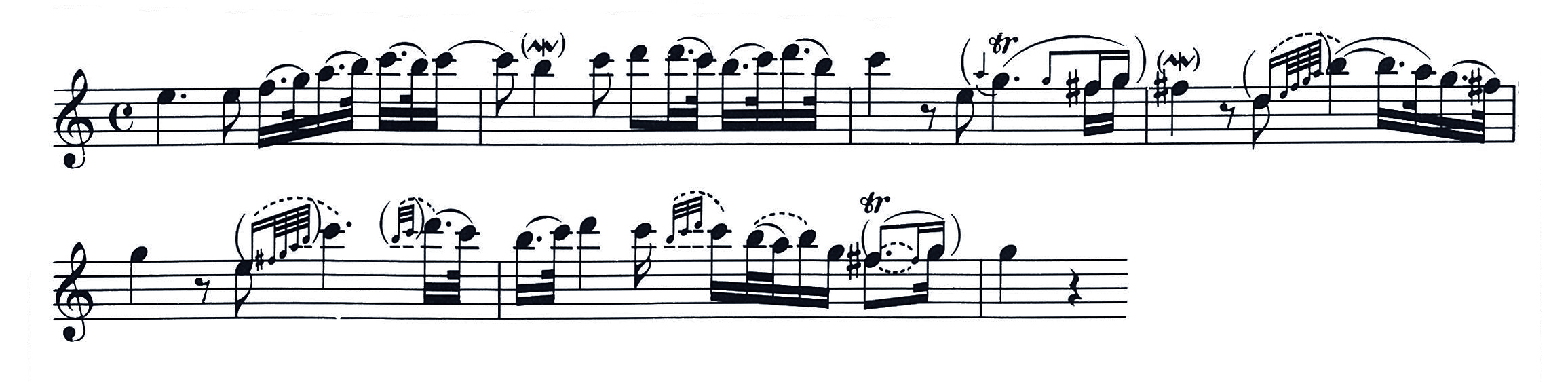
Example 4G.Ph. Telemann, Concerto, Largo, in D bars 3-8.

Example 4

G.Ph. Telemann, Concerto, Largo, in D bars 3-8.

We find diminutions written out by Telemann in the third movement where the rising triad in the orchestra gives rise to triplet groups in the solo part. “Deliberate divisions” and “essential ornaments” may be used, however, in the repeats in the same movement (Ex. 5).
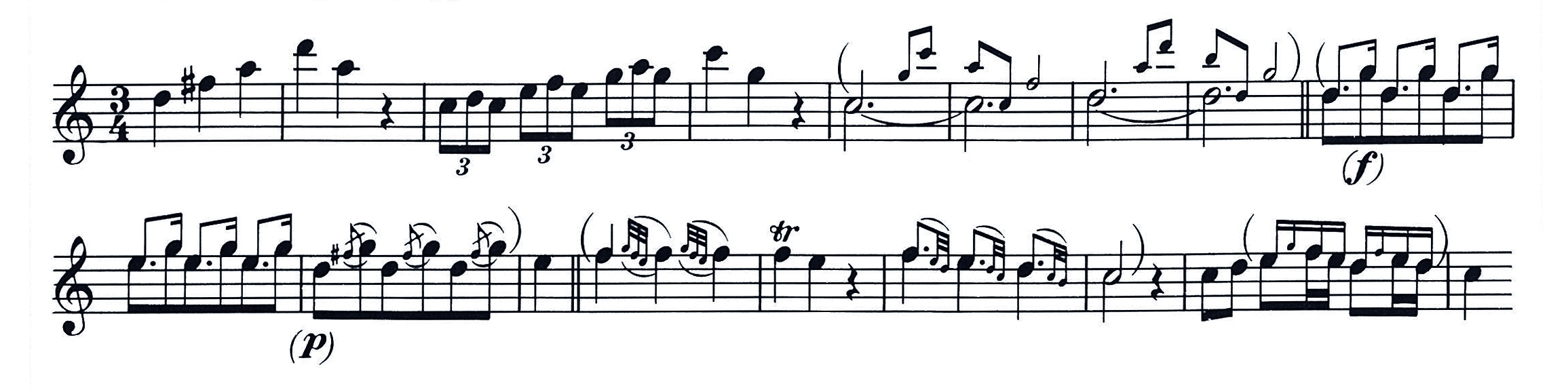
Example 5G.Ph. Telemann, Concerto, Allegro.

Example 5

G.Ph. Telemann, Concerto, Allegro.

In the first movement of the horn concerto (no. 1) by Christoph Förster we find “deliberate divisions” and a few ornaments already written in by the composer. An extended sequential triad phrase, whose original form is probably (Ex. 6A) becomes, when the thirds are filled in with slides “in the Lombard taste”, a trill and a fast tirata (Ex. 7).
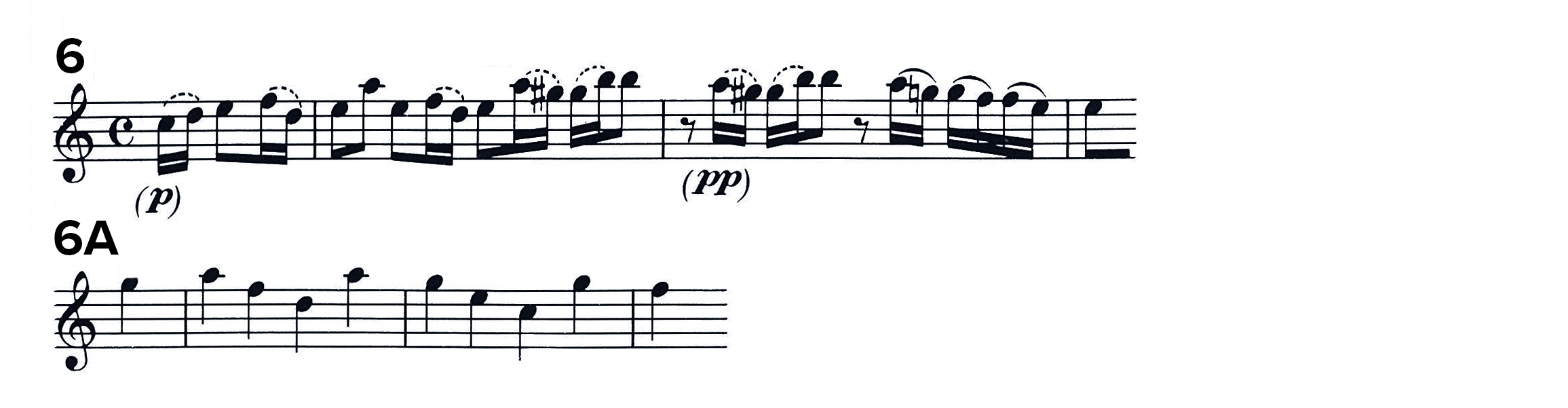
Example 6 & 6ACh. Förster, Concerto, Adagio bars 6ff.

Example 6 & 6A

Ch. Förster, Concerto, Adagio bars 6ff.

Example 7Ch. Förster, Concerto, Adagio bars 6ff.

Example 7

Ch. Förster, Concerto, Adagio bars 6ff.

In the following bars we find written out diminution (Ex. 8).

Example 8Ch. Förster, Concerto, Adagio bars 6ff.

Example 8

Ch. Förster, Concerto, Adagio bars 6ff.

In bar 70, in order to soften the dissonance between the first violin and the solo, the written out mordent is preceded by a short appoggiatura and in the following bar there are diminutions in broken chords (Ex. 9).

Example 9Ch. Förster, Concerto, Adagio bars 6ff.

Example 9

Ch. Förster, Concerto, Adagio bars 6ff.

In bars 80 and 81 a short appoggiatura can be added to the syncopes (Ex. 10).
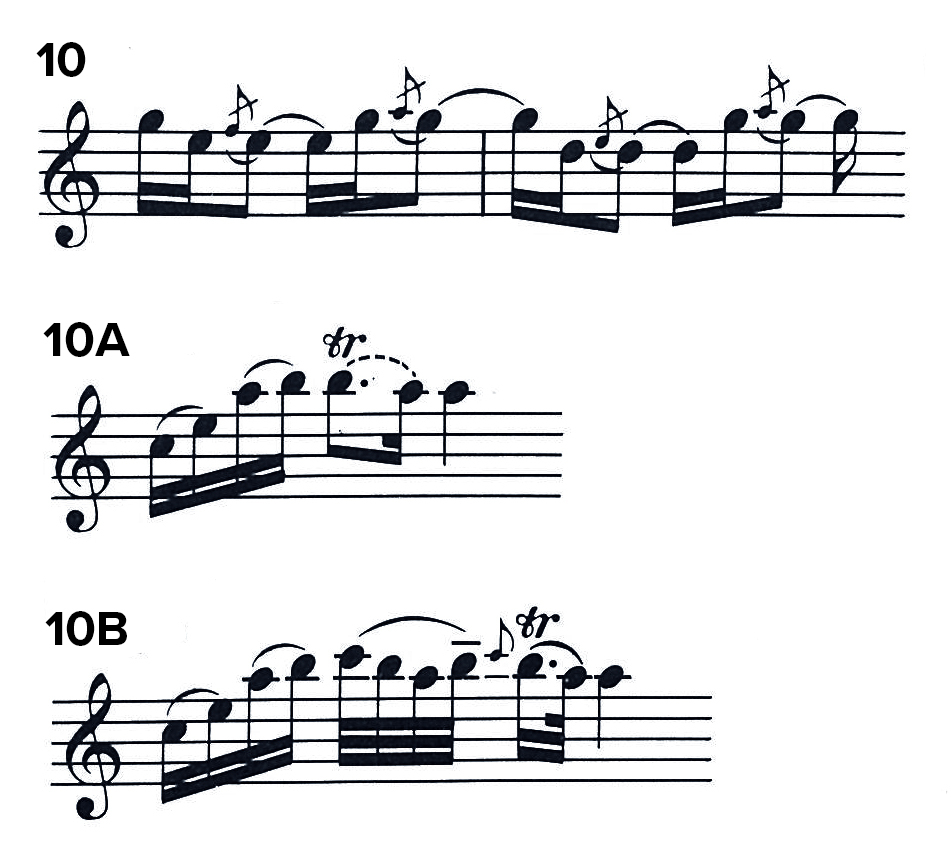
Example 10, 10A, 10B

Example 10, 10A, 10B

In the second movement, adagio, “all the notes must be, as it were, caressed and fondled, but never tongued hard, unless the composer wanted some notes to be short and detached”⁵⁵. Usually “the tender nature of the adagio is conveyed in sustained and slurred notes”⁵⁶, and it must at all costs be played “cantabile”. For this reason it was necessary to add a few slurs. In the final bars two slides can be used (Ex. 6). The penultimate note, which carries only a trill sign (Ex. 10A) can delay the trill by means of a turn or gruppetto (Ex. 10B).

Notes

³⁴ H.-P. Schmitz, op. cit., p. 17.

³⁵ H.-P. Schmitz, op. cit., p. 18.

³⁶ J. J. Quantz, op. cit., XVII, section VII, para. 19, p. 249.

³⁷ J. J. Quantz, op. cit., XVII, section VII, para. 26, p. 253.

³⁸ J. J. Quantz, op. cit. XIV, para 9, p. 140.

³⁹ J. J. Quantz, op. cit. XIV, para. 25, p. 145.

⁴⁰ Peter Ansehl’s introductory text to the record ETERNA 8 27 203 (in Japan: DEUTSCHE SCHALLPLATTEN ET-5078).

⁴¹ J. J. Quantz, op. cit., XV para. 1, p. 151.

⁴² J. J. Quantz, op. cit., XV para. 2, p. 151.

⁴³ J. J. Quantz, op. cit., XV para. 5, p. 153.

⁴⁴ J. J. Quantz, op. cit., XV para. 8, p. 154.

⁴⁵ J. J. Quantz, op. cit., XV para. 14, p. 155.

⁴⁶ J. J. Quantz, op. cit., XV para. 15, p. 156.

⁴⁷ In: G. Ph. Telemann: “Singen ist das Fundament zur Music. Eine Dokumentationssammlung”, Reclam jun. Leipzig, 1981, pp. 130ff.

⁴⁸ Ferdinand Hirsch: “Wörterbuch der Musik”, Berlin 1977.

⁴⁹ J. J. Quantz, op. cit.

⁵⁰ J. J. Quantz, op. cit.

⁵⁰ J. J. Quantz, op. cit., XVII, section VII, para. 49, p. 262.

⁵¹ J. J. Quantz, op. cit., XVII, section VII, para. 49, p. 262.

⁵² J. J. Quantz, op. cit., XVII, section VII, para. 51, p. 264.

⁵³ J. J. Quantz, op. cit., XVII, section VII, para. 51, p. 264.

⁵⁴ op. cit., part I, section III, para. 27, pp. 49ff.

⁵⁵ J. J. Quantz, op. cit., XIV, para. 13, p. 141.

⁵⁶ C. P. E. Bach, op. cit., part III, para. 5, p. 118.

Brass Bulletin 45, I / 1984 páginas 46–54

Todo el contenido está protegido por derechos de autor © Brass Bulletin 1984–2026

Compartir este artículo

Facebook LinkedIn
Cargando…

Preguntas y respuestas

Cómo funciona la edición digital

¿Qué incluye la edición digital?

La edición digital reúne los artículos ya digitalizados como textos legibles y consultables en línea —no simplemente como escaneos o archivos PDF— junto con sus ilustraciones originales, notas, autoría, información del número y traducciones disponibles. Las sugerencias de artículos relacionados incluyen actualmente solo este material digitalizado.

¿Los artículos digitales son idénticos a los originales?

Conservamos con la mayor fidelidad posible el texto original, el idioma, las ilustraciones, los pies de imagen, las notas y el contexto editorial. La presentación se adapta para facilitar la lectura en línea y pueden corregirse errores evidentes de transcripción o escaneado. El contenido y el carácter del artículo publicado permanecen inalterados.

¿Qué idiomas están disponibles?

Brass Bulletin se publicó en inglés, francés y alemán a lo largo de toda su historia. Las traducciones al italiano y al español se añadieron a partir del número 60. Por este motivo, en los sitios italiano y español los artículos de los números 1 a 59 se muestran en inglés de forma predeterminada.

¿Con qué frecuencia se añaden nuevos artículos?

Se añaden nuevos artículos casi a diario, con aproximadamente un número completo digitalizado cada semana. El ritmo puede variar según el trabajo de preparación, tratamiento de imágenes y revisión editorial necesario.

¿Por qué no están disponibles todos los artículos en formato digital?

La colección completa de Brass Bulletin contiene 1.246 artículos publicados entre 1971 y 2003. El índice completo ya está disponible en línea y permite descubrir todos los artículos de la colección, incluidos aquellos cuyo texto íntegro todavía no ha sido digitalizado.

La digitalización comenzó en febrero de 2026. Cada artículo se prepara cuidadosamente para la lectura en línea, se revisa y se vincula con su número, sus autores, sus temas y sus ilustraciones. Al ritmo actual de digitalización, se prevé que la colección completa esté disponible en línea en febrero de 2028.

¿Por qué algunas referencias mencionan artículos que todavía no están disponibles?

Las referencias de los artículos originales se conservan aunque el material al que remiten aún no haya sido digitalizado. De este modo se mantiene intacto el contexto histórico y editorial. A medida que se incorporen más números a la edición digital, un número creciente de estas referencias conducirá a artículos que podrán leerse en línea.

¿Puedo sugerir un artículo o informar de un error de transcripción?

Sí. Si hay algún artículo que le gustaría especialmente ver digitalizado, o si detecta un posible error de transcripción o algún dato que falta, póngase en contacto con nosotros. Los comentarios de los lectores nos ayudan a mejorar la edición digital y a establecer prioridades útiles dentro del archivo.

¿Cómo puedo apoyar a Brass Bulletin?

Su apoyo ayuda a financiar la preparación, verificación y publicación en línea de la colección completa.

Suscríbase a la Edición Digital

¿Prefiere apoyarnos sin suscribirse?

Haga una donación

¿Cómo avanza la digitalización?

Estamos poniendo Brass Bulletin a disposición de los lectores en línea, artículo por artículo. Pueden leer los artículos recién digitalizados en cuanto estén listos, incluso antes de que se complete un número entero.

Consulten nuestro calendario de digitalización para descubrir las últimas novedades y las fechas estimadas de disponibilidad de los próximos números. Estas estimaciones se basan en nuestro ritmo reciente y pueden cambiar.

Busca en Brass Bulletin.