Discoveries for brass players, once a month. Join our free newsletter →
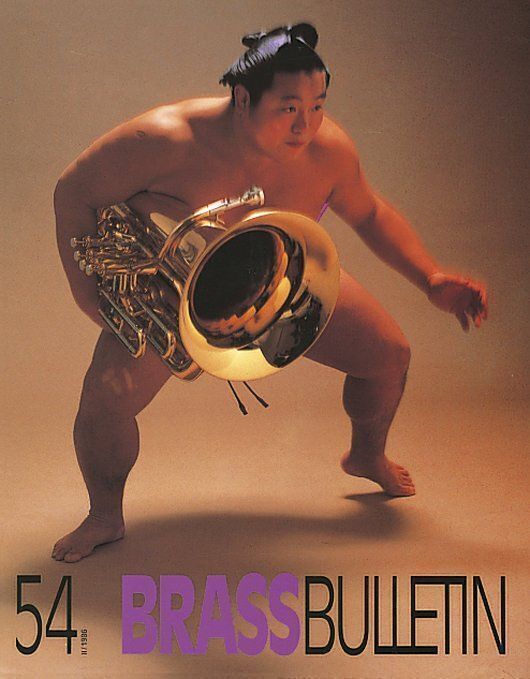
Brass Bulletin 54 - 2 / 1986
Issue
Brass Bulletin No. 54
Date
II / 1986
Pages
108
Contents
12 articles

Original inserts

World News Journal

Out of print

All issues

Brass Bulletin No. 54

II / 1986

Contents

12 articles
Free

Editorial

Jean-Pierre Mathez

pp. 3–4 Repertoire History

A wealth of Baroque music lies dormant in libraries, caught between historical instrument names, technical demands, and the competing claims of horn and trumpet players.

The Coiled Hunting Instrument by J. W. Haas

Bad Säckingen Trumpet Museum

Edward H. Tarr

pp. 8–22 Horn Trumpet History

A rare instrument made in 1688 blurs the boundary between horn and trumpet, while its maker’s mark raises an unresolved question about the Haas family.

Free
Brass Techniques Series • Part 1

The Brain

Jean-Pierre Mathez

pp. 24–27 Technique

Instrumental mastery begins beyond the instrument itself, where motivation, concentration and self-awareness shape the musician’s progress and artistic development.

Sophrology and Music

Robert Ischer

pp. 29–36 Health Technique

For brass players, physical tension and concert anxiety can become habitual obstacles, while sophrology offers a different approach to posture, memory and performance.

Free

The mute belt

Markus Stockhausen

pp. 38–45 Trumpet Equipment Technique

In Stockhausen's demanding trumpet works, six different mutes had to be changed while performing from memory, turning a practical problem into a new stage technique.

British brass players training

Thomas Aitken

pp. 48–59 Teaching Professional life

In 1980s Britain, brass bands, state schools and conservatoires offered different paths into music, while rising standards collided with shrinking budgets and uncertain careers.

Free

The Oldest Concert Band in Japan

Michio Sugihara

pp. 62–64 History

Founded in 1895 by a local banker, Ichinomiya’s municipal band survived war and changing musical traditions, preserving a remarkable chapter of Japan’s musical history.

Free

Frequency and Pitch

Benny Sluchin

pp. 66–67 Acoustics

A = 440 became the international standard only in 1939, after centuries of competing pitches that shaped orchestral practice, instrument making and musical notation.

Part 5

How and why I became a musician

Edouard Gros

pp. 69–73 Tuba Professional life

In wartime Switzerland, a military assignment, a conductor's confusion and an abandoned instrument unexpectedly changed the course of Edouard Gros's musical career.

Free
Part 8

Instrument Makers in USA

Getzen

Stephan Suter

pp. 75–78 Instrument Makers

Two devastating factory fires, rapid reconstruction and a growing export market shaped Getzen’s rise in Wisconsin, where craftsmanship met industrial ambition.

Points and areas of corrosion in brass instruments

Karl Hachenberg

pp. 99–102 Equipment Research

Red spots on brass instruments were often blamed on players and poor maintenance, yet the causes of premature corrosion may lie in manufacturing and surface treatments.

Free
Jazz and the Horn Series • Part 8

Dale Clevenger

Jeffrey Agrell

pp. 104–107 Horn Encounters

Principal horn of the Chicago Symphony Orchestra, Dale Clevenger spent his Tuesday evenings playing jazz, discovering a freedom that classical training alone could not provide.

Loading…

Questions & Answers

How the Digital Edition works

What does the Digital Edition include?

The Digital Edition brings together the articles already digitized as searchable online texts—not simply as scans or PDF files—along with their original illustrations, notes, authorship, issue information, and available translations. Related-article suggestions currently include only this digitized material.

Are the digital articles identical to the originals?

We preserve the original text, language, illustrations, captions, footnotes, and editorial context as faithfully as possible. The presentation is adapted for comfortable online reading, and obvious transcription or scanning errors may be corrected. The substance and character of the published article remain unchanged.

Which languages are available?

Brass Bulletin was published in English, French, and German throughout its history. Italian and Spanish translations were added from issue No. 60 onward.

On the Italian and Spanish sites, articles from issues 1–59 are therefore shown in English by default.

How often are new articles added?

New articles are added almost daily, with approximately one complete issue digitized each week. The pace may vary depending on the preparation, image work, and editorial checking required.

Why aren’t all articles available digitally?

The complete Brass Bulletin collection contains 1,246 articles published between 1971 and 2003. The full index is already available online, allowing readers to discover every article in the collection, including those whose complete text has not yet been digitized.

Digitization began in February 2026. Each article is carefully prepared for online reading, checked, and connected to its issue, authors, subjects, and illustrations. At the current pace of digitization, the complete collection is expected to be available online by February 2028.

Why do some references mention articles that are not available yet?

References in the original articles are preserved even when the material they point to has not yet been digitized. This keeps the historical and editorial record intact. As more issues are added to the Digital Edition, an increasing number of these references will lead to articles that can be read online.

Can I suggest an article or report a transcription error?

Yes. If there is an article you would particularly like to see digitized, or if you notice a possible transcription error or missing detail, please contact us. Reader feedback helps us improve the Digital Edition and prioritize useful connections within the archive.

How can I support Brass Bulletin?

Your support helps fund the preparation, verification, and online publication of the complete collection.

Subscribe to the Digital Edition

Prefer to support us without subscribing?

Make a donation

How is the digitization progressing?

We’re gradually making the Brass Bulletin available online, article by article. You can read newly digitized articles as soon as they’re ready, even before an entire issue is complete.

Visit our Digitization Roadmap to browse recent additions and see estimated availability for upcoming issues. These estimates follow our recent pace and may change.

Search Brass Bulletin.