Discoveries for brass players, once a month. Join our free newsletter →
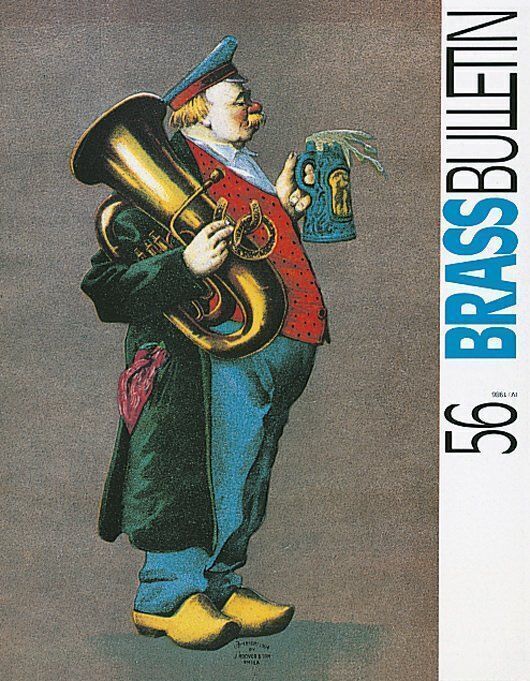
Brass Bulletin 56 - 4 / 1986
Issue
Brass Bulletin No. 56
Date
IV / 1986
Pages
108
Contents
13 articles

Original inserts

World News Journal

Out of print

All issues

Brass Bulletin No. 56

IV / 1986

Contents

13 articles
Free

Editorial

Jean-Pierre Mathez

pp. 3–6 Competition

In his 1986 editorial, Jean-Pierre Mathez announces country features and challenges brass competitions that demand musical sensitivity from exhausted performers.

ARD Music Competition in Munich in 1986

Once again trumpet, after six years

Edward H. Tarr

pp. 7–11 Trumpet Competition

At Munich’s 1986 ARD trumpet competition, Reinhold Friedrich wins second prize after four rounds assessing technical command, interpretation and artistic personality.

Brass Techniques Series • Part 3

The Ear

Jean-Pierre Mathez

pp. 12–14 Technique Acoustics

Pitch recognition, sensitivity to timbre and hearing care form the foundations of a musician’s aural development, linking how brass players listen to how they play.

Free
Part 3 – End

The Art of the Musical Instrument Maker

Encyclopédie méthodique, Paris 1795

Anonyme

pp. 15–16 History Instrument Makers

In 1795, a seashell could still belong to the history of military instruments, its origins entwined with Greek mythology, biblical tradition and ancient warfare.

Free
Part 1

Tubas in Jazz and Popular Music

Michel Laplace

pp. 18–22 Tuba History

Euphonium virtuosos, dance bands and Bill Bell’s example shape the tuba’s early history in jazz and popular music, challenging assumptions about its technical limits.

Part 2 – End

From musical wallpaper to the twelve-note row

The trombone in the chamber ensemble at the beginning of modern music (1913-1934)

Michael Struck-Schloen

pp. 24–32 Trombone Repertoire History

In interwar chamber music, Hindemith, Janáček, Berg and Webern give the trombone new roles, expanding its expressive range beyond its traditional bass function.

Free

The 1986 I.T.G. Conference

A personal view

Colin Bloch

pp. 34–38 Trumpet Report Event

Recitals, brass ensembles, student competitions and new trumpets mark the 1986 ITG gathering in London, though Colin Bloch finds too little emphasis on musicianship.

Free
Part 7 – End

How and why I became a musician

Edouard Gros

pp. 39–43 Tuba Encounters Professional life

Edouard Gros recalls wartime variety work in Geneva, intensive tuba practice and the audition that led to a secure orchestral post and 32 years in Berne.

Free

György Geiger

A Giant of a trumpeter

Balint A. Varga

pp. 44–48 Trumpet Encounters

György Geiger combines orchestral playing, brass chamber music and contemporary premieres with a solo career that brings Hungarian trumpet playing to international audiences.

Free

Yuriy Andreyevich Bol'shiyanov

A Russian Trumpeter

Anatoly Barantsev

pp. 51–53 Trumpet Encounters

In Soviet musical life, Yuriy Bol'shiyanov combined orchestral performance, chamber music and teaching, shaping generations of trumpeters at the Leningrad Conservatoire.

Part 1

Did Bach write the "corne da caccia" part in the B minor Mass for Gottfried Reiche?

Peter Damm

pp. 61–73 Horn History Repertoire

The Quoniam, only movement with horn in Bach’s B minor Mass, lies at the heart of a historical debate over whether its part was written for trumpeter Gottfried Reiche.

Part 1

Trombone and Organ — a Dialog

Klaus Winkler

pp. 75–89 Trombone Repertoire

Since the 1970s, the trombone and organ have inspired a new repertoire in which medieval traditions, sacred music and modern composition meet in unexpected ways.

Free
Part 10 – End

Instrument Makers in USA

E.K. Blessing Co. Inc

Stephan Suter

pp. 105–107 Instrument Makers

In Elkhart, Indiana, Merle Johnson built on E.K. Blessing’s legacy, balancing traditional instrument manufacturing with innovation, craftsmanship and customer service.

Loading…

Questions & Answers

How the Digital Edition works

What does the Digital Edition include?

The Digital Edition brings together the articles already digitized as searchable online texts—not simply as scans or PDF files—along with their original illustrations, notes, authorship, issue information, and available translations. Related-article suggestions currently include only this digitized material.

Are the digital articles identical to the originals?

We preserve the original text, language, illustrations, captions, footnotes, and editorial context as faithfully as possible. The presentation is adapted for comfortable online reading, and obvious transcription or scanning errors may be corrected. The substance and character of the published article remain unchanged.

Which languages are available?

Brass Bulletin was published in English, French, and German throughout its history. Italian and Spanish translations were added from issue No. 60 onward.

On the Italian and Spanish sites, articles from issues 1–59 are therefore shown in English by default.

How often are new articles added?

New articles are added almost daily, with approximately one complete issue digitized each week. The pace may vary depending on the preparation, image work, and editorial checking required.

Why aren’t all articles available digitally?

The complete Brass Bulletin collection contains 1,246 articles published between 1971 and 2003. The full index is already available online, allowing readers to discover every article in the collection, including those whose complete text has not yet been digitized.

Digitization began in February 2026. Each article is carefully prepared for online reading, checked, and connected to its issue, authors, subjects, and illustrations. At the current pace of digitization, the complete collection is expected to be available online by February 2028.

Why do some references mention articles that are not available yet?

References in the original articles are preserved even when the material they point to has not yet been digitized. This keeps the historical and editorial record intact. As more issues are added to the Digital Edition, an increasing number of these references will lead to articles that can be read online.

Can I suggest an article or report a transcription error?

Yes. If there is an article you would particularly like to see digitized, or if you notice a possible transcription error or missing detail, please contact us. Reader feedback helps us improve the Digital Edition and prioritize useful connections within the archive.

How can I support Brass Bulletin?

Your support helps fund the preparation, verification, and online publication of the complete collection.

Subscribe to the Digital Edition

Prefer to support us without subscribing?

Make a donation

How is the digitization progressing?

We’re gradually making the Brass Bulletin available online, article by article. You can read newly digitized articles as soon as they’re ready, even before an entire issue is complete.

Visit our Digitization Roadmap to browse recent additions and see estimated availability for upcoming issues. These estimates follow our recent pace and may change.

Search Brass Bulletin.