9 min. read
This article is for subscribers.
Horns and Huntmen's trumpets
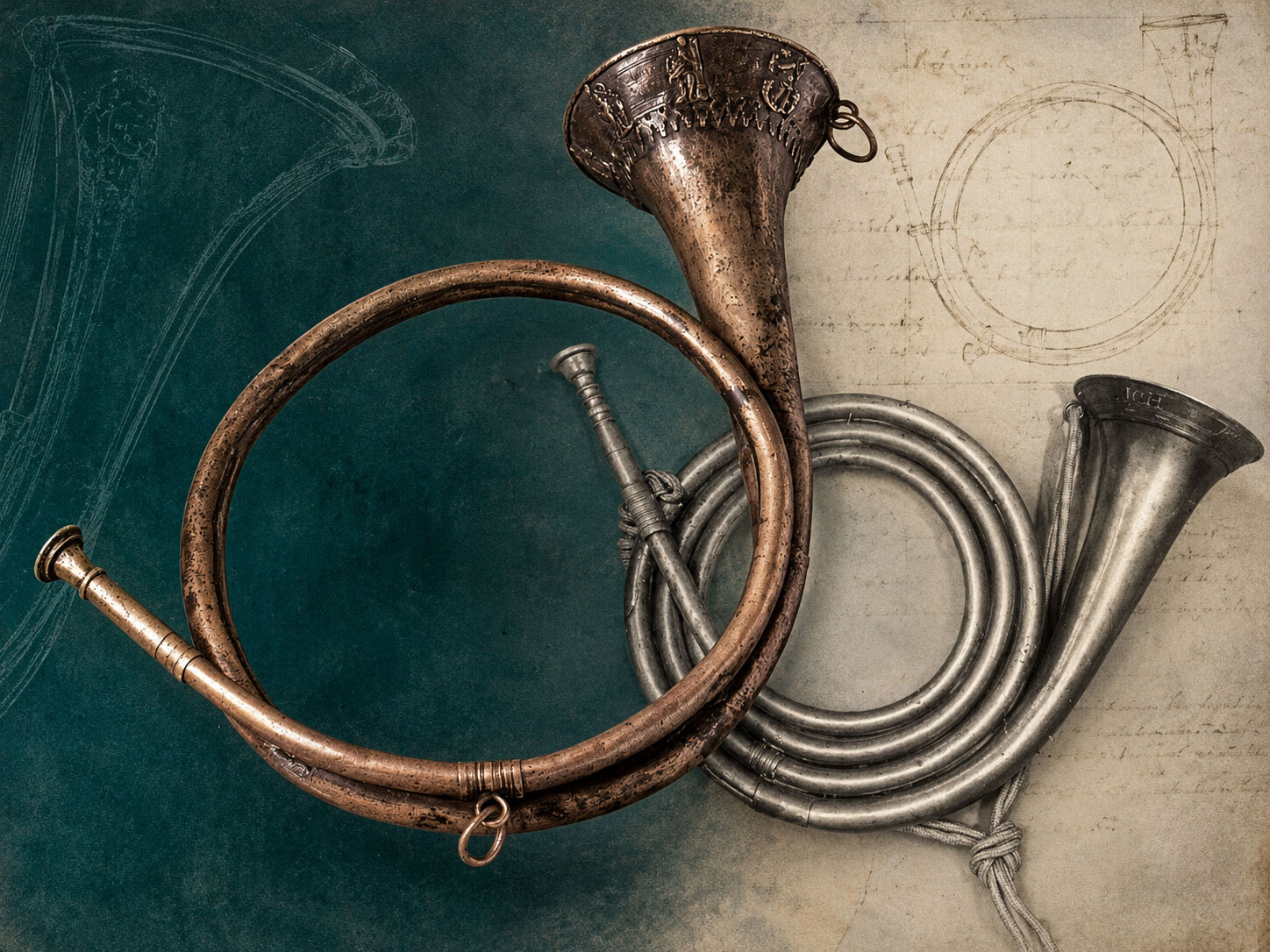
Distinguishing a horn from a trumpet sounds easier at first than it often is in practice.
It is easy to say that a horn is conical and above all has a conical mouthpipe, whereas a trumpet has a predominantly cylindrical bore; but that is a simple formula, one which is largely true, but not always and not in every case.
Horn and trumpet differ more than just in the scaling of the first part of the tube. There is the modern valve trumpet, for example, the mouthpipe of which is normally approximately conical; there is the old Handelian trumpet of Köhler + Sons in London, which in bore largely resembles John Bayley’s Improved Acoustic Cornet (1862); there is the jazz trumpet with its conical mouthpipe; and the mediaeval straight trumpet, which is normally completely conical. Since slightly conical mouthpipes occur even in 18th century long trumpets, it is no surprise that in the early days of the valve trumpet conical mouthpipes were built — by Griesling + Schlott in Berlin, for example — so that one is rather tempted to describe them as cornets. I state these observations now in order to show that, when classifying horns and trumpets, one must also consider their place in the overall sound picture, their social character, their musical traditions, their musical function, their mouthpiece and even their external form. To move on to horns: it was not only in the 19th and 20th centuries that horns and parforce horns with cylindrical bore and trumpet or cornet-style mouthpieces were made by some firms; as early as the 18th century there were horns in which the first part of the tube was cylindrical and which had trumpet-style mouthpieces, including two horns by Friedrich Ehe (Ill. 1), two by Georg Friedrich Steinmetz (Ill. 2) and one by Wilhelm Martin Müller from 1779 (Musikinstrumentenmuseum, Berlin, lost during the war). Trombones were also made with trumpet bells, and indeed trumpets with bells which would be suitable for a trombone or a horn, seen purely from the point of view of sizes.
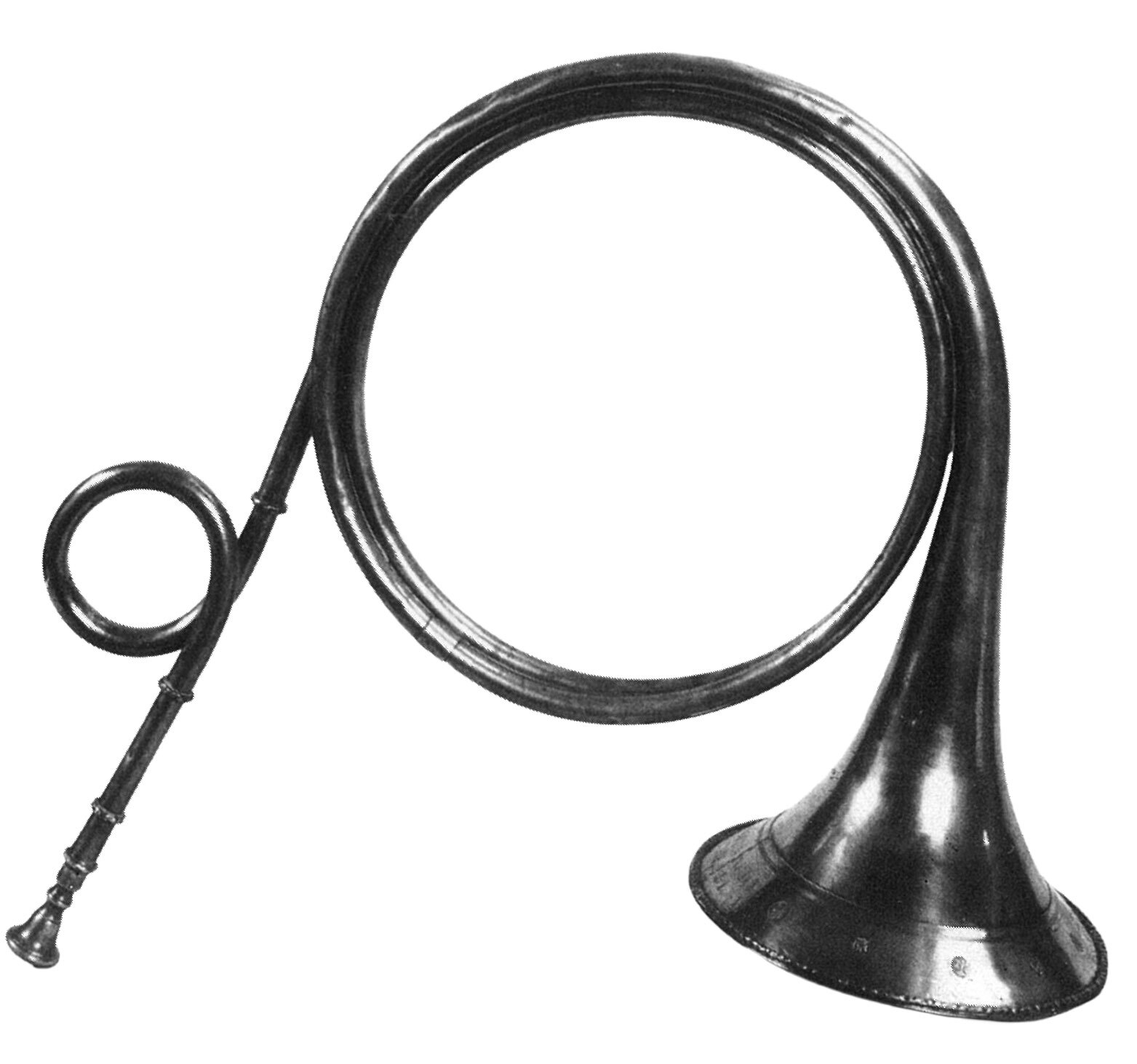
Illustration 1
Jagd-Waldhorn in D alto by Friedrich Ehe (became a master instrument maker in 1697, died in 1743). Cylindrical mouthpipe (internal diameter 10.5mm-11mm), bell diameter 175mm, coil diameter 24cm.
Salzburg, Carolino Augusteum.
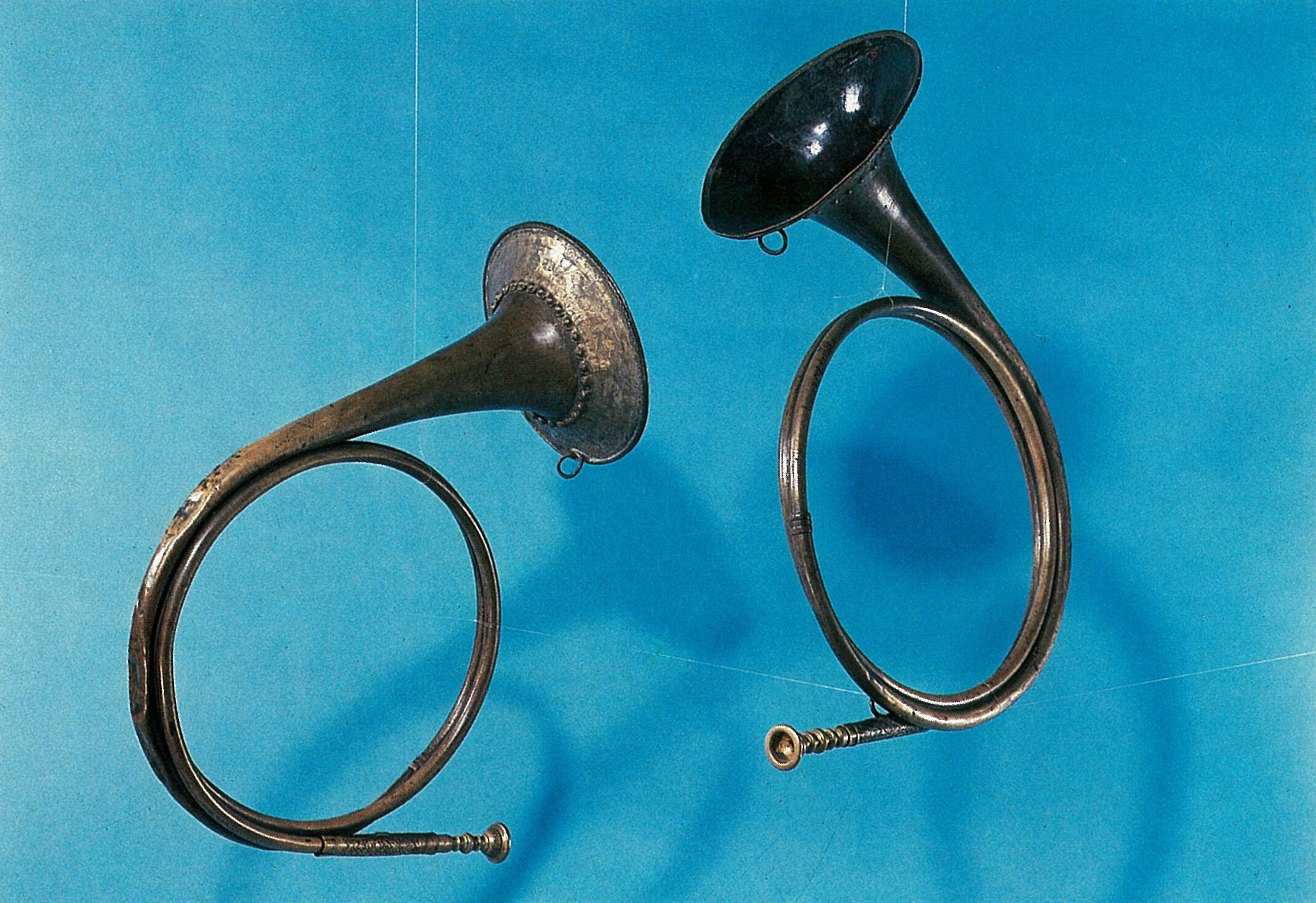
Illustration 2
Jagd-Waldhorn in D alto by Georg Friedrich Steinmetz (Master instrument maker 1694, died 1740) in Nürnberg. Cylindrical mouthpipe with an almost trumpet-like bore of 9.6mm, bell diameter 176mm.
West Berlin, State Institute for Musical Research of the Preussischer Kulturbesitz, Musical Instrument Museum.
Transitional and mixed forms
The 18th century also shows transitional and mixed forms in the area of Jägertrompeten and alto horns. These cases, ”ambiguous” on grounds of scaling, cause much puzzlement nowadays because, from our modern point of view, we like to find a clear, unambiguous, logically unimpeachable classification and an either-or answer for everything. But — we must not try to be more exact then people were in the past.
What were the major developments in the history of the circularly coiled horn between 1600 and 1800? What were the main types? It is difficult to pick out the basic types from among the almost endless variety of shapes¹. Let us deal first with the small, simple single-coiled instruments (type A), sometimes narrow, sometimes wide, with a conical or flared bell section. Perhaps the finest examples of these are the Thurn and Taxis posthorns, on which some postilions played modest calls with fundamental and octave until the 19th century.
In the 16th and 17th century four and five-coiled horns, of the same tube length and pitch as the long trumpets and therefore pitched from C alto to G alto, were of some significance (type B). The oldest known horn of this type is probably that built in Dresden around 1570 by Valten Springer (Ill. 3).
This article is for subscribers.
CHF 5.00 per month · Cancel auto-renewal anytime.
Enjoy unlimited access to all digitized Brass Bulletin articles.
Brass Bulletin 55, III / 1986 pages 42–56
All content is protected by copyright © Brass Bulletin 1986–2026