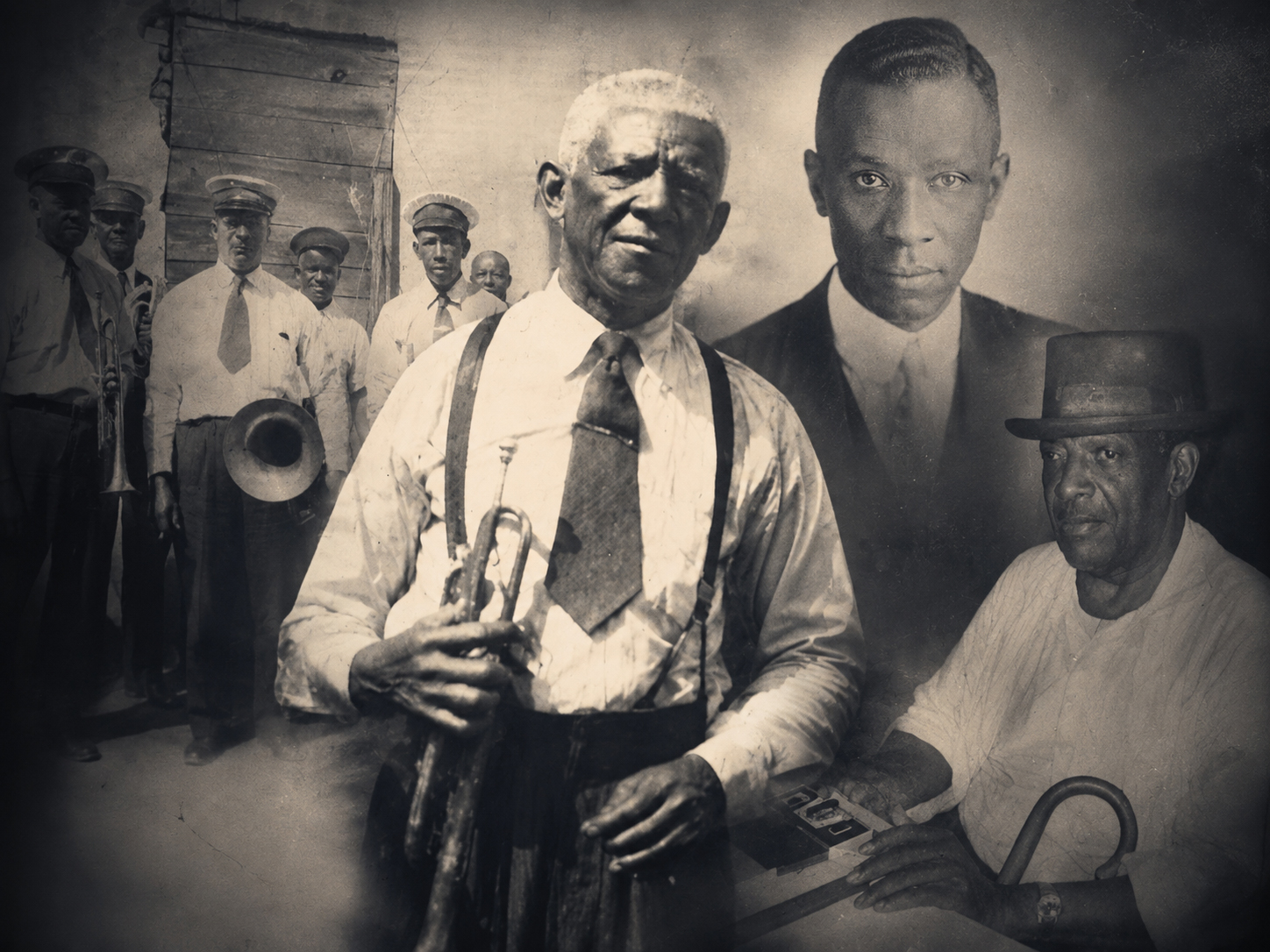

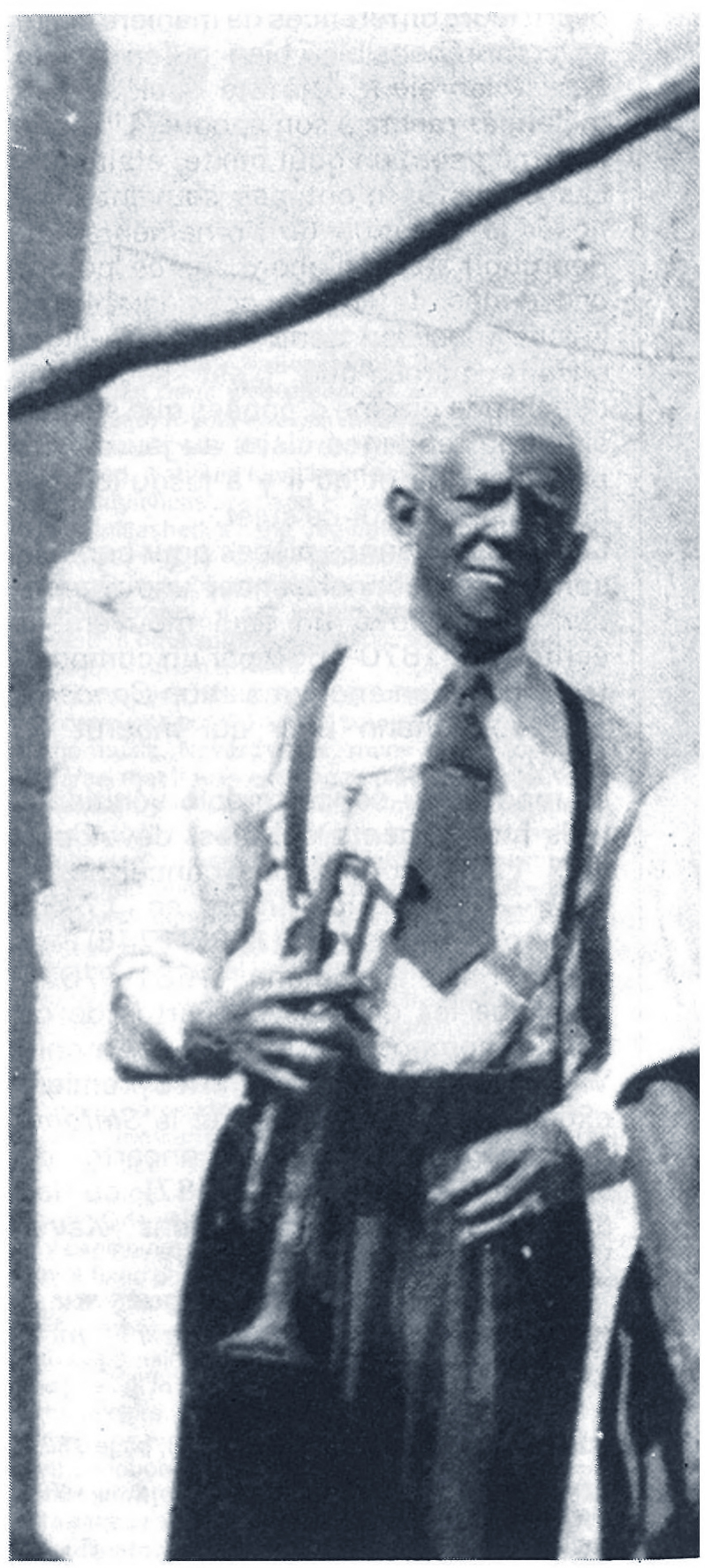
Bunk Johnson
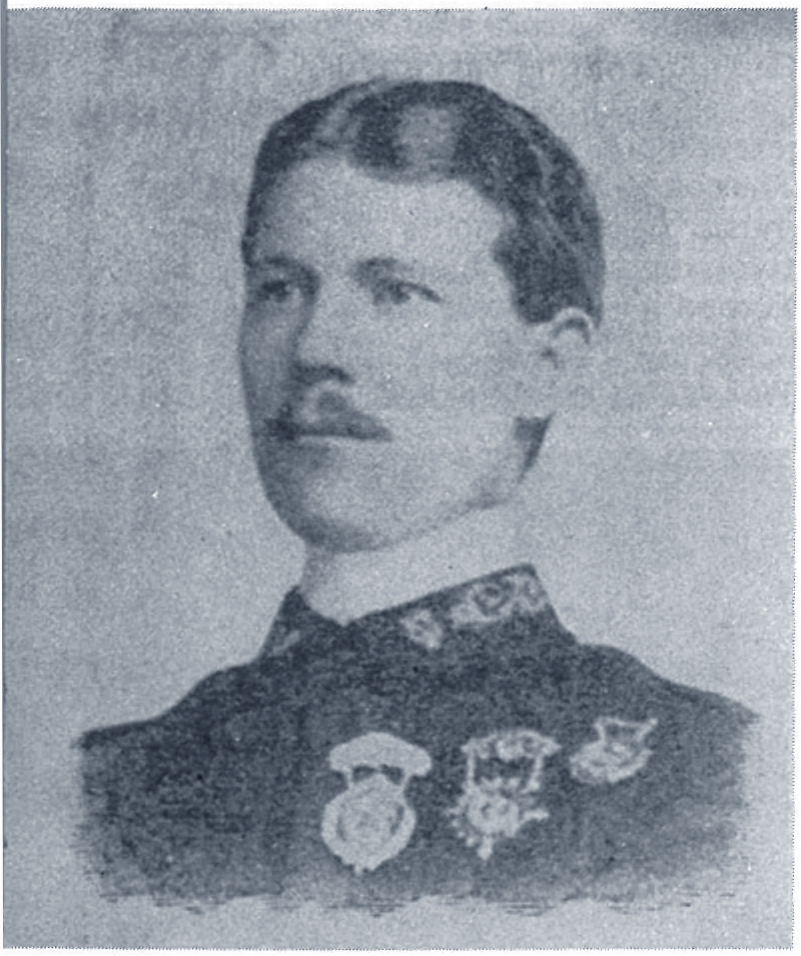
Arthur W. Pryor, trombone and bandleader in ca. 1898. Ragtime pioneer.
(Courtesy of Ward Hodge)
In the 19th century New Orleans, like everywhere else, had its dance halls, which resounded with the rhythms of mazurka and polka, waltz and schottische. The musical influences were just as diverse as everything else, ranging from British songs and ballads (“Derbyshire Ram” was to reappear as “Oh, didn’t he ramble”, a familiar number in the black’s brass bands) to African rhythmic influences. The local musicians’ innovation was to lie in finding a suitable common denominator to all these musical strands and in constructing the basis of a style on rhythms originally intended for dancing. Indeed it seems to be no longer a question of a manner of playing (style) than of a specific form of music (hence the difficulty of teaching it beyond a few rules or “recipes”).
Jazz was born at a time when the difference between the trumpet and the cornet was clear. The tone-colours were quite distinct, with greater agility on the cornet. This accounted for its having been the fashionable instrument in concert circles ever since Arban. The cornet was used by the virtuosos who recorded the first ragtimes — the same people who excelled in polkas, airs variés etc.
The blacks were to opt for the cornet during the early period because, in addition to the teaching they had received, notably from the Creoles, they, like everyone else, were to follow the fashion of what they heard. In New Orleans the West End establishment on Lake Pontchartrain accepted Alessandro Liberati (1883) and the Knoll and McNeil duo (1883). The town also accepted Alfred Weldon (summer of 1900) and Bert Brown in T.P. Brooke’s band (1901). These artists, passing through, were probably noticed by the Creoles like Andrew Kimball (Lyric Theater 1913-1925) and George Moret (Bloom Philharmonic around 1903, Excelsior Brass 1904-1921). Many of the pioneers of New Orleans jazz, who recorded their music (and therefore their culture) between 1917 and 1947, were born between 1880 and 1920: Bunk Johnson (1879), Oscar “Papa” Celestin (1884), Joe “King” Oliver (1885), Freddy Keppard and Nick La Rocca (1889), Papa Mutt Carey (1891), Punch Miller (1894), Louis Armstrong and Tommy Ladnier (1900), Lee Collins (1901), Red Allen (1908) etc.
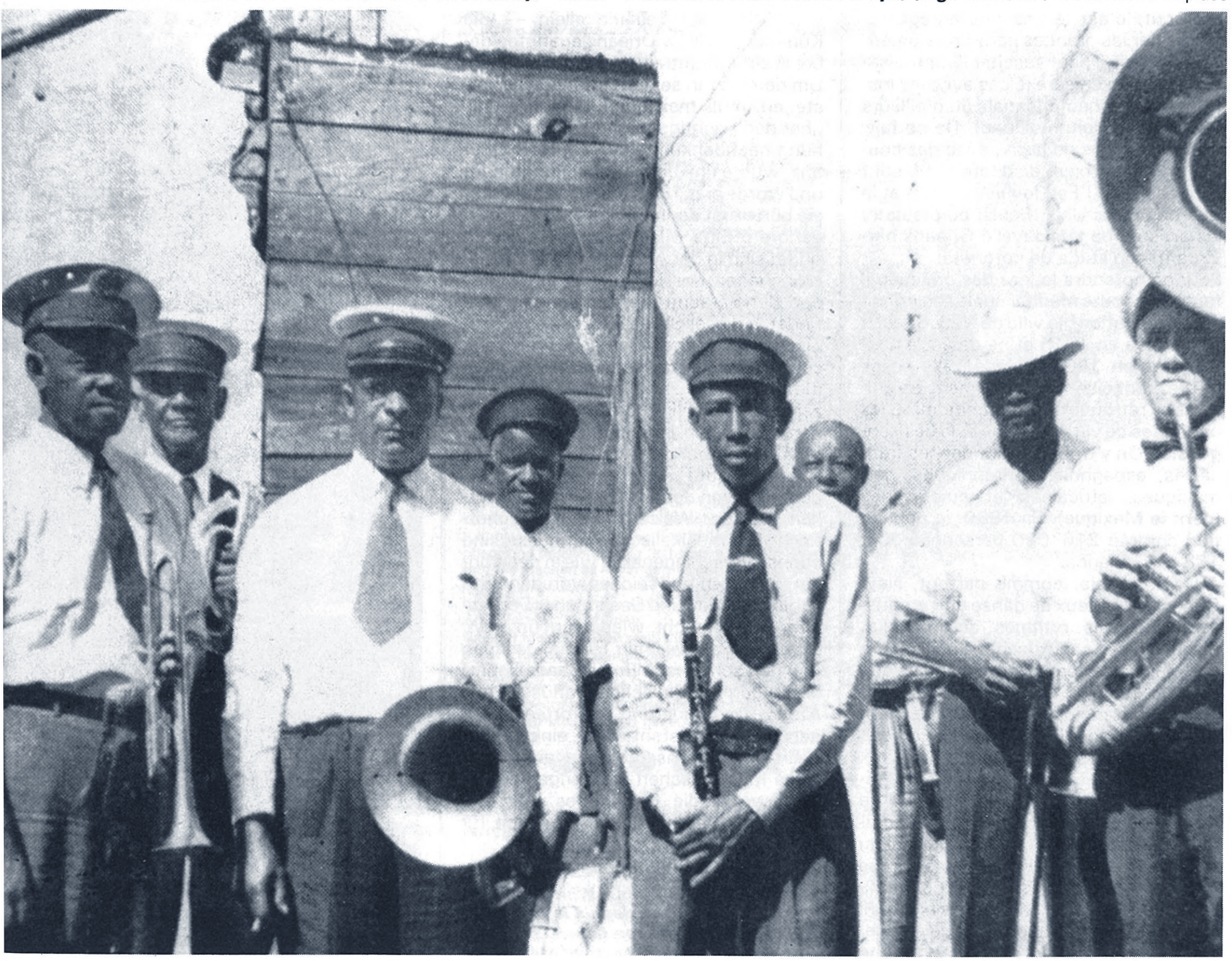
Bunk's Brass Band — New Orleans 1945 (May). "Bunk" Johnson & Louis Madison (trumpets) (left)
Before going on to consider the main periods of jazz in greater detail, we must just recall the “parameters” of the popularisation of syncopated music. One element which determined the world-wide appearance of “rhythm orchestras” (a phenomenon often wrongly linked to the history of jazz) is that in 1910-1911 publishers who had previously been restricted to piano or vocal scores started to circulate orchestral arrangements. The term “fox-trot” widely employed by them first appeared in the United States around 1912. Thus the music first spread throughout the world in the form of written scores (which produced some curious results since the essential element was missing: style) and later in the form of recordings. Eventually the high point was reached through radio, which was still in the research stage in the teens of this century but which by 1930 had place in more than 12 million homes. It was then possible for a trumpet soloist to become as popular as a singer.
Elsewhere² we have noted the part played in the popularity of cornet virtuosos by the first Berliner, Edison, Columbia and Victor recordings. We might add that the acoustic system survived until 1924 and that at the end of May 1925 the Columbia Phonograph Company started recording with microphones and an electrical amplification system, which would reproduce rather better the sound of the great cornet and trumpet players of the past, beginning with Louis Armstrong who burst on the scene in 1925. He makes it possible for us to divide the history of jazz up into “pre-, during and post-Armstrong” periods.
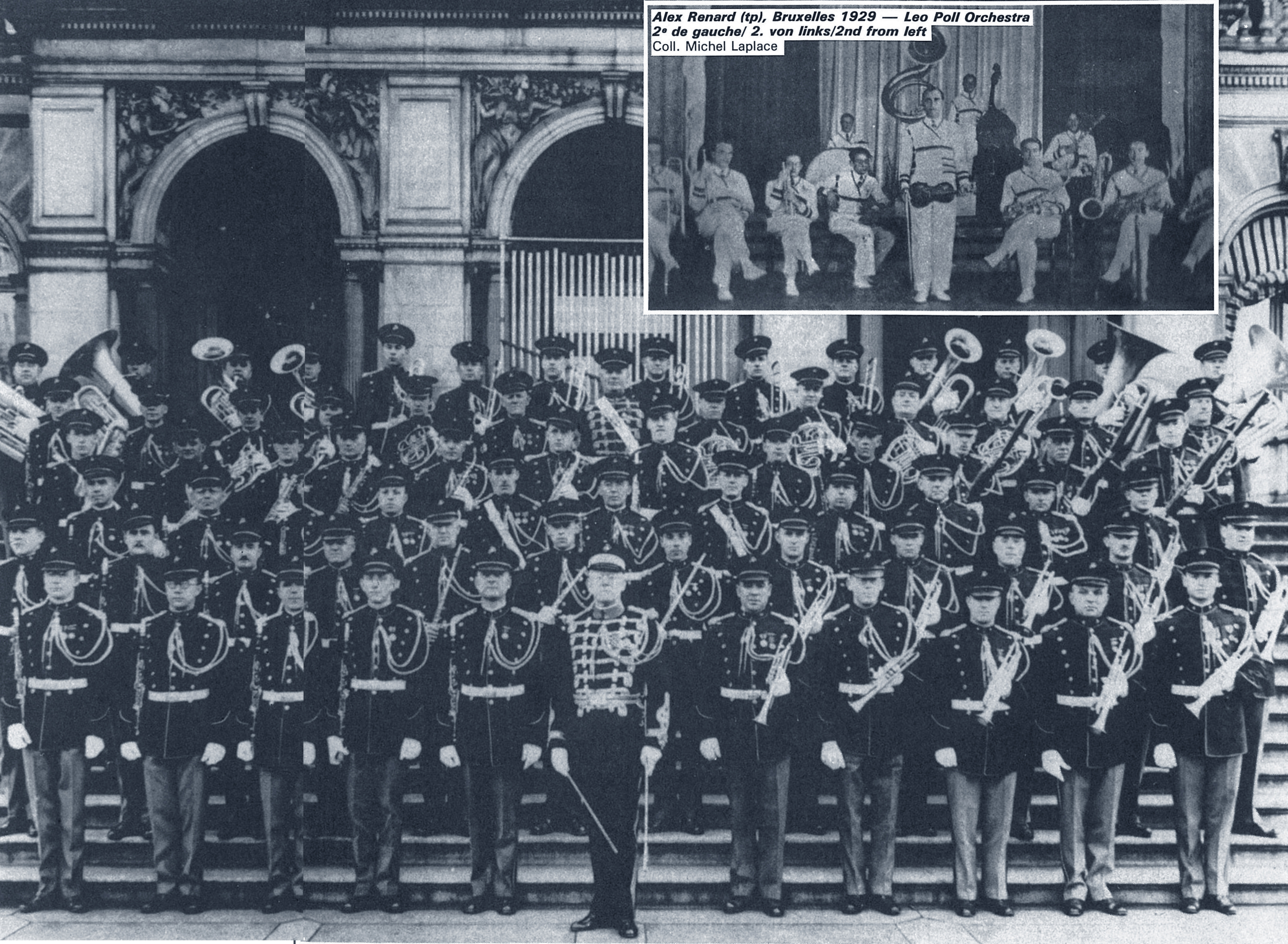
U.S. Marine Corps Band — Washington, March 15, 1929 Arthur Whitcomb (1st row, 1st cornet from left)
The Early Period 1900-1927 (Pre-Armstrong)
Jazz (a pejorative name coined by the whites around 1917) overtook ragtime in the twenties. In the 19th century New Orleans was two towns: one American, west of Canal Street (“uptown”), the other French, to the east (“downtown”). The Creoles studied with the musicians of the French Opera House (downtown). As everywhere else in the United States, brass bands were very popular but here the numbers in each band were smaller, which made it possible for them to play in large halls for dances. There were generally three cornets, two trombones, an alto and tenor horn (tenor and baritone British style), a tuba, one or two clarinets, a snare drum and a bass drum. The names from these years, 1890-1900, are part of legend: the Onward Brass Band of Professor Lainez, the Excelsior Brass Band of Professor T.V. Baquet — Creole bands directed by cornet players. The New Orleans downtown brass bands made no records but their repertoire of ragtimes played by trained Creoles gives us reason to suppose that their sound was similar to that of bands in other states, notably those which recorded for Victor, Columbia, Edison etc., of which we include here a select discography.
There we find the trombone glissandos (“tailgate style”) which were to be used in New Orleans jazz (sometimes caricatured in the Dixieland by-products): “Trombone Sneeze”, “That Rag”, “Slippery Place Rag”, “The Moaning Trombone”. All the line-ups are good, led by good first cornets (nice sounds from Whitcomb and Buono, good technique from Keneke in “Wild Cherries Rag”, coarser sounds from Sousa in “Trombone Sneeze”). On the evidence available these sound like groups with reduced forces, by comparison with the concert bands, and thus closer to the New Orleans brass bands. These are dancing melodies (“Crazy Bone Rag”) and there are no high-register problems. Note the Charleston prelude in slower time in “Maori”. Alongside growl effects (“Memphis Blues”, 1919) we find evidence of training (a fine, tongued solo in “Darktown Strutter’s Ball”, 1919, a rare recording of this type with a solo). The percussion is very much in evidence and was to have a great influence on the first essays in jazz (“Darktown Strutter’s Ball”, 1917). By way of comparison a small group, the Jaudas Society Orchestra, allows us to imagine what the small ragtime groups in New Orleans and elsewhere must have been like: the cornet has a pure sound, a clean attack and a firm “square” style.
Uptown New Orleans was to give us Buddy Bolden, the legendary bandleader and cornet player who was at his peak in 1894-1895. Bolden (1868-1931) is considered one of the inventors of jazz. Among the well known artists who played with him was Bunk Johnson (1879-1949). Bolden remains a mystery (some historians believe there were two musicians of this name!) as does the cylinder, which has never been found, which, according to information (imagined?) supplied by musicians who worked for him, he is supposed to have made. We should remember that some cylinders reproduced and recorded.³ In place of a recording Bolden left a photograph of his orchestra. This band’s signature tune was “If You Don’t Shake” the melody of which, as far as trumpet players Charlie Love and Hyppolite Charles can recall, is as follows:
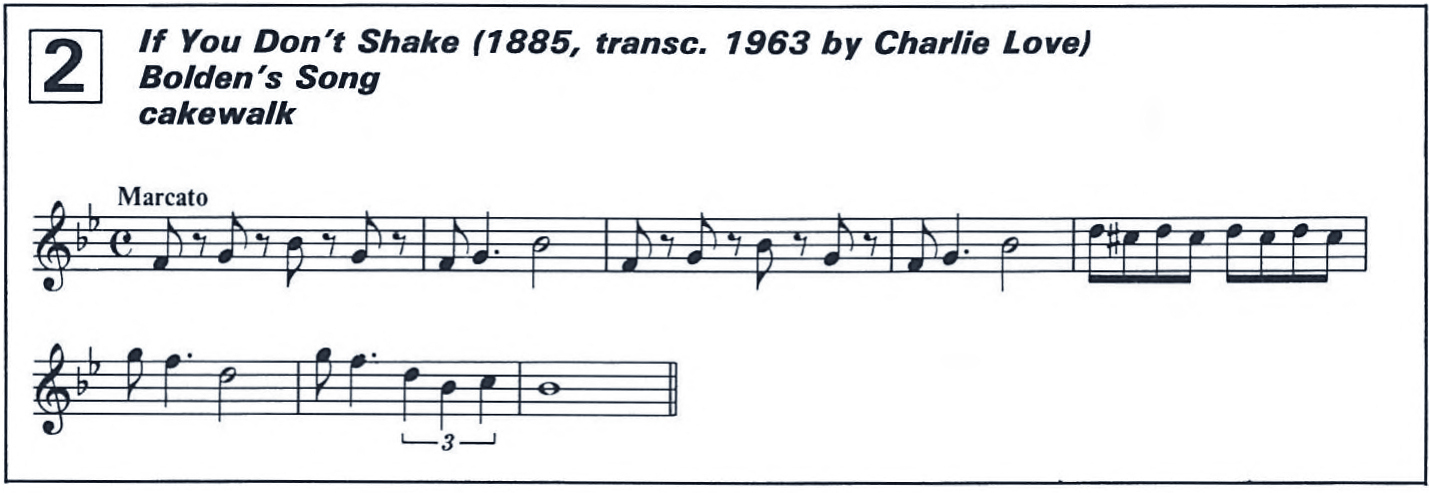
Example 2
Bunk Johnson recorded several takes of Pallet on the Floor in the style of Bolden in San Francisco in 1943 (issued in Japan: Dan VC-4020). Johnson is one of the earliest New Orleans trumpet players to have left a lot of records. He has left no accounts, on the other hand, of the feats of his youth, which survive only in various writings (Armstrong’s recollections etc.). It was historians who got him to start a new career in 1942, at an advanced age and after years away from playing.⁴ His West Coast performances of 1944, however, still allow us to imagine what Bunk must have been: “Spicy Advice” is played with authority and a typical New Orleans flavour in its sound. On this evidence Bunk hardly swings at all and his rigid phrasing is suited to ragtime (he dedicated a set of recordings to Scott Joplin at a Columbia session in 1947). Apart from Bunk the first stylists seem to have been Manuel Perez and Pete Bocage. Manuel Perez recorded some 78s under the direction of the violinist Charles Elgar in Chicago in 1926; in them he shows up as an excellent instrumentalist with a warm, round sound in the Creole manner and without any marked characteristics (unlike F. Keppard and N. Dominique for example). Perez built his big reputation earlier, however, in the teens of this century in New Orleans. The Creole Pete Bocage has left us some 78s cut in 1923 and 1924 with the orchestra of the violinist Armand Piron. This New Orleans band went to New York and at one session Bocage had an opportunity to hear the white trumpet player Phil Napoleon whom he greatly admired. Indeed these two artists share the same concern with good sound. A comparison on disc of the Original Dixieland Jazz Band (ODJB) and the Piron band shows that things scarcely changed between the two. The ODJB is scarcely any different from ragtime and La Rocca’s sound remains quite classical despite a few growl effects in “Darktown Strutter’s Ball” (1917). Six years later we find the idea of ragtime and collective expression with Piron: Bocage gives a firm “square” lead. The discriminating ear will pick up a characteristic New Orleans jazz beat in Bocage’s phrasing, however, (note on coda “dirtier” than the rest in “Bouncing Around”) and the saxophone vibratos give an ensemble sound which is less classical. The New Orleans revival craze rediscovered Pete Bocage in 1954.
Unfortunately the recordings from his second career show a musician betrayed by old age — shortage of breath limits him to a very refined style. These three artists with the “clean phrasing” (without lacking punch as far as Bunk is concerned) contrasts with the “mean” playing of blues men like Buddy Petit, Kid Rena and Chris Kelly (only Rena has left records, made in 1940; by then, unfortunately, he had lost his physical, and thus his instrumental stamina). These cornet players played in small groups for dancing and paraded through the streets as part of a band on various occasions. In 1952 Harry Smith collected for Folkways a notated manuscript of Louis Dumaine, a non-improvising trumpet player who played second in Chris Kelly’s band (this artist’s last engagements):
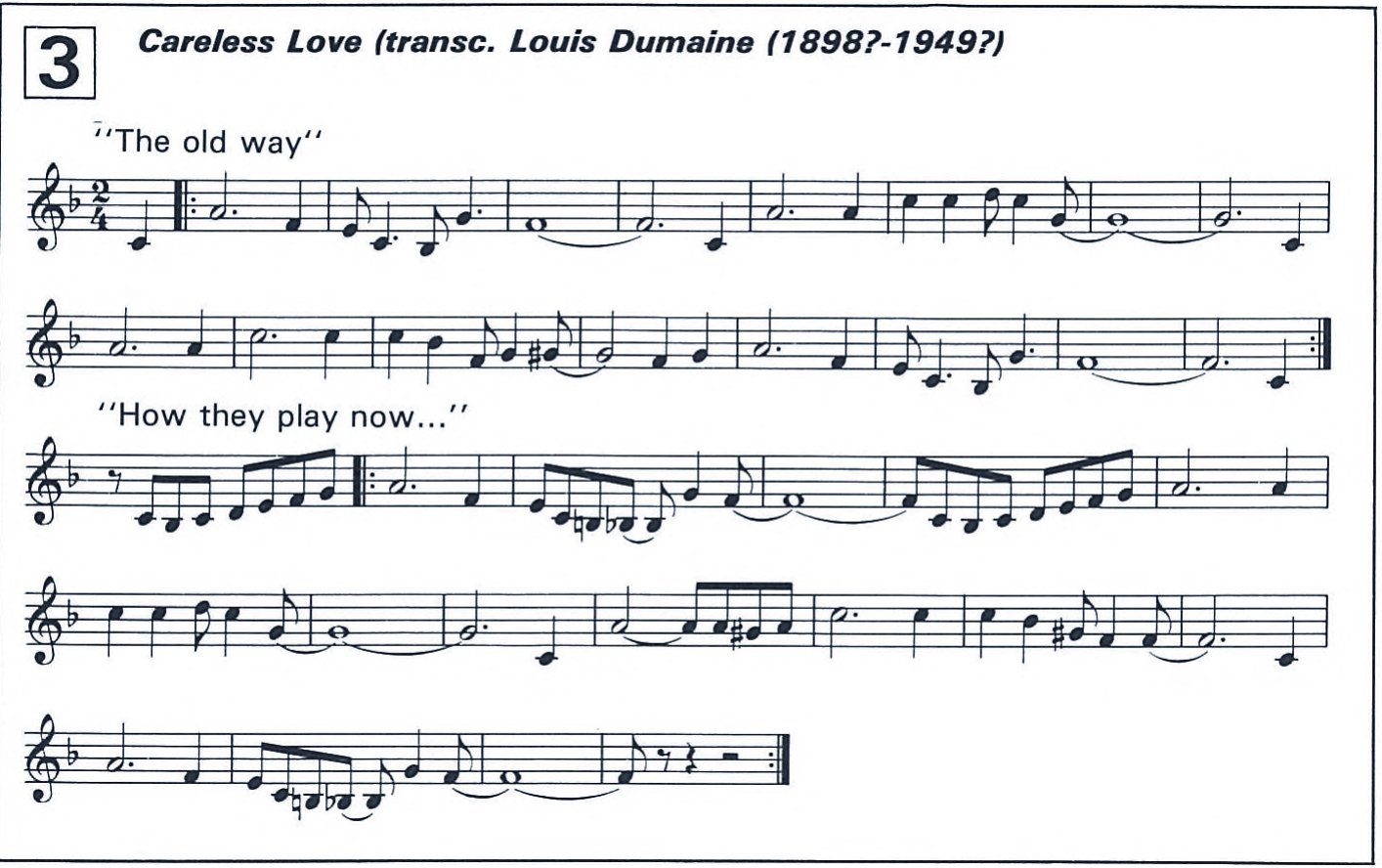
Example 3
This suggests that Kelly’s style was influenced by the blacks’ singing style. He is said to have made expert use of the plunger mute, an art which was to inspire Cootie Williams (a good Ellingtonian).
The late teens of the century also saw the first migrations of musicians from New Orleans. Those who moved included whites like Nick La Rocca, who was partly responsible for a “Dixieland school” which produced the sturdy players Sharkey Bonano and Léon Prima (whose brother Louis became a well known entertainer in the US), the respected technician Henry Knecht and the stylist Paul Mares (1900-1943) who won appreciation in Chicago, recording with the New Orleans Rhythm Kings from 1922 onwards. Blacks moved out too, notably Freddy Keppard, King Oliver, Mutt Carey, Tommy Ladnier and Louis Armstrong. In Chicago and, for some, on the west coast, they spread a style which reached great perfection after 1922. It was the recordings of King Oliver (1885-1938), made in 1923, that proved for the first time that “swing” was not simply a synonym for syncopation. This band enjoyed unprecedented success, due mainly to the fabulous cornet duo of King Oliver and Louis Armstrong, a strong leader and an inventive genius in playing breaks who took cornet virtuosity to new and prolific heights. Black and white brass players took every opportunity to listen to these two masters. King Oliver is certainly one of the most important representatives of the New-Orleans-style cornet (and trumpet, around 1929). A ballad player like few other instrumentalists of the time, his “I’m Not Worrying” is a model of the genre (wrongly attributed in discographies to other players). The art of the south is present in Oliver who plays here with plenty of sound and a marked vibrato. He was also a master of the use of mutes (wa-wa and straight) and of counterpoint, both of which can be heard in recordings like Tell Me Woman Blues (November 1928 with Texas Alexander) and “What Makes Me Love You So?” (December 1929 with Eva Taylor). This last performance shows off to good effect King’s clean, percussive attack, as does “Too Late” (master: BVE 56758-2), recorded in October 1929 with his own orchestra. Some say King’s concern for instrumental perfection led him to write out some of his solos for recording; this must be the case with his muted entry, paraphrasing the tuba, in “What Do You Want Me To Do?” (master: BVE 56756-1, October 1929):
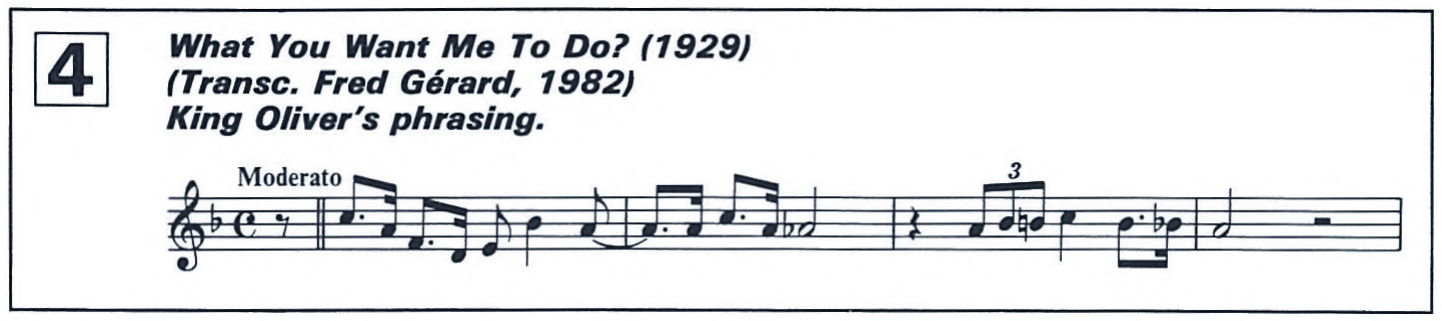
Example 4
The trombonist Clyde Bernhardt revealed that Oliver did not like fast tempos⁵, which probably accounts for his decline with the advent of swing in the thirties. He died in oblivion and poverty. A similar fate was in store for his best pupil (apart from Armstrong), the cornet player and later trumpet player Eddie Allen (1897-1974). In Allen and Joe Smith we have the first black cornet players to come from outside the Crescent City (New Orleans) and achieve fame. Eddie Allen lived in St. Louis from 1904 onwards; despite spending his formative years in the town where Scott Joplin reigned, Allen was more of a blues man than a disciple of rag (although he did come into contact with rag alongside Oliver as a sideman of Clarence Williams: “Wildflower Rag”, Paramount 12839, recorded in 1928). He made remarkable use of the wa-wa mute; his recordings made with the Washboard Band led by Clarence Williams in 1929 and 1937 will be remembered for his sobre style.
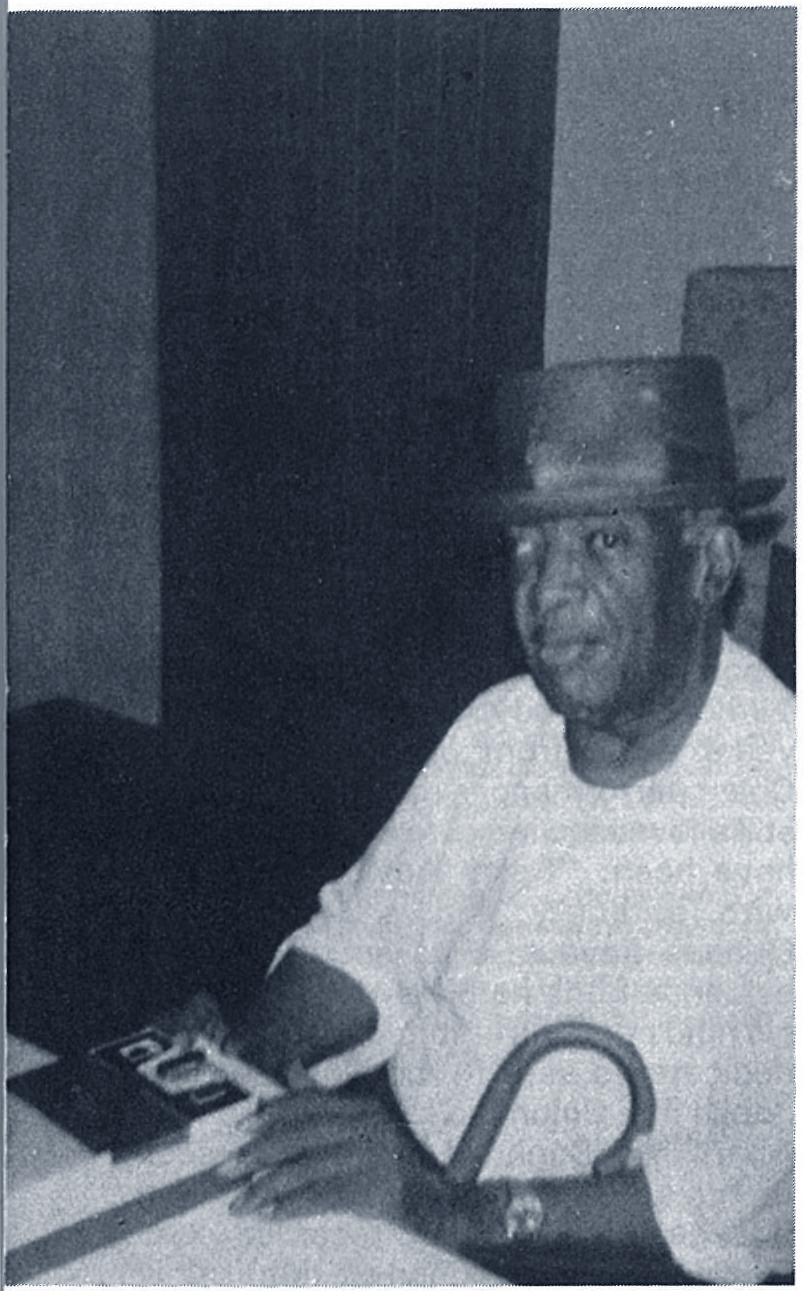
“Eddie” Allen at home (Aug. 1973) Coll. Michel Laplace
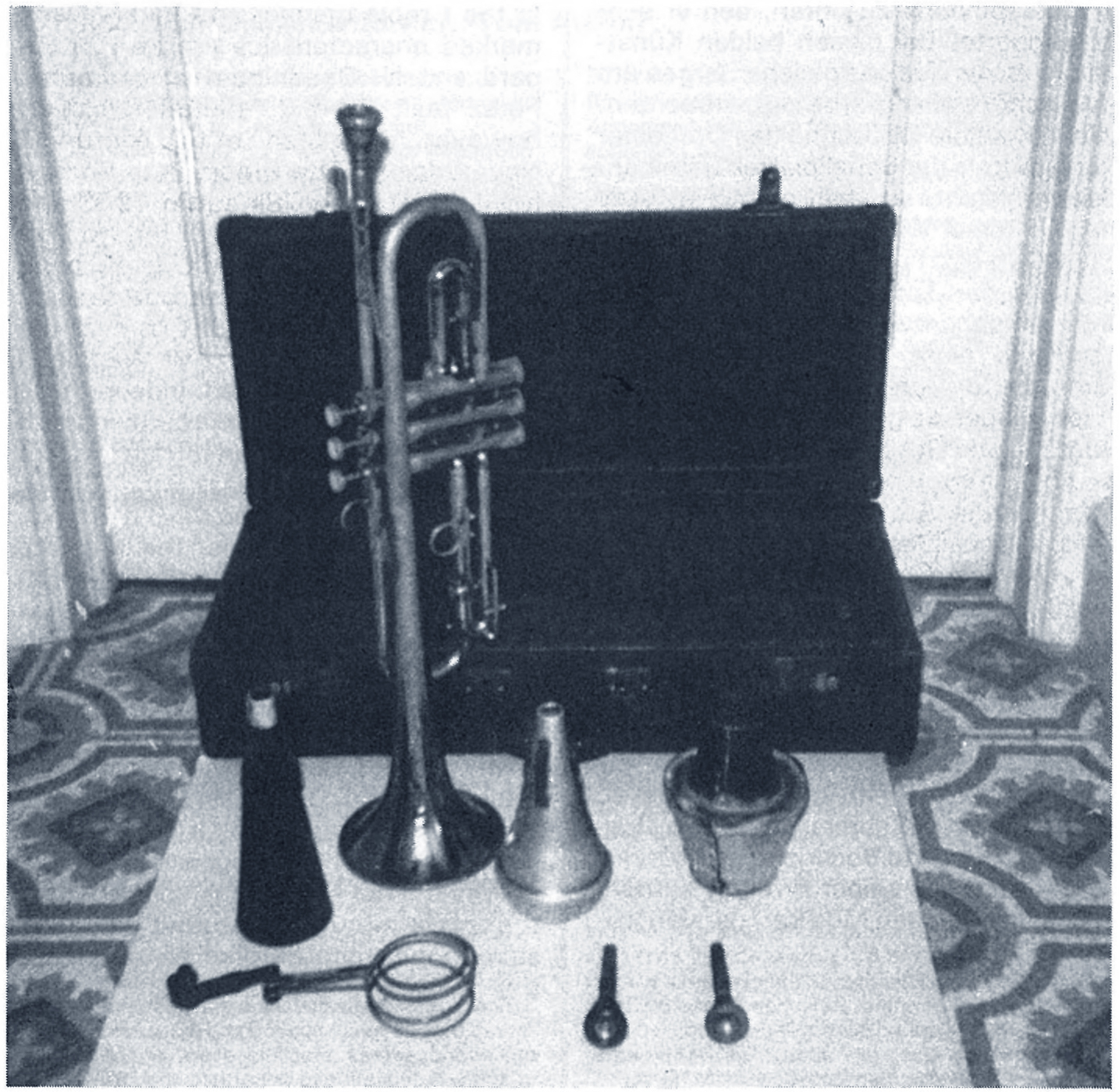
“Eddie” Allen equipment in 1950: Martin tp, J. Parduba mouthpiece, 2 straight mutes, 1 bowl mute, 1 Bach 7CW and 1 Rudy Muck mouthpieces Coll. Michel Laplace
Joe Smith (1902-1937), with his smooth sound, had, along with Armstrong, a great influence on black trumpet players as well as great popular success in his own time (he is said to have caused hysteria among women). He was remarkable in accompanying female blues singers like Bessie Smith and Trixie Smith (see the introduction to “He Likes It Slow”, 1925). He also left his mark on the Fletcher Henderson Band and the McKinney Cotton Pickers. Like Joe Smith, Tommy Ladnier (1900-1939) raised the art of improvised counterpoint (a very free form of instrumental expression at the time) to its apogee, as is proved by his records with the singer Ma Rainey (Paramount, 1923-1924). He also worked with Fletcher Henderson and with Sidney Bechet’s New Orleans Feetwarmers.
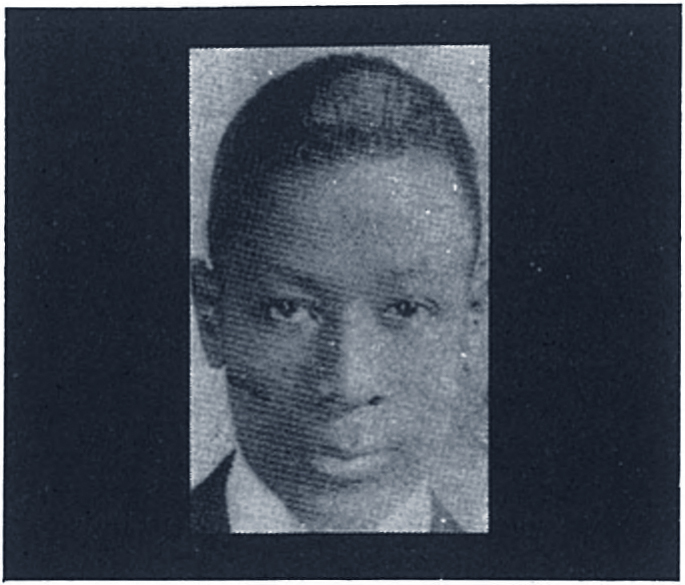
Johnny Dunn Coll. Michel Laplace
Apart from the non New Orleans pioneer Johnny Dunn (1897-1937), who worked in France from 1928 to 1937, Bubber Miley (1903-1932) was to be the great specialist in the “growl” using a mute. Already known before his collaboration with the great bandleader and composer Duke Ellington, his manner of expression lay partly in an elaboration of the “jungle style” later popularised by the sturdy Cootie Williams. Bubber Miley, incidentally, made one of the first series of trumpet and organ recordings, a formula which in perfect for blues and jazz (1924). From 1924, when he joined the Fletcher Henderson Band, Armstrong established in New York a stylistic concept occasionally mingled with that of the white Léon “Bix” Beiderbecke⁶. This artist, a self-taught cornet player little known outside musical circles, became a legend after his death in 1931. His style had been established since 1924, with a most seductive sound and individual phrasing which was to have many followers in the late twenties: Eddie Kitten, Sylvester Ahola, Red Nichols and, most gifted of all, the Frenchman Philippe Brun (of around 1929). The white Muggsy Spanier (1906-1967) was one of the first to use the rubber plunger in a style similar to that of the blacks, as is shown by his records of 1924 with the Bucktown Five. Conversely the black Canadian Arthur Briggs (born 1901)⁷ seems to have assimilated the influence of some white artists like Red Nichols; after a first visit to Europe in 1919, Briggs returned more or less for good to the head of his own Savoy Syncopated Orchestra from 1922.
1919 was also the year when Nick La Rocca and the ODJB (with Emil Christian, cornet/trombone) carried the basic principles of jazz to England. Emil Christian (1895-1974) played in France in the early twenties, some local artists benefitting from his advice (notably the trumpet player Alex Renard). In any case liking jazz was the trendy thing to do for intellectuals in the twenties since this new music outraged conventional criticism. Indeed the arts in Europe were then in a period of hyperactivity and had been all colour, scandal and argument since Igor Stravinsky’s “Rite Of Spring” (1913!) and Erik Satie’s “Parade” (1917). There was also the Dada movement. “Disruption, Sister” (the title of a painting by Max Ernst) seems to have been the keyword of the late teens and twenties; jazz could not have come along at a better time, even if the reasons for the adoration were special, even sometimes non-musical! Jean Wiener, Maurice Ravel, Darius Milhaud and Georges Auric, all familiar with Le Bœuf sur le Toit, liked this music. The Frenchman-of-the-moment from the end of 1917 was without any doubt the legendary and talented Léo Arnaud-Vauchant, a fabulous trombonist (fifty years ahead of his French contemporaries in so-called “classical” circles) and also a chorus man on trumpet. Away from traditional European music, however, the whole of music hall adopted jazz features, not only in writing (in the arrangements used) but also in interpretation (phrasing and accentuation).
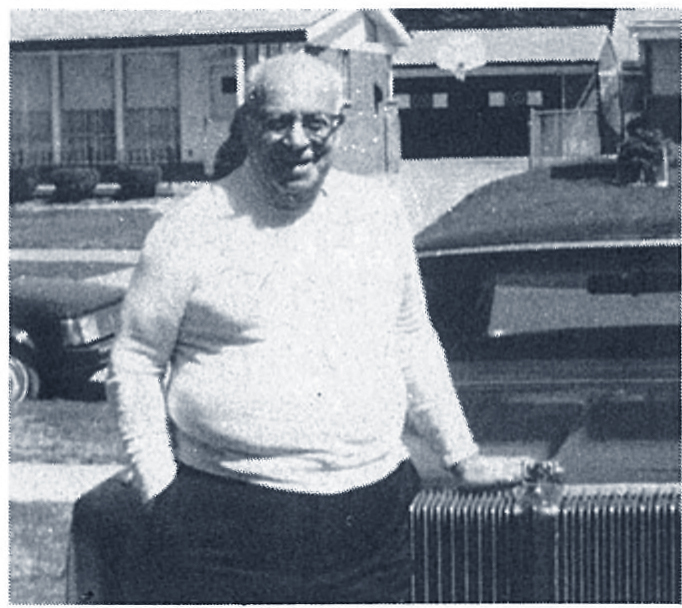
“Eddie” Ritten in Detroit (1980)
At the end of this early period we think the most convincing talents apart from Armstrong were King Oliver, George Mitchell, Eddie Allen, Tommy Ladnier, Joe Smith and, among the whites, Bix Beiderbecke (1903-1931) and Red Nichols (1906-1965). During the same period other captivating players swelled the ranks of many orchestras throughout the world: the Americans Manuel Perez, Pete Bocage, Paul Mares, Phil Napoleon (one of the first advocates of the trumpet rather than the cornet), Freddy Keppard (whose playing was strange because of its very marked and almost constant vibrato), Bubber Miley, Muggsy Spanier, Emil Christian, and in Europe, Arthur Briggs and his uncle Cricket Smith, plus the Canadian Max Goldberg (London), the Frenchmen Alex Renard (1926, Moulin Rouge) and Julien Porret (Berlin) and other very talented musicians playing from 1926 onwards.
Contrary to what some have maintained, the jazz cornet players did not open the way to the high register — which had already been mastered, notably by Herbert L. Clarke, Alessandro Liberati and William Paris-Chambers — and their recordings prove this. While some of them, especially Armstrong, went into the high register, they did so judiciously, as part of the development of an utterance which was still essentially melodic. It is also known that the early 20th-century virtuosos sought a large, good-quality sound; to this end they used deep mouthpieces with a wide cup and throat (this was the case with Fritz Werner, Georg Stellwagen, Herbert L. Clarke, Theodore Hoch, Ernst-Albert Couturier, Walter Rogers, Vincent Bach etc.). In this sense Armstrong did not depart from these principles. It was only later, with the big band craze, that the need to project, and to use smaller mouthpieces, was felt. Even the old guard adapted to this development, and Eddie Allen opted for a Bach 7CW. In addition to the development of mutes in the service of an expressive language, the contribution of jazz cornet players is that very language itself.
Louis Armstrong always had a complete and perfect trumpet technique. Mechanically, his technique scarcely differs from classical technique. Technically, everything he does is correct. With the possible exception of high notes (above G) his fingering is perfectly orthodox. This is the result neither of chance, nor of any special gift. He was not content just to play along with his friends; he had to work hard, throughout his career, on scales and harmonies. What sets him apart from classical trumpeters is his mode of expression: attack, sound, intensity, diversity, the placing of each note, vibrato, phrasing and the rhythmic division of his phrases. (Roger Guérin, Jazz Hot, summer 1970)
The value of the notes and inflexions, the actual pitch of the inflexions, the actual value of the silences, the intensity, smoothness or mellowness of the sounds — how can this be represented graphically? — how can it be written? (Maurice André, Jazz Hot, summer 1970)
So let us have an end to the idea that the black pioneers were self-taught. A few examples: Bunk Johnson attended New Orleans University (Professor Wallace Cutchey) and Johnny Dunn attended Fisk University in Nashville while King Oliver, Freddy Keppard and Arthur Briggs’ teachers were, respectively, Walter Kinchin, Adolphe Alexander and Lieutenant Eugene Mikell. The self-taught players, on the other hand, are to be found among the whites, starting with Bix Beiderbecke with his unorthodox fingerings.
(To be continued)
DISCOGRAPHIE — DISCOGRAPHY
«Pre-Armstrong 1900-1927»
SOUSA’S BAND
January 30, 1902
including (probably) Walter B. Rogers, Henry Higgins (cnt), Arthur Pryor, Leo Zimmerman (tb), Simone Mantia (euph.). “Trombone Sneeze” (composer unknown) (Victor 1223-1).
PRYOR’S BAND
New York, September 1908
Emil Keneke, Bert Brown, unidentified (cnt); Arthur Pryor, George Stell, ... Rose (tb), Otto Winkler?, H. Reitzel? (alt. & ten. horns), ... Leone (bar. horn), Simone Mantia (tuba), unknown (drums). “That Rag” (Browne) (B-6419-2).
VICTOR ORCHESTRA
New York, January 15, 1910
conducted by Walter B. Rogers. Probably including Emil Keneke, Walter Pryor (cnt), O. Edward Wardwell or Frank Pfaff (tb), Herman Conrad (tuba), S.O. Pryor or W.H. Reitz (drums). “Wild Cherries Rag” (Ted Snyder) (Victor B-8554-2).
PRYOR’S BAND
New York, June 1910
including Emil Keneke, Bert Brown, unidentified (cnt), Arthur Pryor, Charles Cusumano (tb), Otto Winkler?, H. Reitzel? (alt. & ten. horns), ... Leone (bar. horn), Simone Mantia (tuba), unknown (drums). “Temptation Rag” (Henry Lodge) (Victor B-9060-1).
VICTOR MILITARY BAND
New York, September 27, 1911
Walter B. Rogers &/or Theodore Levy, Emil Keneke (cnt), Frank Schrader (tb), J. Fuchs (cnt, alt. horn), Otto Winkler, H. Reitzel (alt. & ten. horn), Herman Conrad (tuba), William H. Reitz (drums). “Slippery Place Rag” (Hacker) (Victor B-11028-2).
PRYOR’S BAND
New York, April 1912
Leon Handzlick, Bert Brown, unidentified (cnt), Arthur Pryor, George Stell, ... Rose (tb), Otto Winkler?, H. Reitzel? (alt. & ten. horns), ... Leone (bar. horn), Simone Mantia (tuba), James I. Lent (drums). “The Ragtime Drummer” (Lent) (Victor B-11857-2).
U.S. MARINE BAND
New York, March 22, 1914
Cond. by William H. Santelmann Sr or Walter F. Smith; incl. Arthur Whitcomb (cnt), Robert E. Clark (solo tb), William H. Reitz (drums). “Crazy Bone Rag” (Charles L. Johnson) (Victor C-14611).
ANONYMOUS STUDIO BAND
New York, c. October 1914
Prob. cond. by Charles A. Prince; prob. incl. Vincent Buono (cnt), Leo Zimmerman (tb). “Maori” (W.H. Tyers) (Little Wonder 29) — “Beets & Turnips” (Roy Turk - Fred Ahlert) (Little Wonder 30).
JAUDAS SOCIETY ORCHESTRA
New York, c. December 1914
prob. incl. Benjamin Katzman (cnt), Simone Mantia or Charles Cusumano (tb). “The Music Box Rag” (C. Luckeyth Roberts) (Edison 2604-2).
ORIGINAL DIXIELAND JAZZ BAND
New York, January 24, 1917
Nick La Rocca (cnt), Eddie Edwards (tb), Larry Shields (cl), Henry Ragas (p), Tony Sbarbaro (drums). “At The Darktown Strutters’ Ball” (S. Brooks) (Columbia A-2297).
HELL-FIGHTERS (369th Infantry)
New York, c. March 1919
cond. by lt Jim Europe; probl. incl. Frank De Braithe, Russell Smith, Albert “Pops” Foster, Jake Porter (cnt), Dope Andrews, Herb Flemmings (tb), unknown (tuba). “Memphis Blues” (Handy) (67486) — “That Moaning Trombone” (Bethel) (67485) — “Darktown Strutters’ Ball” (Shelton Brooks) (67475).
ORCHESTRE JAZZ THE MELODY SIX
Paris, spring/summer 1918
probably Faustin Jeanjean, unidentified: as, vln, p, bj, drums. “Georgia Blues” (Walter Donaldson) (mx: 6159) (Pathé 6570).
ROBERTA DUDLEY (vocal)
Los Angeles, June 1921
with “Papa Mutt” Carey (cnt), “Kid” Ory (tb), “Dink” Johnson (cl), Fred Washington (p), Ed Garland (b), Ben Borders (drums). “Kroodek Blues”.
ORCHESTRE MITCHELL’S JAZZ KINGS
Paris, February 1922
Cricket Smith (tp), Frank Withers (tb), James Shaw (cl, asl, possibly Sidney Bechet (ssl, Dan Parish (p), Joe Meyers (bj), Louis Mitchell (drums). “Turkish Ideals” (D. Parish) (mx: 5926) (Pathé 6550).
NEW ORLEANS RHYTHM KINGS
Richmond, August 1922
Paul Mares (tp), George Brunies (tb), Léon Roppolo (cl), Jack Pettis (s), Elmer Schoebel (p), Lew Black (bj), Steve Brown (b), Ben Pollack (drums). “Panama”.
HENDERSON’S ORCHESTRA
New York, May 1, 1923
probably Russell Smith (solo cnt), Elmer Chambers (cnt), unknowns (tb, bj, 2 cl, alt), Don Redman (cl), Fletcher Henderson (p). “Don’t Think You’ll Be Missed” (mx: 1393-2) (Paramount 20226).
OLIVER’S CREOLE JAZZ BAND
Richmond, April 6, 1923
Joe “King” Oliver, Louis Armstrong (cnt), Honoré Dutrey (tb), Johnny Dodds (cl), Lil Hardin (p), Bill Johnson (bj), Baby Dodds (drums). “Froggie Moore”.
OLIVER’S CREOLE JAZZ BAND
Chicago, June 23, 1923
Joe “King” Oliver, Louis Armstrong (cnt), Honoré Dutrey (tb), Johnny Dodds (cl), Lil Hardin (p), Bud Scott (bj), Baby Dodds (drums). “Jazzin’ Babies Blues” (mx: 8403-A) (Okeh 4075).
PIRON’S NEW ORLEANS ORCHESTRA
New York, December 3, 1923
Pete Bocage (tp), John Lindsay (tb), Louis Warnecke (as), Lorenzo Tio Jr (cl, ts), Armand J. Piron (vln), Steve Lewis (p), Charles Bocage (bj), Charles Seguirre (tu), Louis Cottrell Sr (dr). “Bouncing Around” (Bocage-Piron) (mx: 72132-B) (Okeh 40021).
SAVOY HAVANA BAND
London, March 1923
George Eskdale, Eddie Frizell (tp), Bill Marcus (tb), Bert Ralton (cl, ss, C-mel.), Cyril Ramon Newton (vln), unidentified (ts, bs), Billy Mayerl (p), Jack Bellamy (tu), Dave Wallace (bj), McCabe (drums). “Sister Kate” (mx: 73353) (Columbia 3276).