Explore institutional access →

4 min. read

Harry James (1916-1983)

Young Man With A Horn
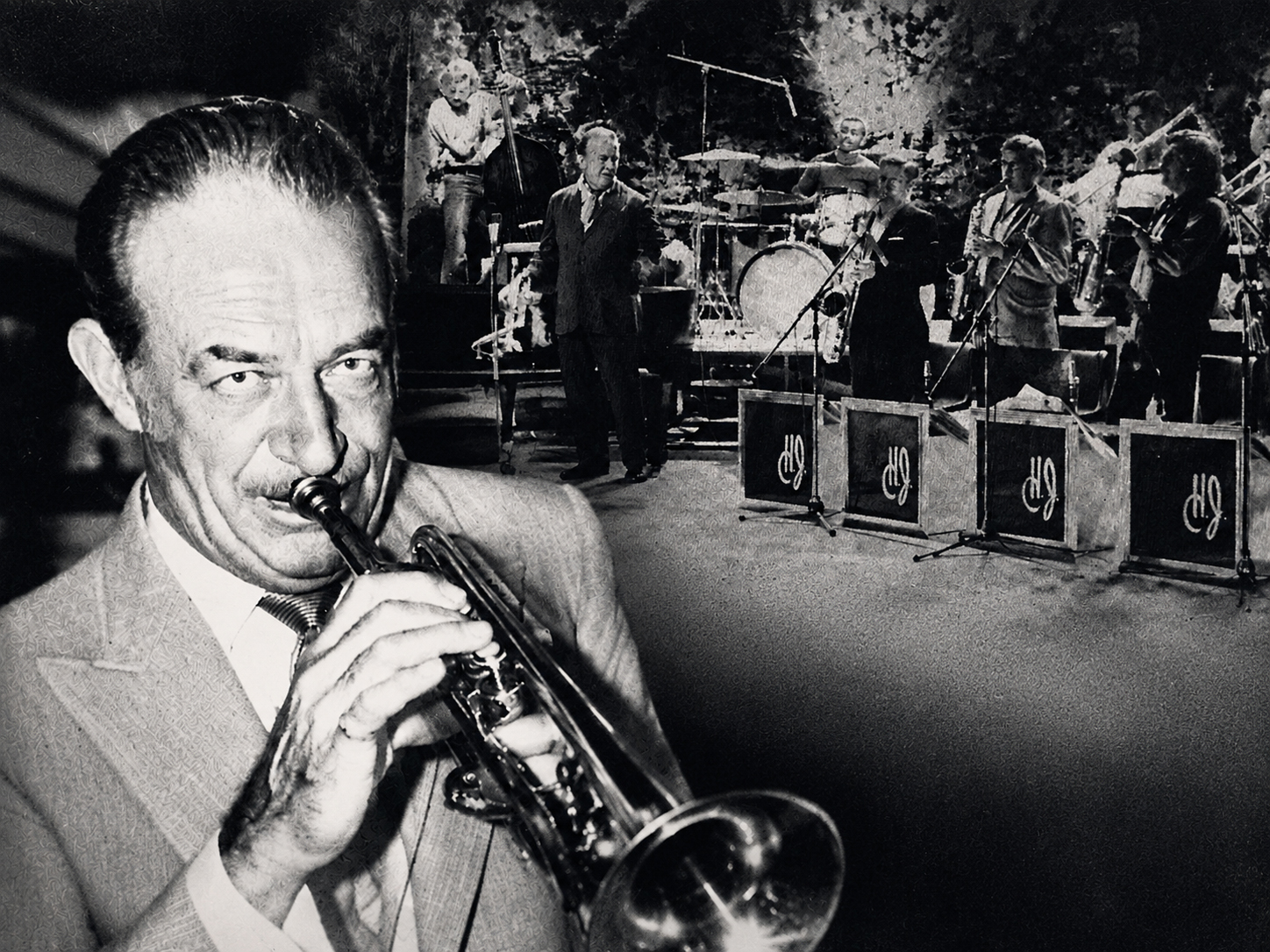
Harry James stood between jazz virtuosity and popular showmanship, turning the trumpet into a mass-audience voice without losing the respect of classical players.
Harry James (1916-1983)

Harry James

A curtain opens to reveal a trumpet bell whose music glows with fire... Harry James. A whole generation of listeners and trumpet players will long remember the man who introduced them to the charms of the “concert trumpet”, even to jazz. In this field of music there are both creators and “popularisers” (with no pejorative connotations), each with his own essential role to play. Harry assimilated jazz but he was best known as the star leading his own band, distilling a form of expression both seductive and accessible to the tastes of the white audience.

Harry was born into a family of musicians in the state of Georgia in 1916. His father Everette James, a circus musician from New Orleans, started him on drums when he was very young, then on trumpet when he was ten. Harry seems to have been a member of that generation which did not arrive at the trumpet via the cornet. His father moved to Beaumont, Texas, where he taught in school and gave private music lessons. This was when Harry first became the star of his high-school band. Although Everette slanted the boy prodigy’s education towards a “legitimate” career, the “young man with a horn” was drawn to jazz. In 1931 Louis Armstrong was drawing the crowds and bringing true recognition to the trumpet. That year Harry played for various local bands, including that of the violinist Joe Gill who took him to New Orleans. By 1932 he was professional and was clearly set on the path of dance music and jazz. His first job with a well known band came in 1935 when the phenomenon from Texas caught the attention of the drummer Ben Pollack. Harry stayed with Pollack for a year and, thanks to him, recorded his first solos (“Deep Elm”).

But what really made him familiar to a wide audience was when he joined clarinettist Benny Goodman’s very popular band (January 1937 to December 1938). The trumpet section was one of the most famous in the history of jazz and light music: Harry James, Ziggy Elman and Chris Griffin!

In 1937 the black players Lionel Hampton and Teddy Wilson invited him to sessions where he proved to be an excellent jazz player, very close to the black style¹. On 16th January 1938 he took part in the legendary Goodman concert in Carnegie Hall. Surely everyone has heard Harry’s virtuoso playing in “Sing, Sing, Sing”? Despite the talent of Bunny Berigan, his greatest rival, Harry continued to climb and in 1939 he was rated number one in all the polls. This led to his recording on 11th January 1939 with the Metronome All-Stars, a group intended to reassemble the favourite players of the readers of the magazine “Metronome”: Bunny Berigan, Sonny Dunham and Harry James on trumpet; Tommy Dorsey and Jack Teagarden on trombone! A whole era when syncopation was in the hands of the greatest brass virtuosos, regardless of style — the Golden Age! Yet Harry remained clear-headed, as the drummer Jo Jones relates: “In a poll conducted by one of the big magazines (“Down Beat”) they offered Harry James the Oscar. He refused it and said, ‘Take that back and give it to Louis Armstrong’...”

In 1939 Harry started to look around: he recorded “Ciribiribin” which shows jazz influence in the phrasing combined with almost “classical” features. (Ex. 1)

Continue reading

Access the full Digital Edition.

Brass Bulletin 45, I / 1984 pages 14–17

All content is protected by copyright © Brass Bulletin 1984–2026

Share this article

Facebook LinkedIn
Loading…

Questions & Answers

How the Digital Edition works

What does the Digital Edition include?

The Digital Edition brings together the articles already digitized as searchable online texts—not simply as scans or PDF files—along with their original illustrations, notes, authorship, issue information, and available translations. Related-article suggestions currently include only this digitized material.

Are the digital articles identical to the originals?

We preserve the original text, language, illustrations, captions, footnotes, and editorial context as faithfully as possible. The presentation is adapted for comfortable online reading, and obvious transcription or scanning errors may be corrected. The substance and character of the published article remain unchanged.

Which languages are available?

Brass Bulletin was published in English, French, and German throughout its history. Italian and Spanish translations were added from issue No. 60 onward.

On the Italian and Spanish sites, articles from issues 1–59 are therefore shown in English by default.

How often are new articles added?

New articles are added almost daily, with approximately one complete issue digitized each week. The pace may vary depending on the preparation, image work, and editorial checking required.

Why aren’t all articles available digitally?

The complete Brass Bulletin collection contains 1,246 articles published between 1971 and 2003. The full index is already available online, allowing readers to discover every article in the collection, including those whose complete text has not yet been digitized.

Digitization began in February 2026. Each article is carefully prepared for online reading, checked, and connected to its issue, authors, subjects, and illustrations. At the current pace of digitization, the complete collection is expected to be available online by February 2028.

Why do some references mention articles that are not available yet?

References in the original articles are preserved even when the material they point to has not yet been digitized. This keeps the historical and editorial record intact. As more issues are added to the Digital Edition, an increasing number of these references will lead to articles that can be read online.

Can I suggest an article or report a transcription error?

Yes. If there is an article you would particularly like to see digitized, or if you notice a possible transcription error or missing detail, please contact us. Reader feedback helps us improve the Digital Edition and prioritize useful connections within the archive.

How can I support Brass Bulletin?

Your support helps fund the preparation, verification, and online publication of the complete collection.

Subscribe to the Digital Edition

Prefer to support us without subscribing?

Make a donation

How is the digitization progressing?

We’re gradually making the Brass Bulletin available online, article by article. You can read newly digitized articles as soon as they’re ready, even before an entire issue is complete.

Visit our Digitization Roadmap to browse recent additions and see estimated availability for upcoming issues. These estimates follow our recent pace and may change.

Search Brass Bulletin.