15 min. read
The founders of the French Trumpet School
Merri Franquin, Eugène Foveau and Raymond Sabarich
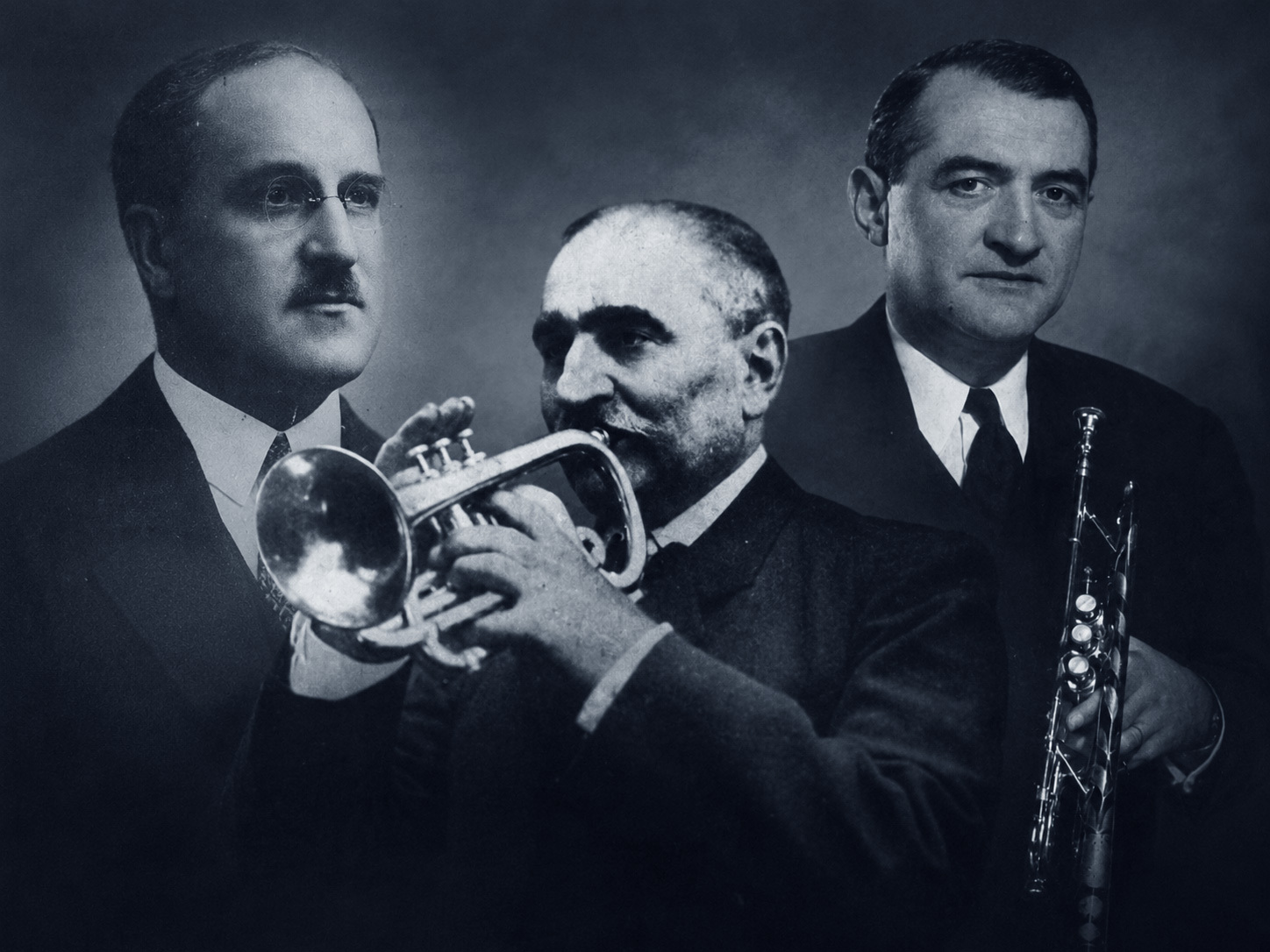
Eugène Foveau, Merri Franquin, Raymond Sabarich
Merri Franquin (1848-1934)
The story of "Papa Franquin" as we affectionately used to call him is greatly under-appreciated. Merri was born in 1848 in Lançon, a small town in the département of Bouches-du-Rhône. His interest in music emerged at an early age when he discovered an old brass instrument — a cornet — in the family home. This discovery at the age of 15 mapped out his future. He studied the instrument by himself for four years — a far from easy task! An orchestral conductor passing through Lançon heard him play and advised him to go to Marseille. Thus in 1867 he was taken on as a cornet-player in the Marseille Casino Musical. There he later played as soloist at the Palais Lyrique and at the Théâtre Chave until 1870 when he joined the band of the Marseille Garde Nationale as solo flugelhorn, staying there until the age of 24.
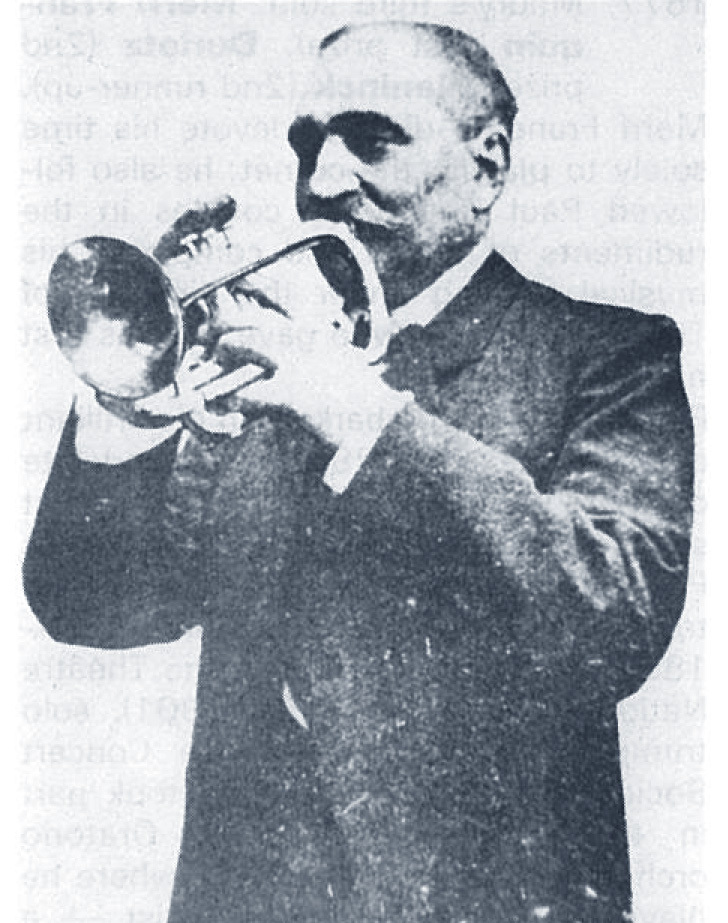
Merri Franquin (env. 1920)
(Coll. M. Laplace)
His desire to get to know the capital took him, despite various difficulties, to the Paris Conservatoire where, on 7th May 1872, he was admitted to the cornet class under Jean-Baptiste Arban. The 1873 examination included Boehm's Air Suisse arranged by Arban and the winners were Silvestre (1st prize), H. Senée (1st prize), Culenaere (2nd prize) and Jaussaud (2nd runner-up). At that time it was not traditional to enter the Paris Conservatoire one year and leave the following year with one’s prize! The norm was a long apprenticeship under the teacher's guidance.
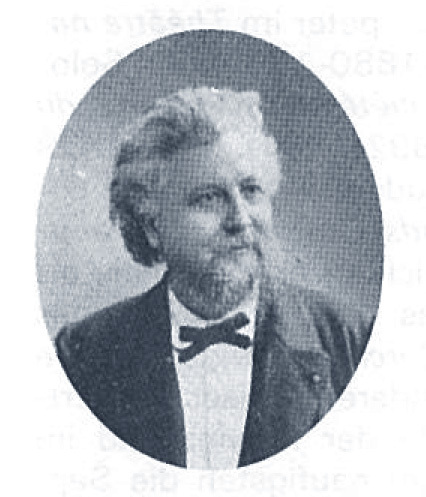
Culenaere
Directeur de l'École Nationale de musique de Douai.
1er prix de Cornet à Paris.
Arban's second solo was set for the 1874 examination and prizes were awarded to E. Lachanaud (1st), Leroux and Simeon (2nd), Jaussaud (1st runner-up) and — Merri Franquin (2nd runner-up). Arban resigned from his post in 1875 and was succeeded by his friend J. H. Maury (ex horn-player turned cornet-player); Maury sensed the makings of an artist in Merri Franquin, assured him of his esteem (he dedicated a solo to him) and supervised his work very closely.
The years passed and so did the examinations:
1875, Maury's first solo: Jaussaud (1st prize), Galipeau (2nd prize), Franquin (1st runner-up), Philippe (2nd runner-up)
1876, Maury’s second solo: Léon Galipeau (1st prize), Franquin (2nd prize), Jouchoux (1st runner-up), Philippe (2nd runner-up)
1877, Maury's third solo: Merri Franquin (1st prize), Durietz (2nd prize), Naninck (2nd runner-up).
Merri Franquin did not devote his time solely to playing the cornet; he also followed Paul Rougnon's courses in the rudiments of music and completed his musical training under the direction of Théodore Dubois who gave him his first harmony lessons.
Franquin finally embarked on his brilliant career at the age of 28 (which is very late compared with Foveau); he became first soloist at the Concerts Populaires Pasdeloup (1876-1892), then solo trumpet at the Concerts Colonne (1884-1892), first solo trumpet at the Théâtre National de l’Opéra (1880-1901), solo trumpet of the Conservatoire Concert Society (1892-1901) and he took part in the St. Eustache Grand Oratorio orchestra from 1899 to 1901 where he played several times as a soloist — a remarkable feat for the period.
Brass Bulletin 29, I / 1980 pages 67–80
All content is protected by copyright © Brass Bulletin 1980–2026