9 min. read
The Trumpet and the Cornet in Jazz and in Popular Music
Breathing
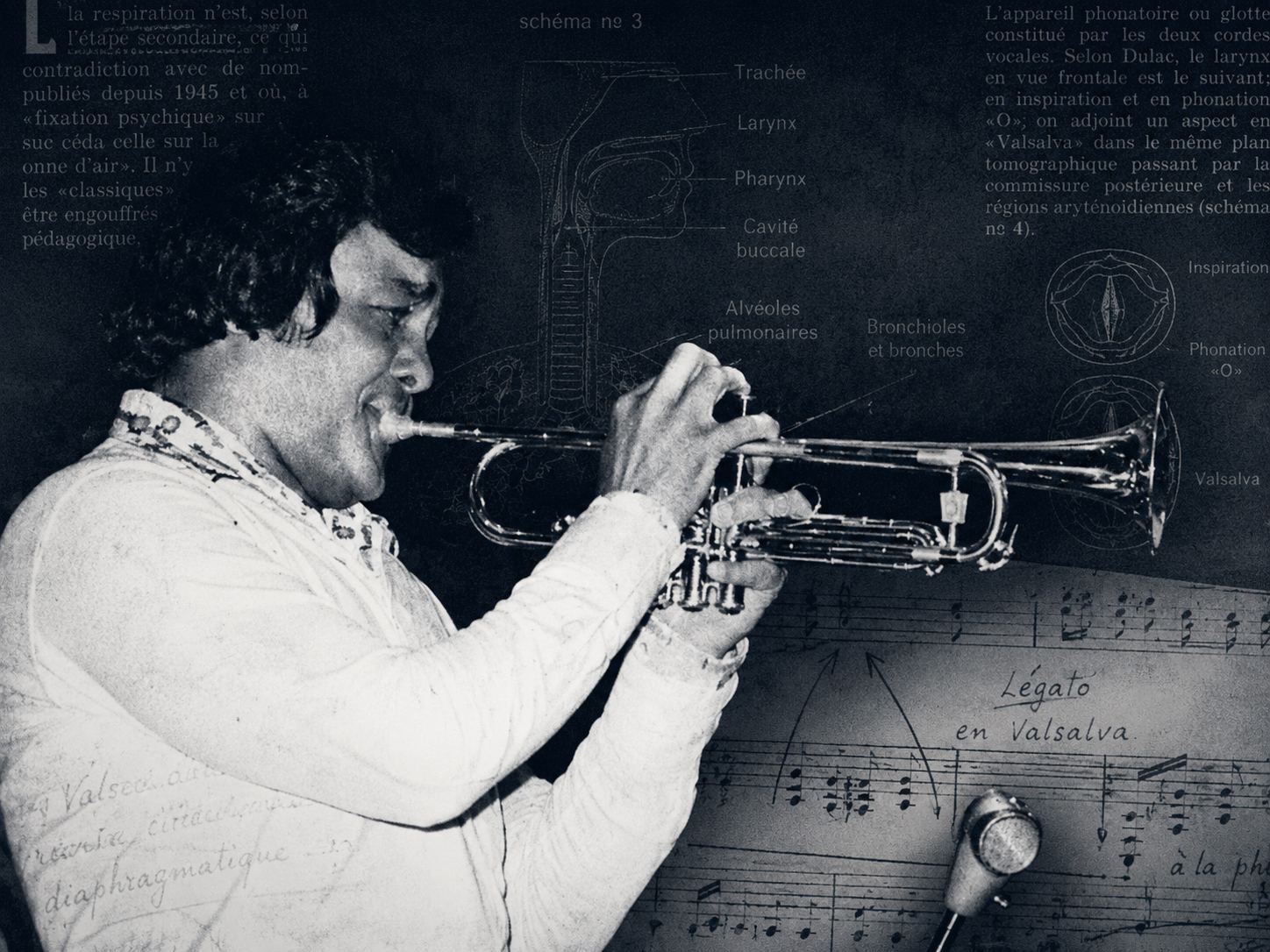
We regard this as the second stage, which puts us at odds with much writing published since 1945 in which one “psychic fixation” with tu is followed by another with the “air column”. It is not only “classicists” that have been marshalled into this methodological camp: jazzmen like Christian Bellest and, today, Tony Russo make breathing the fundamental principle, the basis of trumpet playing, relegating to an ancillary position all that we have seen so far.
It seems to us that good breathing is of little use in playing the trumpet if the connection between mouth and instrument is constricted for one reason or another. Nevertheless good breathing is healthy for each one of us in life and no-one doubts, when it comes to playing the trumpet, the importance of air pressure maintained by pulmonary expiration, the only known means of making the lips vibrate. The polemic is concerned only with the order of events. Fig. 3 shows us the path of the air from the pulmonary alveoli to the bronchioles and bronchi, coming together in the trachea and reaching the larynx before flowing into the pharynx and the mouth cavity to face the lips-mouthpiece system. This illustration shows the vital regulatory role of the larynx (Fig. 3 bis), which the Marseille team of René Périnelli and Jean-Jacques Greffin compare to the relief valve of a gas bottle (in their tutor to appear soon). Dr. Dulac’s description says: “The larynx is a membranous passage, largely muscular, which is held in shape by a shell of bone, fibre and cartilage; it joins the pharynx with the trachea. Its variable aperture helps to regulate the rate of respiration; it contains a phonatory device and a device to cover itself during swallowing.” (EMC)
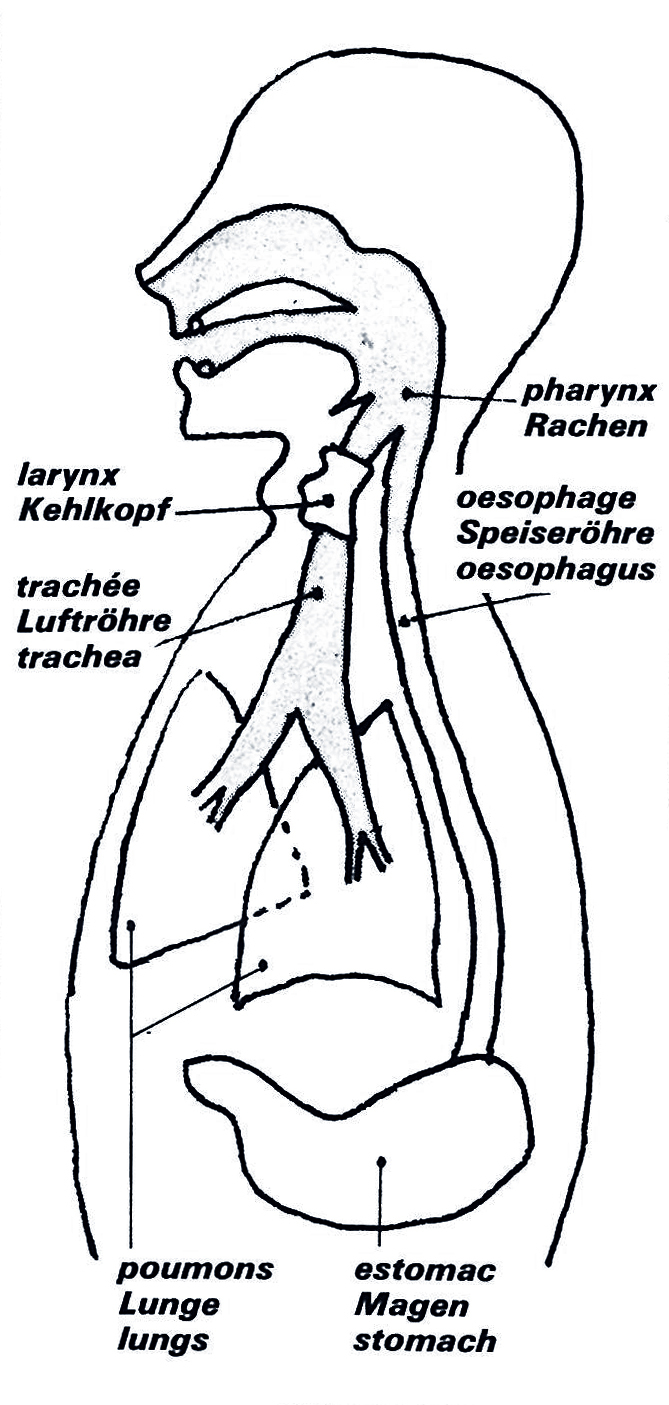
Figure 3
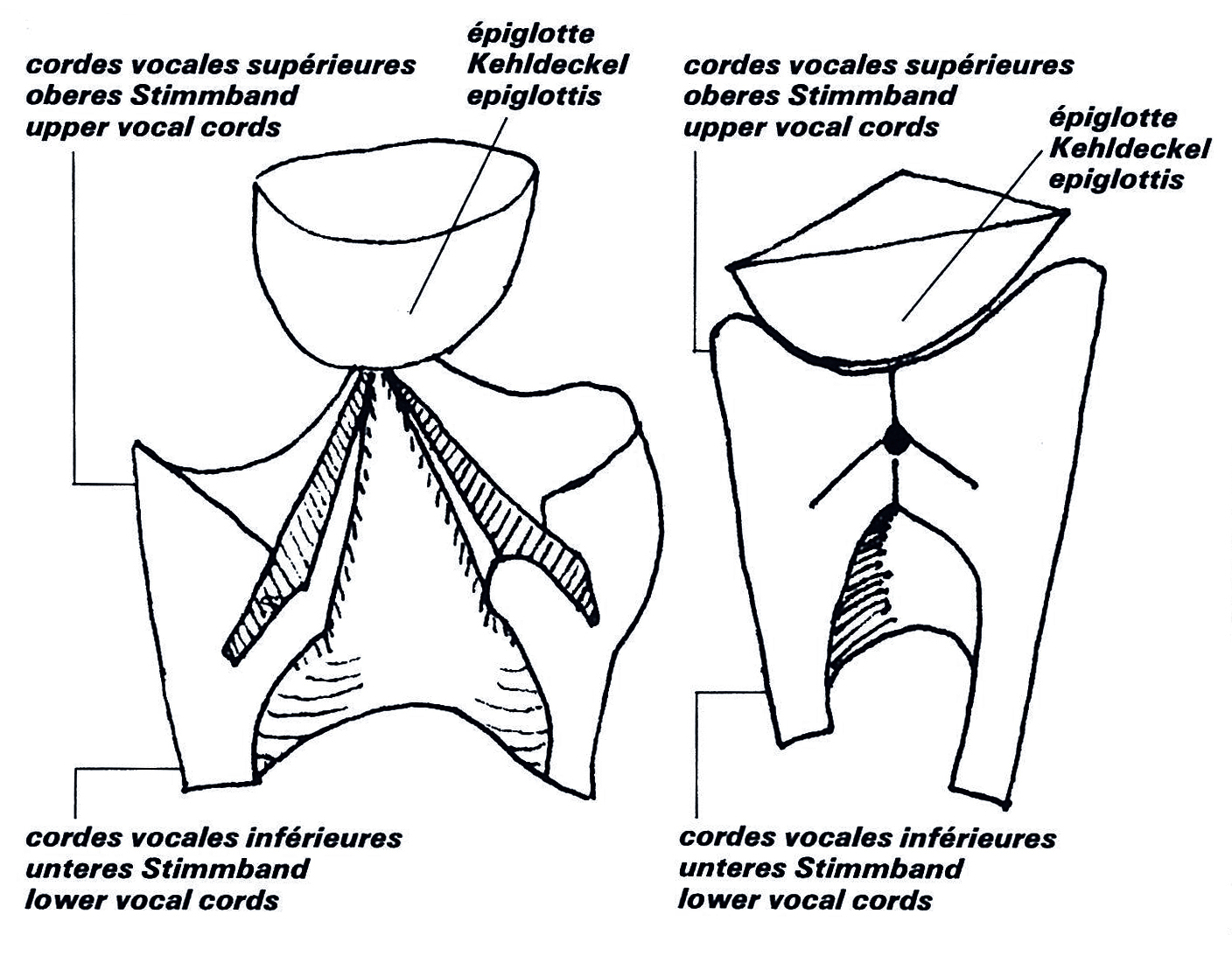
Figure 3bis
The phonatory device of glottis consists of the two vocal chords. According to Dulac the front view of the larynx in inhalation and phonation is O. There is also a “Valsalva view” in the same tomographic plane, passing through the posterior commissure and the arytenoid area. (Fig. 4)
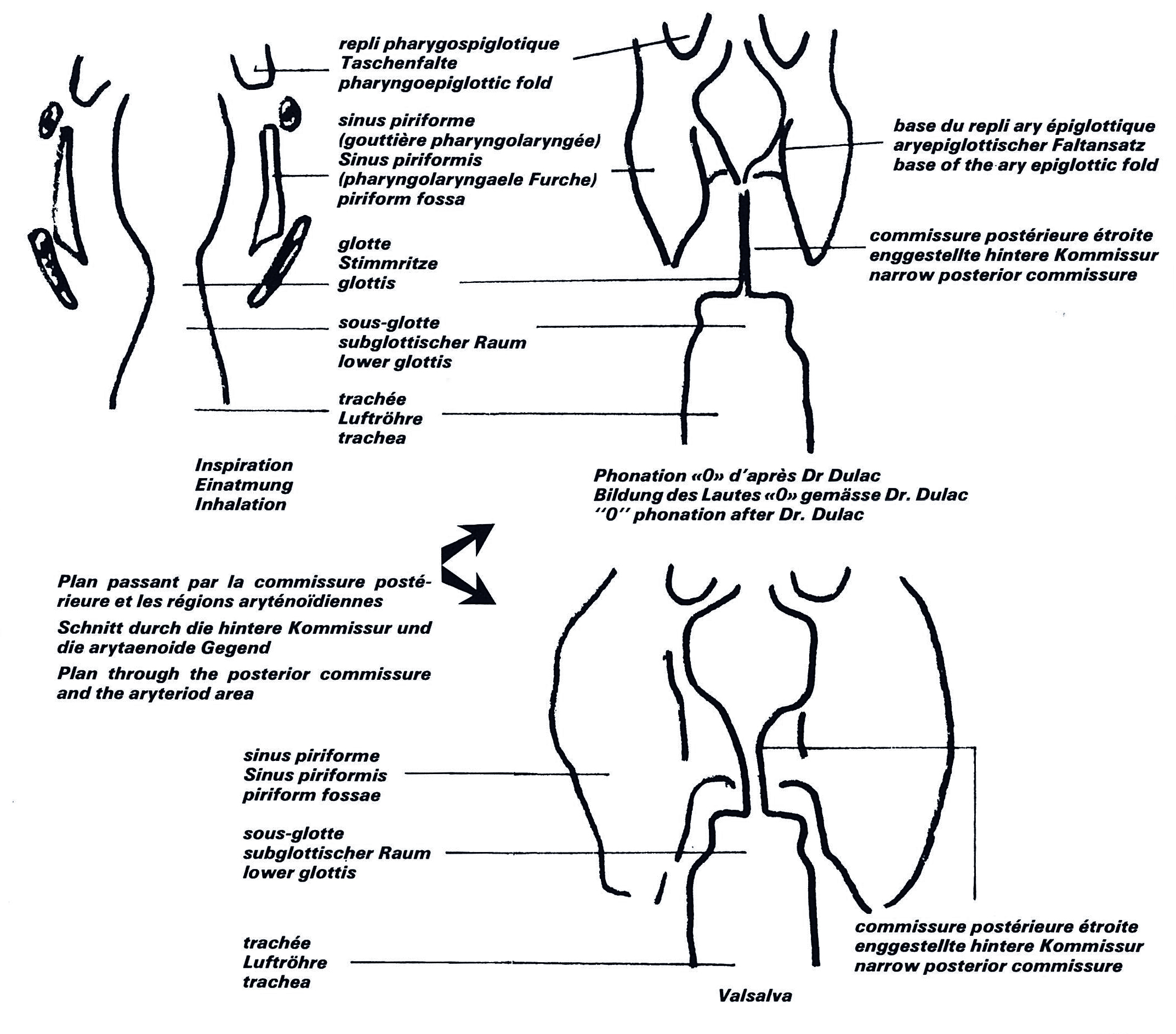
Figure 4
Faulkner showed in 1959 that trumpet playing is related to Valsalva’s manoeuvre (with side effects on the circulation of the blood, which can cause blackouts in lead trumpets). Studying the behaviour of the larynx during trumpet playing has to be carried out using Valsalva’s manoeuvre (blowing into the cap of a pen with a pinhole in its end). The amplitude of this manoeuvre is greater among professional trumpet players than it is with most people, whom we have illustrated here. During inhalation the glottal area is wide, creating the effect of an hourglass in combination with the areas above and below (with the sub-glottal “shoulders” lowered). In phonation and Valsalva the glottal area is narrow (more so in phonation) and the sub-glottal “shoulders” are horizontal. These aspects are not identical, however, and should put an end to parallels between singing and trumpet playing on the physio-technical level. In Valsalva the glottis is narrow enough to create a resistance to the air pressure and the piriform fossae are much more open, filled with air, than in phonation (which gives some trumpet players the appearance of having an inflated neck).
How should the player breathe in?
Brass Bulletin 46, II / 1984 pages 23–30
All content is protected by copyright © Brass Bulletin 1984–2026