Explore institutional access Explore institutional access

6 min. read

Glenn Ferris - Profile
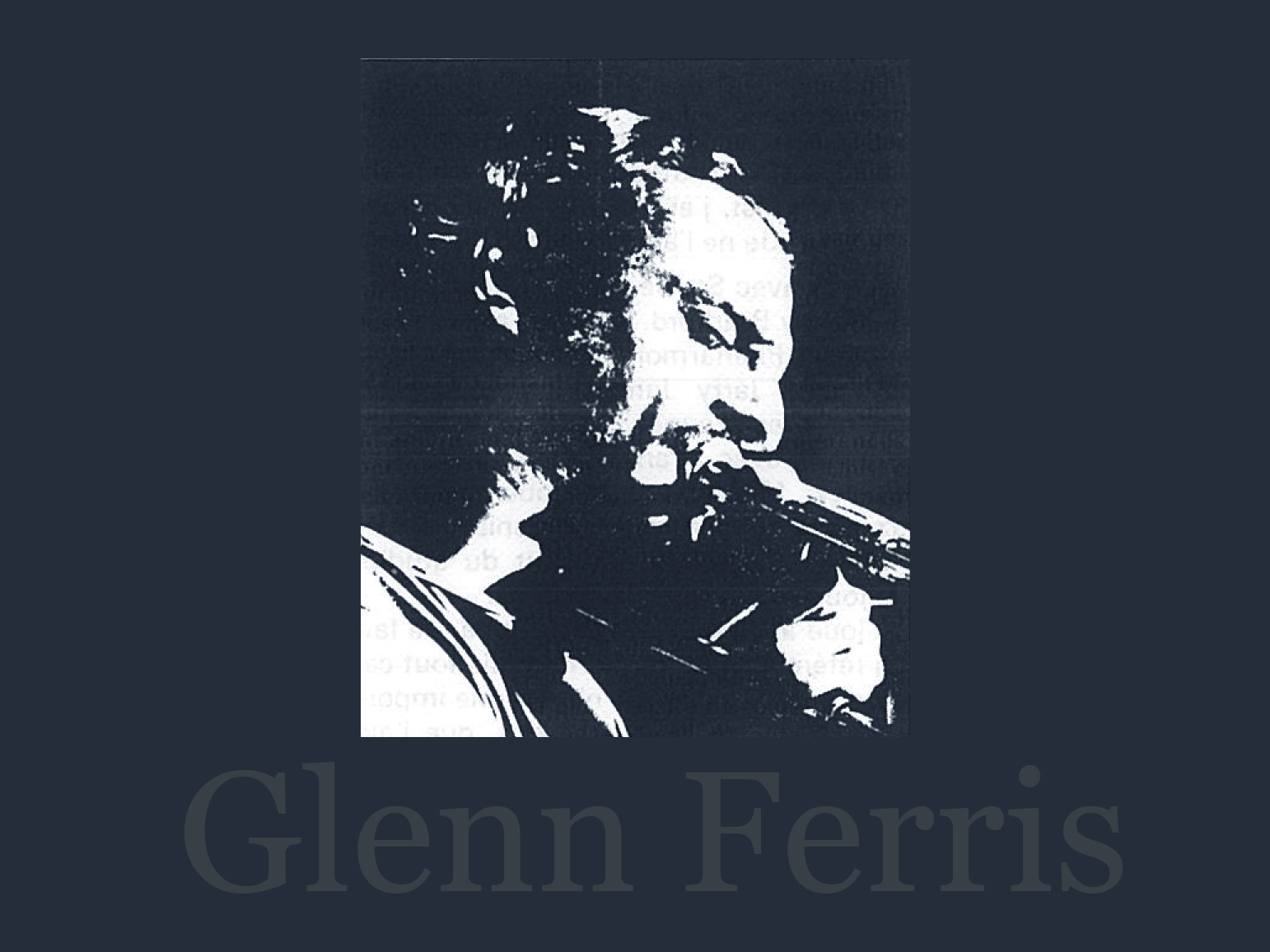
Beyond fame and labels: Glenn Ferris rejects the music business game—defining a raw, uncompromising vision of creativity, freedom, and what it means to truly play.
Glenn Ferris - Profile

Glenn Ferris

Born June 27, 1950 in Los Angeles and raised in North Hollywood and Van Nuys, trombonist Glenn Ferris studied classical music under Ed Freudenberg and Miles Anderson for several years. From 1964–1966 he studied theory with Don Ellis, and at 16 became a member of the Don Ellis Orchestra (spotlighted on Ferris Wheel from the LP Don Ellis Goes Underground).

He has played with the UCLA Opera Company, the UCLA Dance Troupe, the American Ballet, the Joffrey Ballet, and the L. A. Symphony Orchestra. He has also been featured with Billy Cobham (Total Eclipse, A Funky Thide of Sings, Shabazz), Frank Zappa, Tim Buckley and numerous others. Today he plays with trumpeter Bobby Bradford, with Dr. Jazz (a good-time '20s and '30s band) and with his own new Celebration Orchestra, some 20 instruments strong.

Glenn Ferris stands not only at the forefront of the evolution of the trombone, but at the forefront of today's new generation of serious creative musicians. His versatility in a wide variety of contexts seems to know no bounds. As a dedicated individual artist, however, he has often envisioned music that has drawn little or no recognition from the commercially oriented recording industry. At his home in Santa Monica, he spoke with quietly stated, passionate conviction...

A lot of times people say, "Hey Glenn, I've heard you on this or that record. I've seen you play here or there, man. You should be famous! What are you doing?"

Well, I'm still scuffling my ass off. I still don't know if I can pay the gas bill. So, in a way, "doing things" has nothing to do with... in other words, down beat has nothing to do with the real world the way I see it. It's an illusionary thing: "This week we have a Profile on Joe Schmoe. This is what Joe Schmoe is doing." A very superficial thing, supermarket stuff. Music has nothing to do with a down beat magazine or a record company or a TV program or a following or a cult or an identity or an image.

Music is just... it's like a flower. It is there, no matter if you dig it or you don't dig it. It's still there, and it's still going to be growing.

Continue reading

Access the full Digital Edition.

Brass Bulletin 23, III / 1978 pages 31–34

All content is protected by copyright © Brass Bulletin 1978–2026

Share this article

Facebook LinkedIn
Loading…

Questions & Answers

How the Digital Edition works

What does the Digital Edition include?

The Digital Edition brings together the articles already digitized as searchable online texts—not simply as scans or PDF files—along with their original illustrations, notes, authorship, issue information, and available translations. Related-article suggestions currently include only this digitized material.

Are the digital articles identical to the originals?

We preserve the original text, language, illustrations, captions, footnotes, and editorial context as faithfully as possible. The presentation is adapted for comfortable online reading, and obvious transcription or scanning errors may be corrected. The substance and character of the published article remain unchanged.

Which languages are available?

Brass Bulletin was published in English, French, and German throughout its history. Italian and Spanish translations were added from issue No. 60 onward.

On the Italian and Spanish sites, articles from issues 1–59 are therefore shown in English by default.

How often are new articles added?

New articles are added almost daily, with approximately one complete issue digitized each week. The pace may vary depending on the preparation, image work, and editorial checking required.

Why aren’t all articles available digitally?

The complete Brass Bulletin collection contains 1,246 articles published between 1971 and 2003. The full index is already available online, allowing readers to discover every article in the collection, including those whose complete text has not yet been digitized.

Digitization began in February 2026. Each article is carefully prepared for online reading, checked, and connected to its issue, authors, subjects, and illustrations. At the current pace of digitization, the complete collection is expected to be available online by February 2028.

Why do some references mention articles that are not available yet?

References in the original articles are preserved even when the material they point to has not yet been digitized. This keeps the historical and editorial record intact. As more issues are added to the Digital Edition, an increasing number of these references will lead to articles that can be read online.

Can I suggest an article or report a transcription error?

Yes. If there is an article you would particularly like to see digitized, or if you notice a possible transcription error or missing detail, please contact us. Reader feedback helps us improve the Digital Edition and prioritize useful connections within the archive.

How can I support Brass Bulletin?

Your support helps fund the preparation, verification, and online publication of the complete collection.

Subscribe to the Digital Edition

Prefer to support us without subscribing?

Make a donation

Search Brass Bulletin.