Ofrezca Brass Bulletin en su universidad, conservatorio o biblioteca Descubra el acceso institucional

10 min de lectura

The Trumpet and the Cornet in Jazz and Popular Music

The instrument for jazz

Parte 4

Por Michel Laplace

Jazz trumpet playing balances equipment, embouchure and articulation, as changing sound ideals reshape mouthpieces, technique and the physical approach to playing.
The Trumpet and the Cornet in Jazz and Popular Music

The instrument for jazz

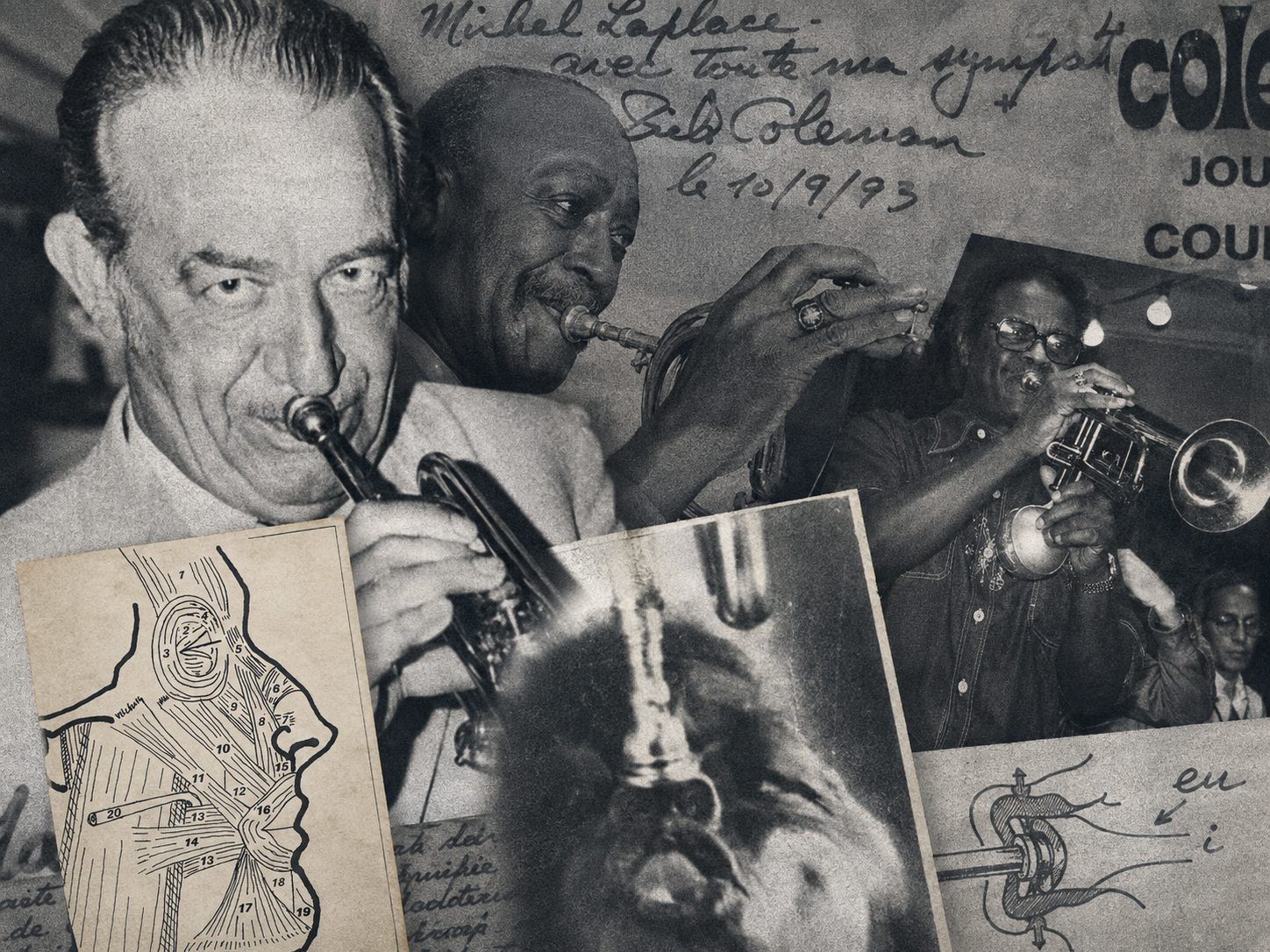
Standard equipment is the B♭ trumpet and the flugelhorn. The cornet is rarely used, and the piccolo trumpet only occasionally. The C trumpet has no place in jazz (it was played by Boyd Senter in the twenties) but gave good service in the music hall (because of the ease of transposing parts written in various keys; Robert Fassin and Fred Gérard at the beginning of his career). The models usually chosen are those of the top American makers. For jazz and light music, as elsewhere, the important thing is to find the right ratio between volume and sound quality. Choice of mouthpiece, however, often differs between jazz and “classics”, but all kind of exceptions can be observed.

We have considered the subject briefly as it concerned early players. A mouthpiece with a large diameter and a deep cup produces a good volume of sound in the immediate vicinity but because of its lack of tonal clarity it has poor projection. Since the forties lead trumpets like Snooky Young and, in France, Robert Fassin, have not had a “big sound” — quite the contrary — but they “projected” well.

The choice of mouthpiece is determined by the kind of sound and effect desired. Here too there are fashions, since musical styles evolve with time. A studio musician, for example, knows that, in order to earn his living, he must be able to do certain things and he equips himself accordingly. In rock the current fashion is for strident mouthpieces rather than for those which bring the trumpet sound closer to that of the cornet or flugelhorn. I might point out in passing that this fashion is based on modern sound-recording techniques which mean that it is no longer necessary to produce much volume. The so-called “compact” sound is preferred, i.e.: very pointed, instead of very broad. The important thing is to convey the idea of the trumpet — the recording will do the rest. One other thing which must be understood is that nowadays, when people get up on the stand, they are trying to recreate the conditions of studio work whereas formerly it was quite the reverse: people tried to reproduce the sound of live music in the studio!

(Roger Guérin: Jazz Magazine, no. 281, 1979).

“The human instrument”

These remarks by Timofey Dokshitser give a good description of everything that leads the trumpet towards musical expression, which is the ultimate goal. Although some jazz players, especially some of the whites, were self-taught (Bix Beiderbecke, Ruby Braff), none of the leaders (Armstrong, Miles Davis, Wynton Marsalis) did without the advice of one or more teachers, well known or otherwise. On the other hand less conservative ideas became established very early on in jazz and light-music circles, arising from the players’ thoughts about problems experienced and from a confrontation of ideas. The basic technique for a cup-mouthpiece instrument in this context, according to Fred Gérard, consists in having:

  • resistance
  • a wide range
  • sound

the last being the most neglected today. This requires mastering the different aspects in a logical order. Tony Russo, like Charles Colin, talks about “intelligent concentration every instant”. The difficulties are, in order:

  1. your embouchure
  2. your articulation
  3. the way you blow

This plan of priorities is roughly the same as that set up by Roy Stevens, Charles Colin and Fred Gérard.

Continue reading

Accede a la edición digital completa.

Brass Bulletin 45, I / 1984 páginas 38–44

Todo el contenido está protegido por derechos de autor © Brass Bulletin 1984–2026

Compartir este artículo

Facebook LinkedIn
Cargando…

Preguntas y respuestas

Cómo funciona la edición digital

¿Qué incluye la edición digital?

La edición digital reúne los artículos ya digitalizados como textos legibles y consultables en línea —no simplemente como escaneos o archivos PDF— junto con sus ilustraciones originales, notas, autoría, información del número y traducciones disponibles. Las sugerencias de artículos relacionados incluyen actualmente solo este material digitalizado.

¿Los artículos digitales son idénticos a los originales?

Conservamos con la mayor fidelidad posible el texto original, el idioma, las ilustraciones, los pies de imagen, las notas y el contexto editorial. La presentación se adapta para facilitar la lectura en línea y pueden corregirse errores evidentes de transcripción o escaneado. El contenido y el carácter del artículo publicado permanecen inalterados.

¿Qué idiomas están disponibles?

Brass Bulletin se publicó en inglés, francés y alemán a lo largo de toda su historia. Las traducciones al italiano y al español se añadieron a partir del número 60. Por este motivo, en los sitios italiano y español los artículos de los números 1 a 59 se muestran en inglés de forma predeterminada.

¿Con qué frecuencia se añaden nuevos artículos?

Se añaden nuevos artículos casi a diario, con aproximadamente un número completo digitalizado cada semana. El ritmo puede variar según el trabajo de preparación, tratamiento de imágenes y revisión editorial necesario.

¿Por qué no están disponibles todos los artículos en formato digital?

La colección completa de Brass Bulletin contiene 1.246 artículos publicados entre 1971 y 2003. El índice completo ya está disponible en línea y permite descubrir todos los artículos de la colección, incluidos aquellos cuyo texto íntegro todavía no ha sido digitalizado.

La digitalización comenzó en febrero de 2026. Cada artículo se prepara cuidadosamente para la lectura en línea, se revisa y se vincula con su número, sus autores, sus temas y sus ilustraciones. Al ritmo actual de digitalización, se prevé que la colección completa esté disponible en línea en febrero de 2028.

¿Por qué algunas referencias mencionan artículos que todavía no están disponibles?

Las referencias de los artículos originales se conservan aunque el material al que remiten aún no haya sido digitalizado. De este modo se mantiene intacto el contexto histórico y editorial. A medida que se incorporen más números a la edición digital, un número creciente de estas referencias conducirá a artículos que podrán leerse en línea.

¿Puedo sugerir un artículo o informar de un error de transcripción?

Sí. Si hay algún artículo que le gustaría especialmente ver digitalizado, o si detecta un posible error de transcripción o algún dato que falta, póngase en contacto con nosotros. Los comentarios de los lectores nos ayudan a mejorar la edición digital y a establecer prioridades útiles dentro del archivo.

¿Cómo puedo apoyar a Brass Bulletin?

Su apoyo ayuda a financiar la preparación, verificación y publicación en línea de la colección completa.

Suscríbase a la Edición Digital

¿Prefiere apoyarnos sin suscribirse?

Haga una donación

¿Cómo avanza la digitalización?

Estamos poniendo Brass Bulletin a disposición de los lectores en línea, artículo por artículo. Pueden leer los artículos recién digitalizados en cuanto estén listos, incluso antes de que se complete un número entero.

Consulten nuestro calendario de digitalización para descubrir las últimas novedades y las fechas estimadas de disponibilidad de los próximos números. Estas estimaciones se basan en nuestro ritmo reciente y pueden cambiar.

Busca en Brass Bulletin.