10 min. read
The Haydn Trumpet Concerto
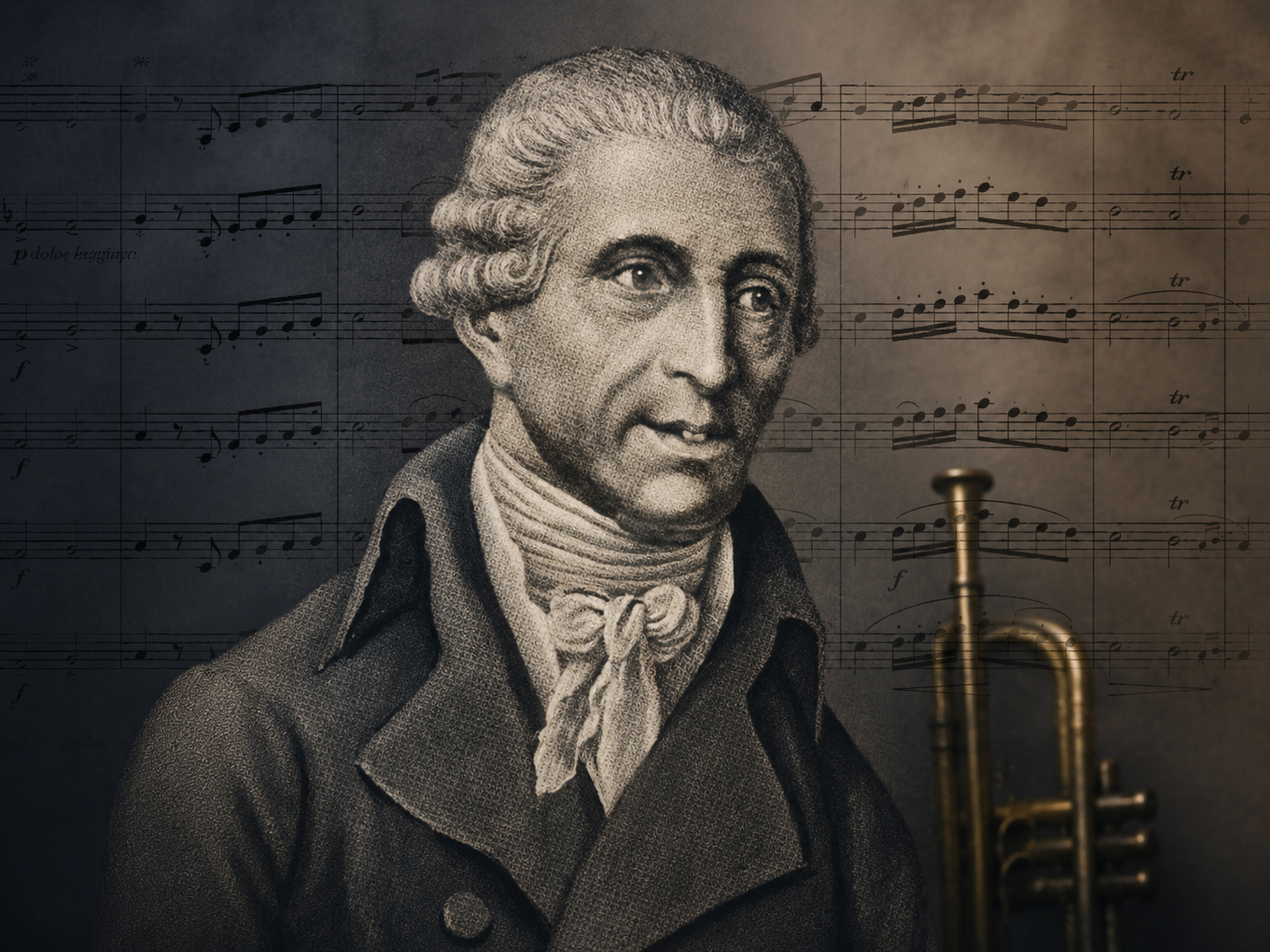
Extracts from scores in part I of this article illustrated the written differences which one meets. The space available for this series of three articles (II – interpretation, III – reception) is very restricted. In a later publication I shall develop the analysis which has at present only begun (I shall for example check the score against a microfilm of the original and I shall reproduce interviews and letters from performers).
II. The Interpretation
Most of us know that it is possible to translate from one language into another in two ways: superficially (word for word); or in essence (in relation to the spirit and content of what is to be said). Now translating the spoken language is called interpreting, and this use of the word puts us on the track of our problem.
In music it is not enough to play the notes (the words) — everyone knows that. It is much more a question of distinguishing between the essential (the key words) and the incidental, of using the correct punctuation (commas, full stops, paragraphs) without either departing from the intended style (the type of expression intended by the original text) or losing the content (the intention of the person telling the story), the overall aim of the interpreter of a piece (like the translator of a text) being to render the spirit of the movements (chapters) and of the work (book).
The spirit and content of the work
How can we define these? How can we find them?
Little seems to have been written about this concerto. I have not yet examined all the literature. It might be interesting to make a few points about the composer's personality, his social position and his period.
Haydn is said to have been one of the five geniuses in the history of the world to enjoy perfect physical and mental health. Of robust health, an Austrian, our composer was known for his sense of humour. His personal position at court (1761–1790) involved many sacrifices — a great deal of work and solitude — while at the same time offering him some advantages. He was able to carry out experiments and had a motive for doing so — writing different versions of works for orchestra and recasting them, for example, according to the degree of success achieved in certain cases, or introducing new instruments or new ways of playing them (Karajan, p. 9).
He thought of composing by the throw of a dice. Suffering from overwork by day, for six months he worked late into the night to learn to play the baryton himself in order to impress his master who was a poor performer on this instrument and to prove to him how much further one could go (Hughes, p. 39). One of Haydn's cantatas (Die Erwählung eines Kapellmeisters) contains an ironic account of the choosing of a conductor (Kobald, p. 224).
If this composer wrote a concerto for a new trumpet, it was probably not just because a court trumpeter was a friend of his but it was probably with a view (perhaps this was his whole intention) to throwing down a challenge. The instrument built by Weidinger was imperfect and difficult to play (it had notes of uneven power and quality). Tenschert (p. 213) writes that this trumpet was not yet “fully developed” at the time the work was written. Writing for this trumpet was adventurous.
Written in 1796 for “solo trumpet, 2 violins, 2 violas, bass, 2 flutes, 2 oboes, 2 bassoons, 2 horns, 2 trumpets and 2 drums” (Hoboken, H. 22, no. 1), the work was not played until 1800, in the Vienna Burgtheater (Robbins, p. 35).
Brass Bulletin 36, IV / 1981 pages 34–41
All content is protected by copyright © Brass Bulletin 1981–2026