Explore institutional access →

2 min. read

Points and areas of corrosion in brass instruments
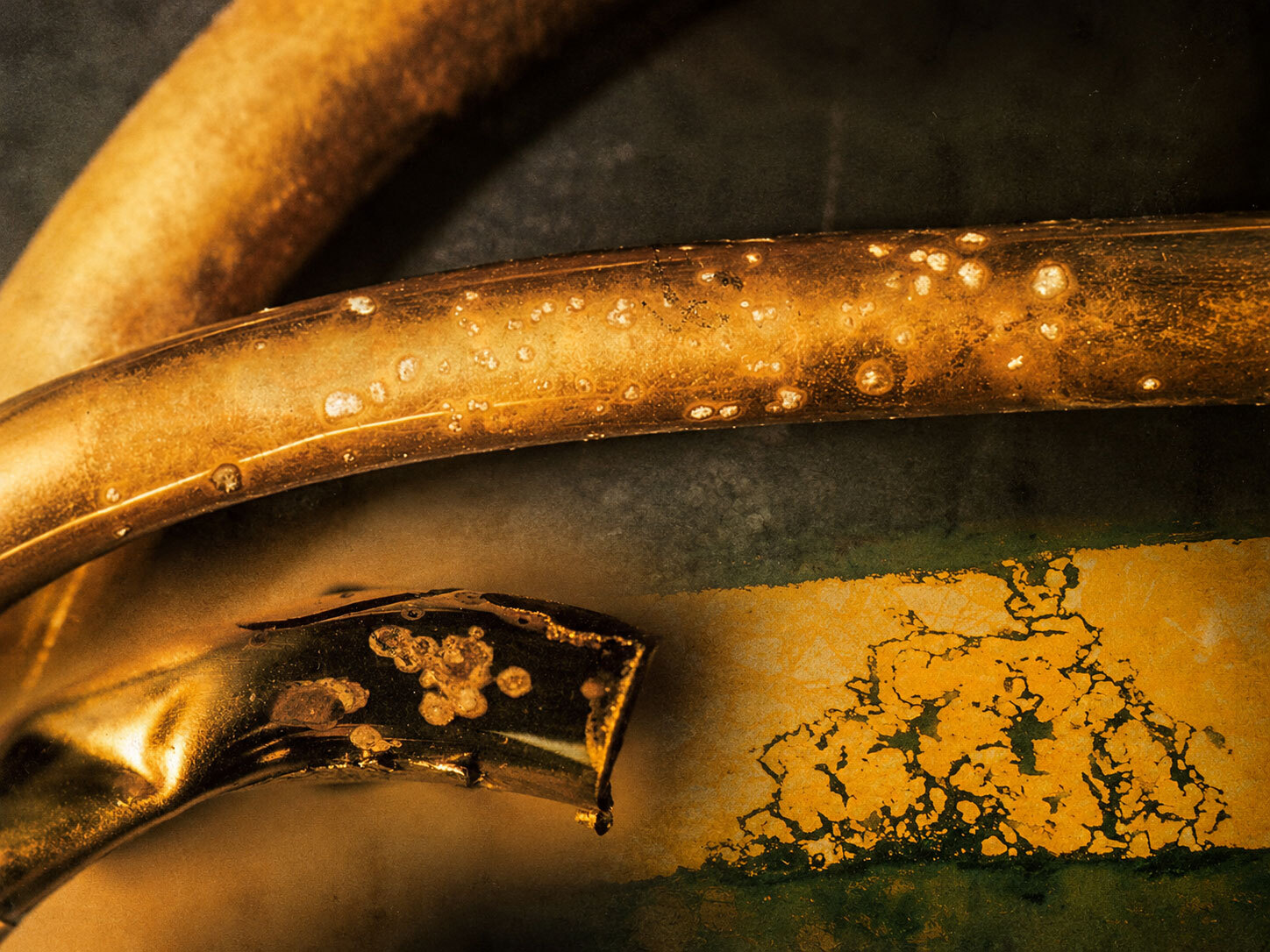
Red spots on brass instruments were often blamed on players and poor maintenance, yet the causes of premature corrosion may lie in manufacturing and surface treatments.
Points and areas of corrosion in brass instruments

According to a definition of the German industrial standard DIN 50900 corrosion is understood as "alteration of a material, starting at the surface, caused by unintentional chemical or electrochemical action". We all know the destructive effect of corrosion in iron, better known as rust. It may be less well known that there is similar destructive corrosion in other metals and alloys. This applies particularly to a special form of corrosion of brass, known as "dezincing".

Dezincking generally arises through the formation of "local elements" on the surface of the metal, which lead to a breakdown in the structure of the material. A precondition for dezincking is of course the presence of moisture, which acts as an electrolyte. Through corrosion the more basic zinc is removed from the structure of the material. A more or less porous mass of copper remains at the site of the corrosion. The point of failure generally displays the characteristic reddish colour of copper.

In instruments made of yellow brass (standard MS 72) the corrosion is often observed in the form of isolated red points or patches up to 5 mm in diameter. It occurs most on those parts of the instrument which in use become moist inside e.g: mouthpipes, tuning slides etc. Many players and certainly all instrument makers must be familiar with this phenomenon from their work but there is an extraordinary variety of views on these failures. The most common are:

  • the player's saliva is too aggressive;
  • the instrument was not properly cared for;
  • stomach acid got into the instrument;
  • materials are not as good as they used to be;
  • the metal can't breathe through the lacquer;
  • in the course of stretching brass pipe hydraulically pores develop in the material.

Since professionally I work constantly on laboratory investigations of instances of corrosion and am repeatedly confronted with these corrosion problems in looking after my private collection of brass instruments, I have naturally been motivated to study this problem more closely. Over the course of several years I have studied many instrument parts with and without red points and patches microscopically and analytically. In this connection see illustrations 1 - 4. I have also analysed the corrosive action as far as possible while the instrument is in use.

Continue reading

Access the full Digital Edition.

Brass Bulletin 54, II / 1986 pages 99–102

All content is protected by copyright © Brass Bulletin 1986–2026

Share this article

Facebook LinkedIn
Loading…

Questions & Answers

How the Digital Edition works

What does the Digital Edition include?

The Digital Edition brings together the articles already digitized as searchable online texts—not simply as scans or PDF files—along with their original illustrations, notes, authorship, issue information, and available translations. Related-article suggestions currently include only this digitized material.

Are the digital articles identical to the originals?

We preserve the original text, language, illustrations, captions, footnotes, and editorial context as faithfully as possible. The presentation is adapted for comfortable online reading, and obvious transcription or scanning errors may be corrected. The substance and character of the published article remain unchanged.

Which languages are available?

Brass Bulletin was published in English, French, and German throughout its history. Italian and Spanish translations were added from issue No. 60 onward.

On the Italian and Spanish sites, articles from issues 1–59 are therefore shown in English by default.

How often are new articles added?

New articles are added almost daily, with approximately one complete issue digitized each week. The pace may vary depending on the preparation, image work, and editorial checking required.

Why aren’t all articles available digitally?

The complete Brass Bulletin collection contains 1,246 articles published between 1971 and 2003. The full index is already available online, allowing readers to discover every article in the collection, including those whose complete text has not yet been digitized.

Digitization began in February 2026. Each article is carefully prepared for online reading, checked, and connected to its issue, authors, subjects, and illustrations. At the current pace of digitization, the complete collection is expected to be available online by February 2028.

Why do some references mention articles that are not available yet?

References in the original articles are preserved even when the material they point to has not yet been digitized. This keeps the historical and editorial record intact. As more issues are added to the Digital Edition, an increasing number of these references will lead to articles that can be read online.

Can I suggest an article or report a transcription error?

Yes. If there is an article you would particularly like to see digitized, or if you notice a possible transcription error or missing detail, please contact us. Reader feedback helps us improve the Digital Edition and prioritize useful connections within the archive.

How can I support Brass Bulletin?

Your support helps fund the preparation, verification, and online publication of the complete collection.

Subscribe to the Digital Edition

Prefer to support us without subscribing?

Make a donation

How is the digitization progressing?

We’re gradually making the Brass Bulletin available online, article by article. You can read newly digitized articles as soon as they’re ready, even before an entire issue is complete.

Visit our Digitization Roadmap to browse recent additions and see estimated availability for upcoming issues. These estimates follow our recent pace and may change.

Search Brass Bulletin.