7 min. read
The contrabass trombone
Picture and sketches, taking particularly into account the construction principles (1973)
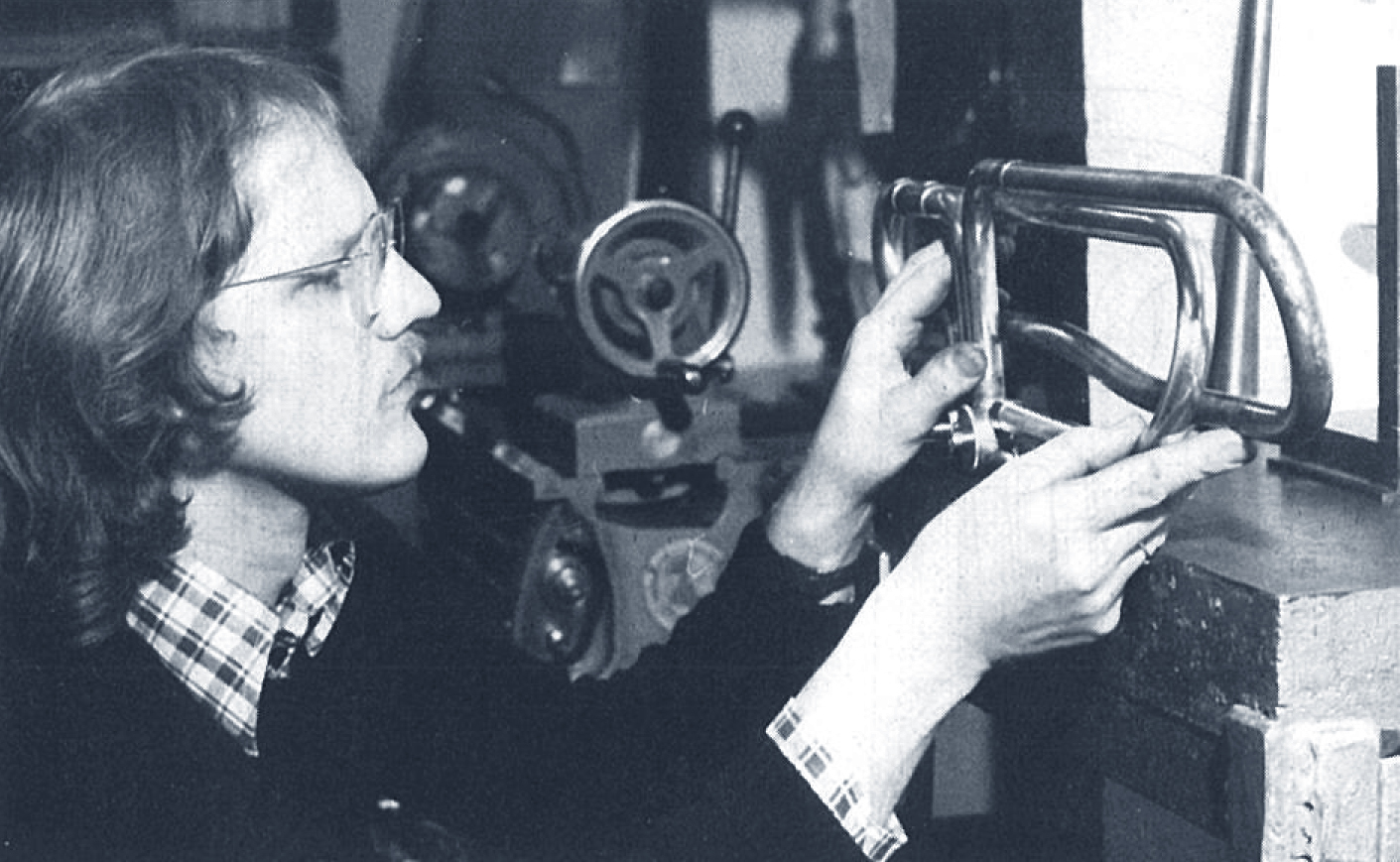
II. Constructional Aspects
2.1. Model construction
At the beginning of instrument manufacture there is first of all the drawing, whether it is the sketch of an idea as the preliminary stage to an individual design, or the hand or workshop design of an approved model.
The contrabass trombone dealt with here is a new construction design by the author, Heinrich Thein, based on an approved model.
This existing model is the contrabass trombone by Heinrich Kull, Witzenhausen.
His instruments are to be found in the European large symphony and opera orchestras and are praised especially for their good intonation (ill. 1).
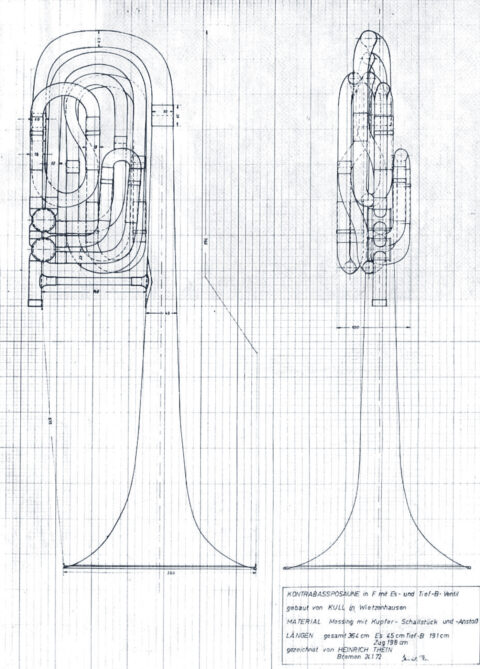
When examining the instrument and the drawing and in discussion with contrabass trombonists faults in the construction came to light: disadvantageous upright position of the valves, one above the other. Very long depression of thumb levers. The instrument spoke badly when valves were depressed and various slides which collected condensation were difficult to remove.
These faults in the model by Kull have all been corrected in the new design (ill. 2). The valves were put side by side and turned downwards. They are operated by a stable thumb valve mechanism which has a very short depression.
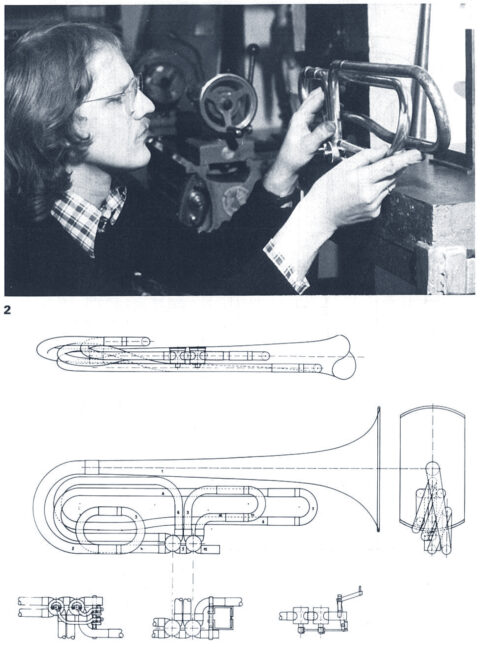
The tuning slide was positioned in such a way that it can be pulled out comfortably in the playing position, besides the condensation from the main tube collecting in it.
The shorter tube lengths are contained in as many straight sections and round bows as possible, so that the vibrating air column is unhindered by any narrow tubing. The rounded tubing creates an improvement in the way the instrument speaks, as has been proved. In consequence all the bows in this design have been built as rounded slides.
The "innards" (subsidiary coils) are positioned in such a way that all the condensation is collected in two easily accessible slides, which at the same time serve as fine tuners for the short sections. The inclusion of a bell stay was completely left out, and not only for reasons of weight. The bell section is unencumbered, which according to the latest knowledge acquired in instrumental constructional techniques contributes a great deal to improved response.
2.2. Basic pitch
The discussion about the basic pitch of the instrument finishes with the fixing of the main tube length and the individual tube sections for the "guts" (valve slides). The main tube length is 364 cm, of that 198 cm is allotted to the slide. The low Bb valve is 191 cm long, the Eb valve 45 cm. The present instrument is built in high orchestral pitch a' — 445 Hz.
2.3. The bell (complete)
2.3.1. The actual construction of the trombone begins with the preparation of the unfashioned bell section. This was ordered from the firm Meinl und Lauber, Geretsried, according to the construction design by H. Kull, Witzenhausen. The material is gold brass with French rim. The raw section is checked with respect to the bore, scoured, cut to length, smoothed off, ground and receives preliminary polishing (ill. 3).
Brass Bulletin 23, III / 1978 pages 55–64
All content is protected by copyright © Brass Bulletin 1978–2026