8 min. read
The untimely demise of the ophicleide
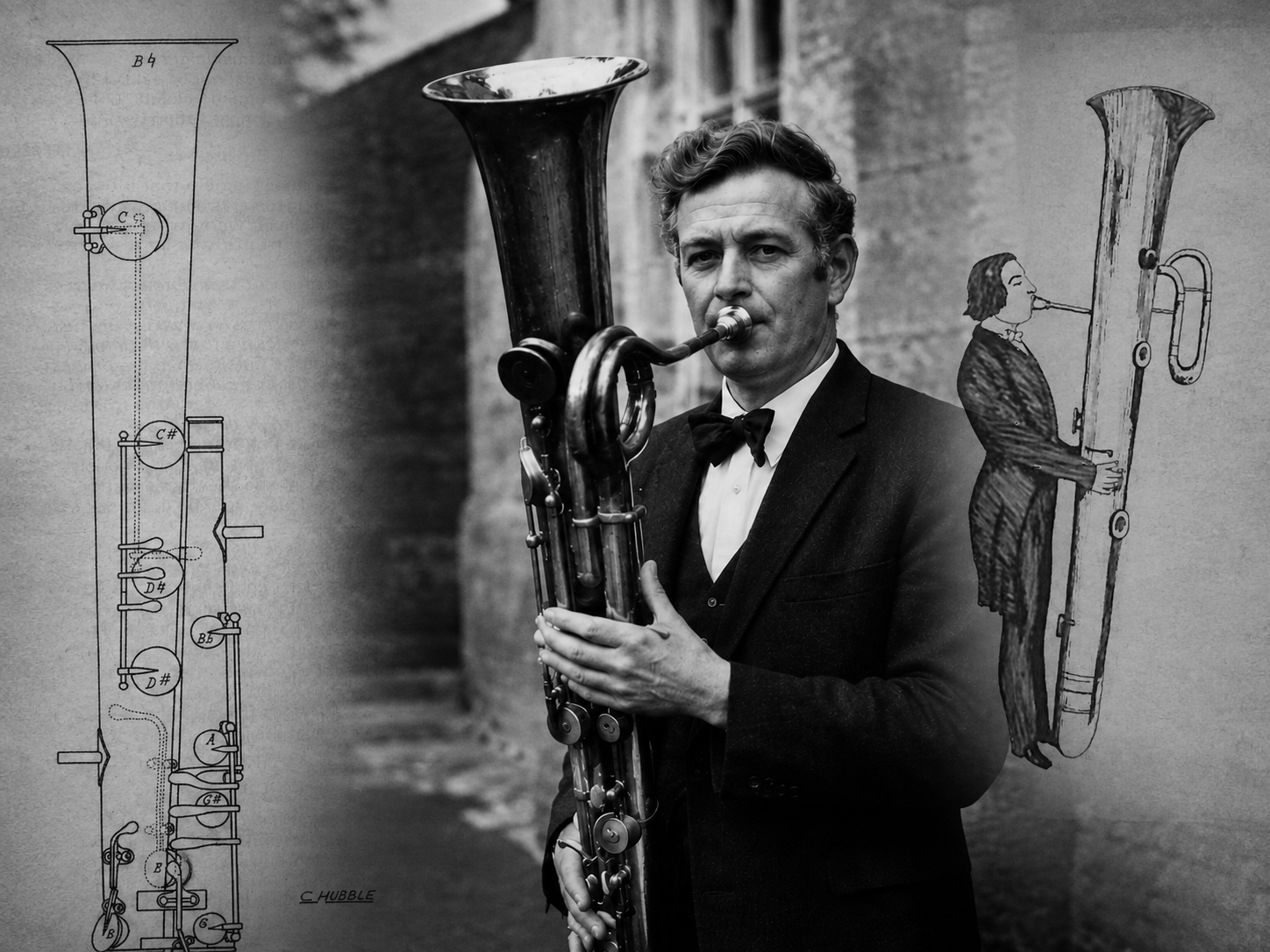
The last and finest musical instrument of the family referred to as the “keyed brass” was the ophicleide, which flourished in its bass form during the greater part of the last century.
The brass instrument in C measures approximately 105 centimetres in height, but consists of two parallel tubes, one wide, one narrow, joined at the lower end. The upper section of the wide tube opens into a bell, whereas the narrow tube is fitted with a crook, sometimes coiled or in elliptical shape, tapering to a mouthpiece, which is similar to that of a euphonium. There are between nine and twelves keys, evenly spaced over the tubes.
Examples are usually in yellow brass, but red brass and silver-plated instruments are known. Occasionally noted are wooden instruments, and in this form they are generally called “serpent-cleides”.
The ophicleide was invented in 1817 by the Frenchman Halary and continuously perfected in both England and France until 1860 when MacFarlane, Newton and Carte patented their model with open-standing keys. By 1880, however, it was obsolescent in France, but survived rather longer in England.
Out of pure conjecture it is interesting to imagine the circumstances which would have permitted the instrument to remain an acceptable part of military and orchestral music.
A first consideration must be the contemporary criticism of the ophicleide, and whether these problems were insuperable.
I. Intonation
In the past it was always presumed that this was the ophicleide’s major shortcoming — a presumption which can only ridicule the sensibility of Victorian musicians and audiences. A good instrument, played by a competent musician is very highly acceptable. This has been proved recently by Alan Lumsden and others. The acclaim given to Ponder, Prospère, Caussinus and Hughes can scarcely be tempered with suspicions about intonation. The same cannot be said of the early valved instrument soloists, before the invention of compensating devices.
II. General timbre
It is of interest to note that most of the disparaging remarks about this aspect of the ophicleide were written after its demise, by people who probably never heard it.
This instrument was formerly much in vogue, but it has gradually and justly been put aside, as its croaking unmusical and false tones are to say the least, quite disagreeable. Employed in the orchestra it may auger as a substitute for the bass-trombone, but as a solo instrument it would be simply disgusting.
Thus wrote Professor Kling in the 1902 American edition of his “Modern Orchestration and Instrumentation”. He was, obviously, greatly in favour of the bass tuba:
This colossal instrument has replaced the ophicleide excellently.
The Berlioz comment about the bull escaped from its stall (in the Bennet edition of the treatise), which gave rise to the “chromatic bullock” quotation, is more of a condemnation of contemporary operatic composers who insisted on fast solo passages for the ophicleide, than a criticism of the instrument’s timbre.
Brass Bulletin 43, III / 1983 pages 10–17
All content is protected by copyright © Brass Bulletin 1983–2026