2 min di lettura
Points and areas of corrosion in brass instruments
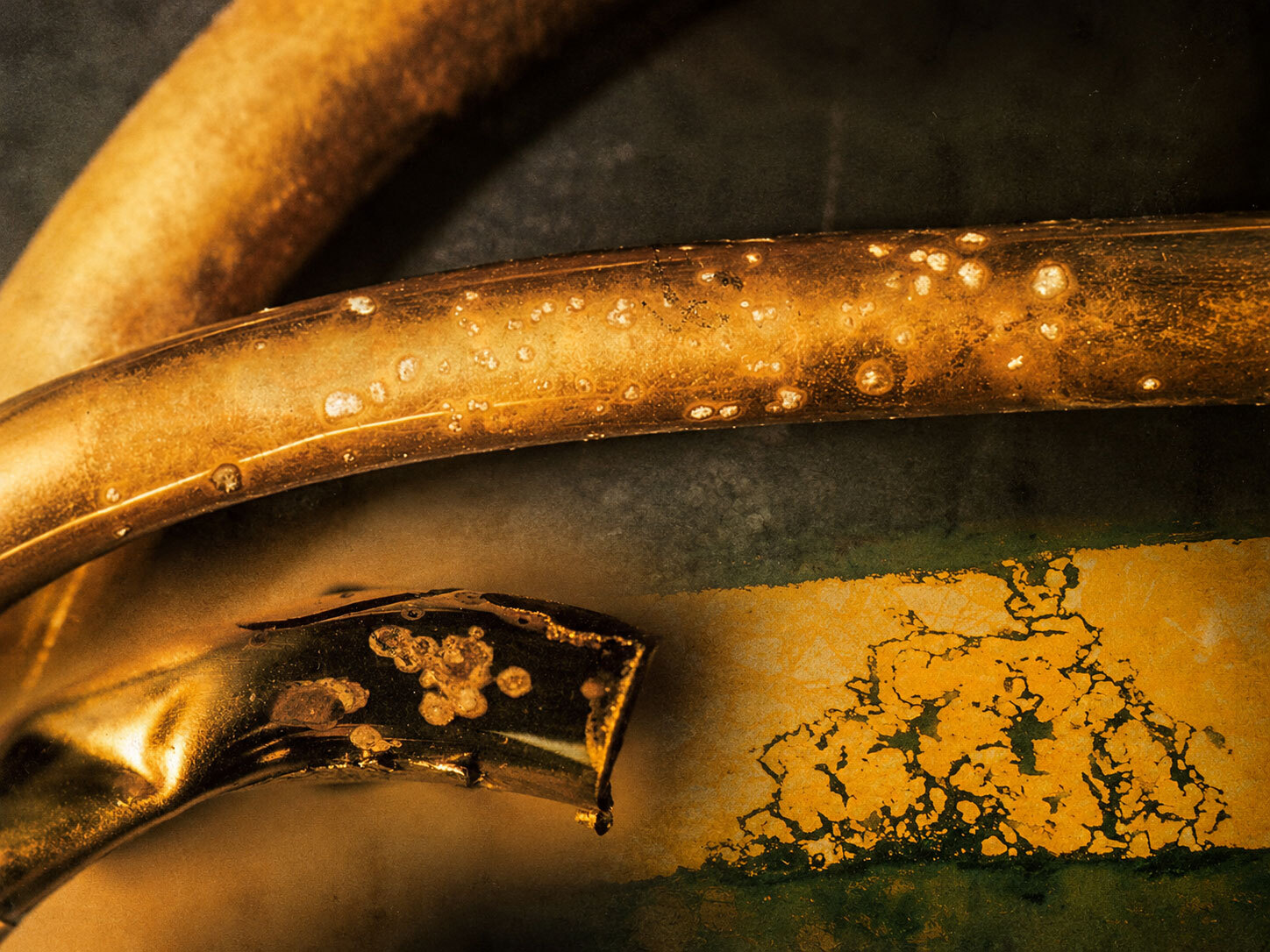
According to a definition of the German industrial standard DIN 50900 corrosion is understood as "alteration of a material, starting at the surface, caused by unintentional chemical or electrochemical action". We all know the destructive effect of corrosion in iron, better known as rust. It may be less well known that there is similar destructive corrosion in other metals and alloys. This applies particularly to a special form of corrosion of brass, known as "dezincing".
Dezincking generally arises through the formation of "local elements" on the surface of the metal, which lead to a breakdown in the structure of the material. A precondition for dezincking is of course the presence of moisture, which acts as an electrolyte. Through corrosion the more basic zinc is removed from the structure of the material. A more or less porous mass of copper remains at the site of the corrosion. The point of failure generally displays the characteristic reddish colour of copper.
In instruments made of yellow brass (standard MS 72) the corrosion is often observed in the form of isolated red points or patches up to 5 mm in diameter. It occurs most on those parts of the instrument which in use become moist inside e.g: mouthpipes, tuning slides etc. Many players and certainly all instrument makers must be familiar with this phenomenon from their work but there is an extraordinary variety of views on these failures. The most common are:
- the player's saliva is too aggressive;
- the instrument was not properly cared for;
- stomach acid got into the instrument;
- materials are not as good as they used to be;
- the metal can't breathe through the lacquer;
- in the course of stretching brass pipe hydraulically pores develop in the material.
Since professionally I work constantly on laboratory investigations of instances of corrosion and am repeatedly confronted with these corrosion problems in looking after my private collection of brass instruments, I have naturally been motivated to study this problem more closely. Over the course of several years I have studied many instrument parts with and without red points and patches microscopically and analytically. In this connection see illustrations 1 - 4. I have also analysed the corrosive action as far as possible while the instrument is in use.
Brass Bulletin 54, II / 1986 pagine 99–102
Tutti i contenuti sono protetti dal diritto d’autore © Brass Bulletin 1986–2026