Discoveries for brass players, once a month. Join our free newsletter →

2 min. read

This article is free.

The Oldest Concert Band in Japan

The Oldest Concert Band in Japan

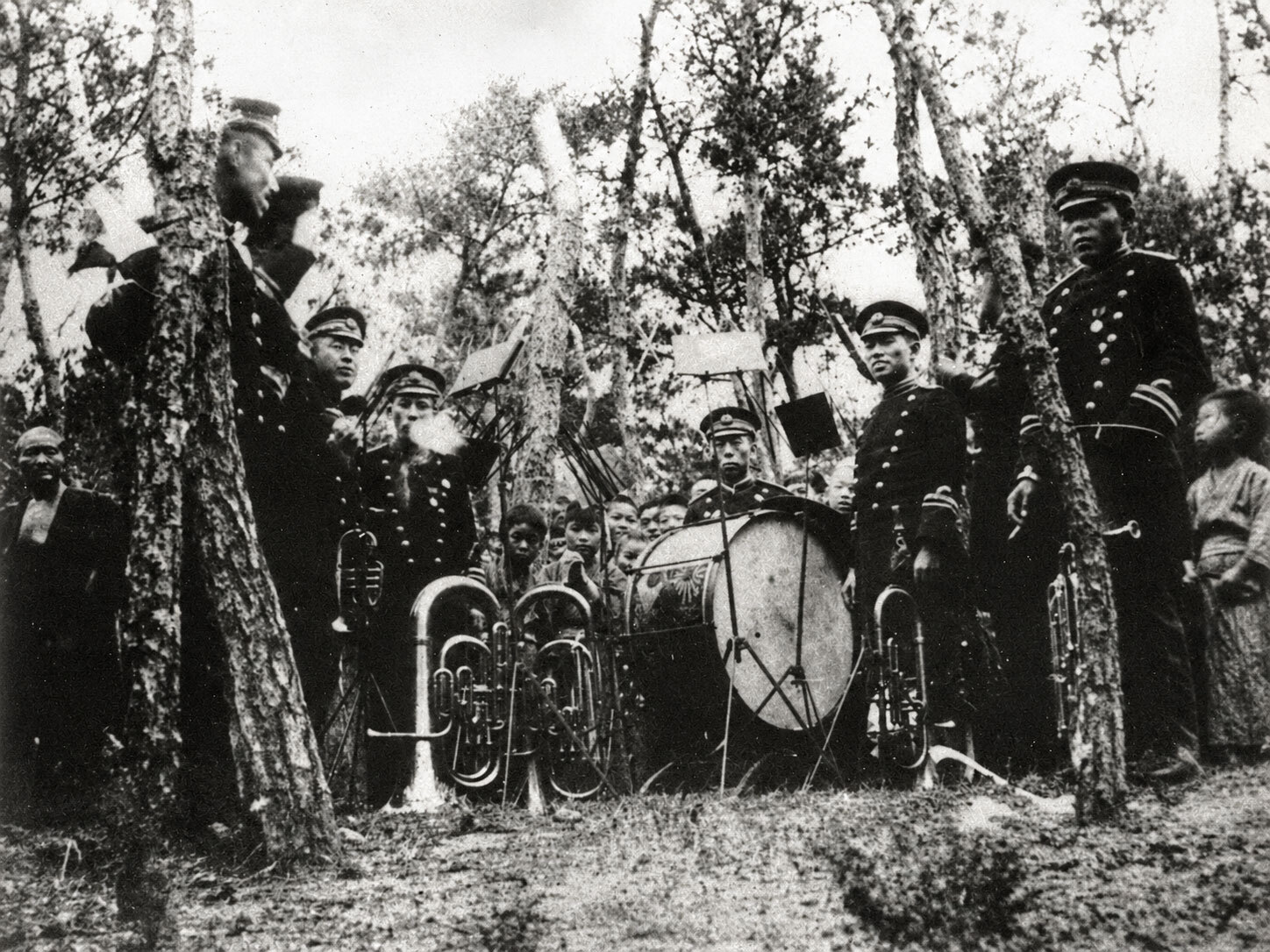
1901 — opening ceremony when piped water arrived in Ichinomiya.

In the center of Japan is a big city called Nagoya. One of its satellite towns, Owari Ichinomiya, has long been famous for its textile industry, but it also has a municipal band dating back to 1895.

It is around one hundred years since European music and instruments first came to Japan, so it is around that time that the Ichinomiya band was born. In those distant days there were hardly any military bands in Japan.

The Ichinomiya band was founded by Shinichi Saburi, manager of the local bank. He wanted to bring musical culture to his town so he gave his employees wind instruments (which in those days hardly anyone had ever seen) and formed a band.

The photograph was taken in 1901, when piped water arrived in Ichinomiya. The players in the photo performed at the opening ceremony. Their instruments are German, purchased from a German import agent in Yokohama.

Aren’t the children behind the band funny, watching so curiously? It was probably the first time that they had ever heard wind instruments. In those days cameras were also rare of course. Note too the kimono worn by the girl on the right (nowadays women hardly ever wear kimono except for special occasions).

Although the band broke up during World War II, it was revived after the war thanks to the local people’s efforts and enthusiasm for music, and continues to this day. In Japan it is extremely rare to find a band that is as old as ninety.

Today the band has its office in the headquarters of the local fire brigade. It receives financial assistance from Meitaroh Mori, Owari Ichinomiya City mayor, and from the Ichinomiya Chamber of Commerce and Industry. The band is a mixture of professional and amateur musicians ranging from twenty to seventy-four years old. It is like a living picture gallery of Japanese musicians from the Meiji era, when western culture was first introduced to Japan, to the present day.

The leader of the band, Kiyozaburo Omiri, is perhaps its most symbolic figure. Aged seventy-four, he is vice-president of the Ichinomiya Chamber of Commerce and Industry and president of Ohmori Oil Company, located in Nagoya. He took over the conducting and managing of the band in 1927, and has been a spiritual and material supporter of the band for half a century. He is a truly devoted patron, willing to pay out of his own pocket for the band. He still conducts at local functions, but a young flutist, Tsutomu Nomura, takes care of the day-to-day rehearsals and conducting. Over the past five years Mr. Omori has raised the band to new levels. He has brought in some top quality professional players, and entrusted teaching to Genkichi Harada, a tuba player in the NHK Symphony Orchestra and honorary conductor of the Yamaha Band. Mr. Omori has tried to bring the band closer to the local people; it now has a repertoire of four hundred numbers, ranging from marches, popular music and folk songs to opera overtures and other classical music.

He says,

I don’t know how many times I’ve thought of giving up, but I’m not the type who can walk out on a hobby and continue my main work. I believe in doing a thing properly once you’ve made up your mind. And I don’t regret it. I’m pleased that I’ve continued with my music.

Brass Bulletin 54, II / 1986 pages 62–64

All content is protected by copyright © Brass Bulletin 1986–2026

Share this article

Facebook LinkedIn
Loading…

Questions & Answers

How the Digital Edition works

What does the Digital Edition include?

The Digital Edition brings together the articles already digitized as searchable online texts—not simply as scans or PDF files—along with their original illustrations, notes, authorship, issue information, and available translations. Related-article suggestions currently include only this digitized material.

Are the digital articles identical to the originals?

We preserve the original text, language, illustrations, captions, footnotes, and editorial context as faithfully as possible. The presentation is adapted for comfortable online reading, and obvious transcription or scanning errors may be corrected. The substance and character of the published article remain unchanged.

Which languages are available?

Brass Bulletin was published in English, French, and German throughout its history. Italian and Spanish translations were added from issue No. 60 onward.

On the Italian and Spanish sites, articles from issues 1–59 are therefore shown in English by default.

How often are new articles added?

New articles are added almost daily, with approximately one complete issue digitized each week. The pace may vary depending on the preparation, image work, and editorial checking required.

Why aren’t all articles available digitally?

The complete Brass Bulletin collection contains 1,246 articles published between 1971 and 2003. The full index is already available online, allowing readers to discover every article in the collection, including those whose complete text has not yet been digitized.

Digitization began in February 2026. Each article is carefully prepared for online reading, checked, and connected to its issue, authors, subjects, and illustrations. At the current pace of digitization, the complete collection is expected to be available online by February 2028.

Why do some references mention articles that are not available yet?

References in the original articles are preserved even when the material they point to has not yet been digitized. This keeps the historical and editorial record intact. As more issues are added to the Digital Edition, an increasing number of these references will lead to articles that can be read online.

Can I suggest an article or report a transcription error?

Yes. If there is an article you would particularly like to see digitized, or if you notice a possible transcription error or missing detail, please contact us. Reader feedback helps us improve the Digital Edition and prioritize useful connections within the archive.

How can I support Brass Bulletin?

Your support helps fund the preparation, verification, and online publication of the complete collection.

Subscribe to the Digital Edition

Prefer to support us without subscribing?

Make a donation

How is the digitization progressing?

We’re gradually making the Brass Bulletin available online, article by article. You can read newly digitized articles as soon as they’re ready, even before an entire issue is complete.

Visit our Digitization Roadmap to browse recent additions and see estimated availability for upcoming issues. These estimates follow our recent pace and may change.

Search Brass Bulletin.