13 min. read
This article is for subscribers.
British brass players training
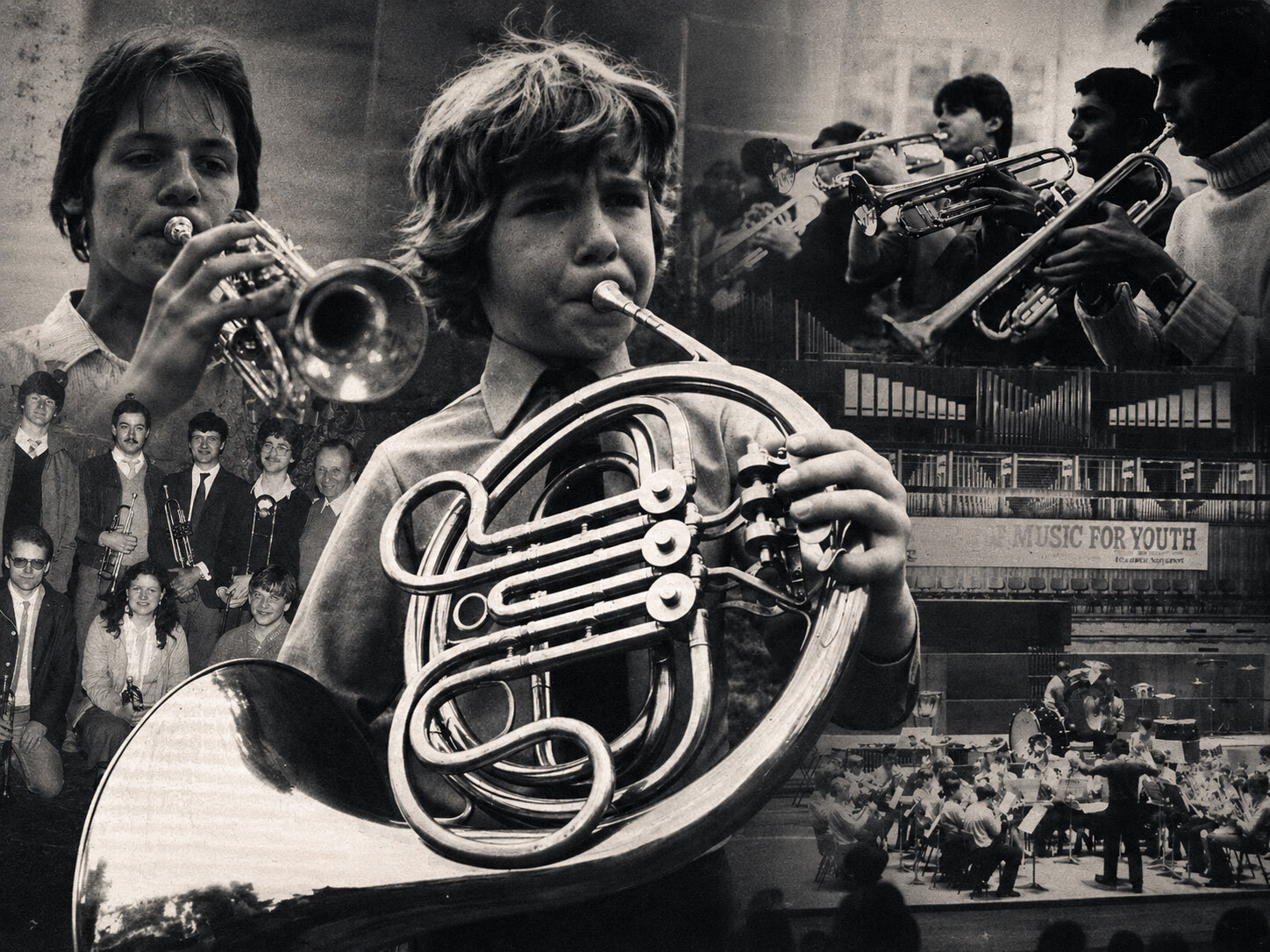
Until perhaps thirty years ago most young Britons who began learning a brass instrument would have done so in connection with one of the country’s many amateur brass bands. A good many still do. The teaching they receive varies from very good to rather poor. There has always been, also, some private professional teaching of brass instruments — although this is by no means evenly spread around the country — and many public (i.e. fee-paying, private) schools have employed brass teachers for a number of years.
In the last thirty years, however, a very high proportion of brass learners have begun in their ordinary state day school, under visiting (peripatetic) teachers, on instruments which are initially loaned to them. Schools tend to organise bands and orchestras of various kinds, so there is plenty for these pupils to do once they have mastered basic techniques, and they can also, of course, play in the bands and amateur orchestras which are to be found in most adult communities. If when they leave school they wish to continue their brass training, they will seek a place at one of the music colleges. In most respects this has not changed — except for very considerable expansion — during this century.
In considering the training of British brass players, I therefore spoke to John Edney, one of the two Brass Organisers of the Inner London Education Authority (ILEA), and Harold Nash, Convenor of Brass at the Royal Academy of Music and Principal Trombone at the Royal Opera House, Covent Garden.
John Edney himself went to school in London. He started on trombone at 14 and returned to it finally after experiments with horn and trumpet. He was a member of the London Schools Symphony Orchestra when it was founded in 1951. After study at Trinity College of Music he played in succession in the Band of the Grenadier Guards, the Festival Ballet, the BBC Scottish Orchestra, as a London free-lance and in the Royal Opera House Orchestra. He took up his present (part-time) post with ILEA in 1970 and continues to play free-lance with some of London’s leading chamber orchestras.
Harold Nash began playing in a Salvation Army band in South Wales. After a less than wholly successful attempt to master the tenor horn he switched to trombone and was much happier. He won a scholarship to the Royal Academy of Music, where he studied under Sydney Langston, who eventually took him into the trombone section of the Royal Philharmonic Orchestra. From there he moved to Sadler’s Wells Opera and, in 1956, to the Royal Opera House, where he has remained. He succeeded Sydney Langston as Professor of Trombone at the Academy in 1973 and during his time there that institution has undergone considerable changes in structure and curriculum.
In broad outline, ILEA and the Academy are representative of other similar bodies and institutions — although ILEA has for a long time been more generous than most local education authorities. (With the Thatcher government’s attempt to reform the pattern of metropolitan local government in Britain, this may change, because ILEA is one of their most notable targets. This article may come, unfortunately, to have a historical, not to say nostalgic flavour!)
With his colleague Michael Hinton, John Edney oversees the work of some 320 peripatetic brass teachers in London’s primary and secondary schools. These teachers, drawn from London’s vast pool of professional players, can only be employed by ILEA for ten hours per week. Some do far less. Some teach only their specialist instrument but most teach the whole range.
This article is for subscribers.
CHF 5.00 per month · Cancel auto-renewal anytime.
Enjoy unlimited access to all digitized Brass Bulletin articles.
Brass Bulletin 54, II / 1986 pages 48–59
All content is protected by copyright © Brass Bulletin 1986–2026