16 min. read
The Coiled Hunting Instrument by J. W. Haas
Bad Säckingen Trumpet Museum
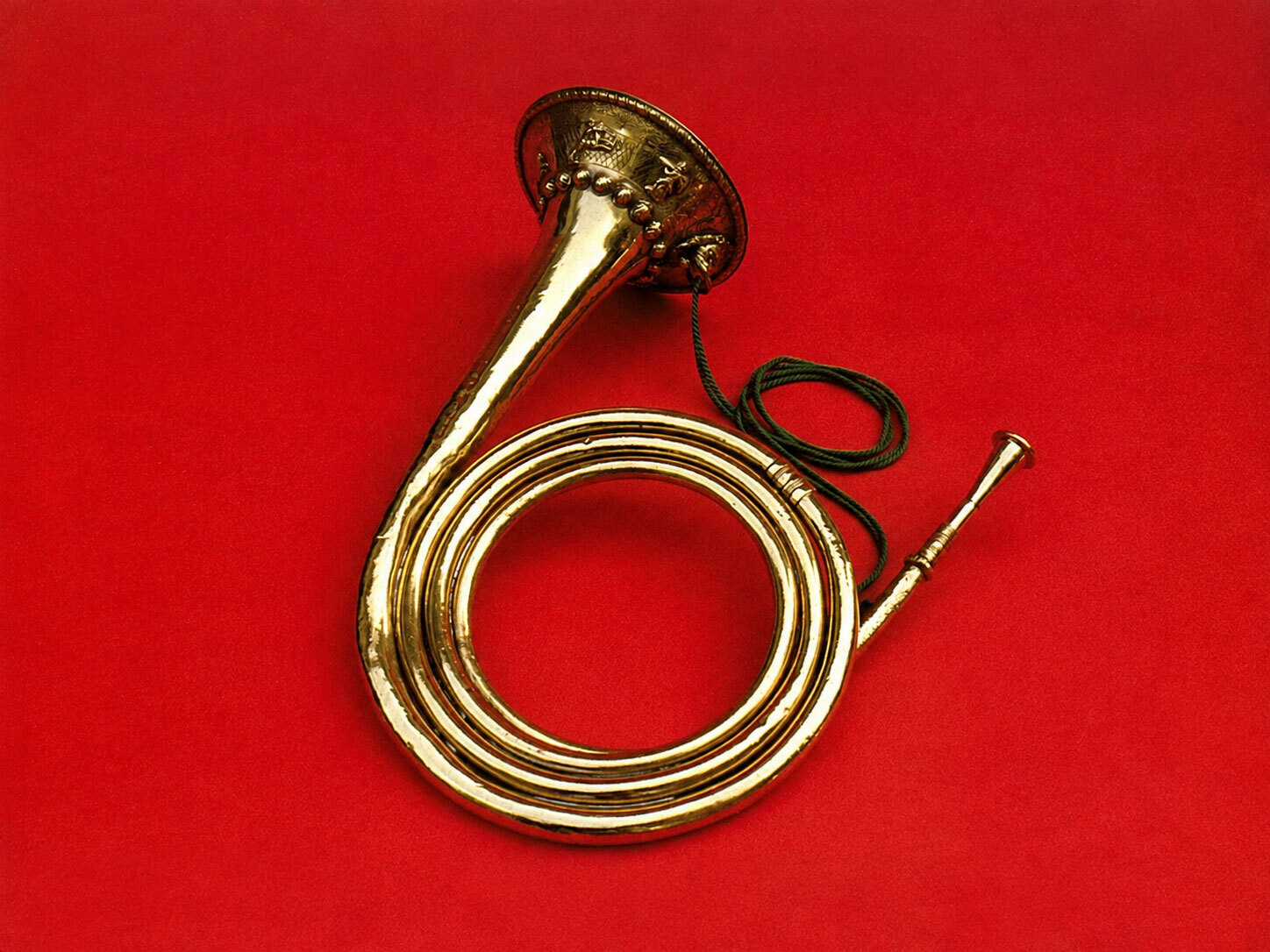
The hunting horn by Haas after restoration.
In a showcase in the second exhibit room of the Bad Säckingen Trumpet Museum an instrument is hanging which, in the museum catalogue, is simply described as a "coiled hunting instrument".¹ The instrument's value increases when we learn that it was made in 1688 by Johann Wilhelm Haas (1649-1723), probably the most famous brass instrument maker of his time. Its singular impact, however, comes from the almost life-size portrait hanging next to it: a framed color reproduction of the famous oil painting of Bach's trumpeter in Leipzig, Gottfried Reiche (1667-1734).² The viewer can recognize immediately that the Haas instrument and the coiled one in the Reiche portrait are of one and the same type. The true revelation of the jewel we have before us comes, furthermore, when we realize that the Haas instrument is the only one of its type to have survived, after a similar one made in 1697 by Heinrich Pfeiffer of Leipzig disappeared during the Second World War.³ The Bad Säckingen instrument is thus unique.
Characteristic of this coiled instrument's form is the fact that the three and a half coils — four and a half for the one in the Reiche portrait — are all in one plane. The earliest pictorial representation of such a brass instrument can be found in Michael Praetorius' Syntagma musicum. On Plate VIII of Volume II (Wolfenbüttel 1619)⁴ a similar instrument with four and a half coils and a whole-tone crook — as with Reiche's instrument — is depicted as No. 11. In the legend below, it is called a "hunters' trumpet" ("Jäger-Trommet").
A similar instrument can be seen on an engraving from 1710. The source is Unfehlbare Engel-Freude oder Geistliches Gesangbook ("Infallible Angel Joy or Spiritual Hymnal") (Leipzig 1710), showing the musicians in St. Thomas's Church in Leipzig under the direction of Bach's predecessor Johann Kuhnau (1660-1722).⁵ In the left foreground, a musician — perhaps Gottfried Reiche himself, who in 1706 became "Stadtpfeifer-Senior" — is standing next to two other instrumentalists who are holding long natural trumpets. The musician in question is holding a horn-like instrument with one and a half coils (probably incorrectly drawn in the engraving), its bell in the air.
Similar instruments of small diameter with coils in one plane do exist, but on the evidence of their bell form they are unequivocally to be called horns.⁶ Reiche's instrument, however, has variously been called a horn or a trumpet.⁷ The great scholar Herbert Heyde recently wrote the following about it:
The instrument has a hybrid bore between that of a horn and of a trumpet. Such a bore had already been developed, at the latest, by the mid 17th century and was to become the normal bore of posthorns and cornets in the 19th century.⁸
He further calls attention to a Saxon tradition of constructing small horns, a tradition which "can be followed back to the 16th century".⁹ Since Heyde has announced his intention of writing a longish article on this subject in these pages, I will not anticipate what he has to say.¹⁰
In the case of such an obvious dispute among scholars, some of whom call the instrument a horn, others a trumpet, it is impossible to give Reiche's instrument a definite name on the basis of the literature alone. However, the Bad Säckingen instrument does offer us some help. Let us look at it more closely.
Brass Bulletin 54, II / 1986 pages 8–22
All content is protected by copyright © Brass Bulletin 1986–2026