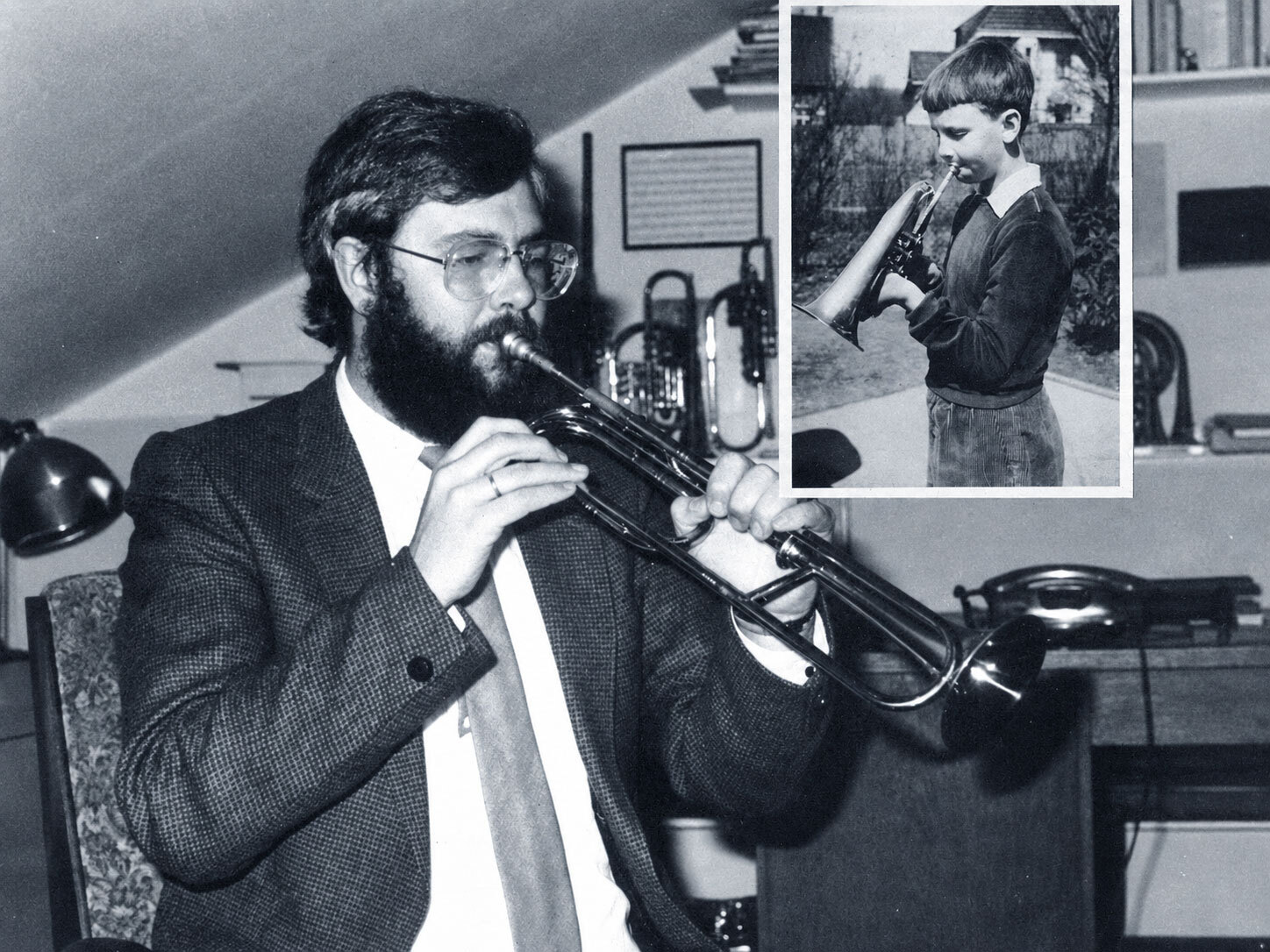
Modern trumpets - first career
In 1970 at the age of only 22 he successfully tackled the difficult trumpet part in Bach’s 2nd Brandenburg Concerto. He could play the 1st part in the B minor Mass perfectly. His reputation never stopped growing from then on.
Throughout this period, however, he did not only study music. He enrolled first in medecine, then in maths and in physics. It was not until 1977, shortly before his final exams, that he gave up all his scientific studies to devote himself entirely to music.
His solo career was already well under way when he enrolled in the Cologne College of Music to study with Walter Holy¹. What he wanted most of all was the knowledge of theory he needed for his teacher’s diploma.
As a student but also a full-time professional musician he was in an ambiguous and slightly comical situation, especially when the college where he was studying offered him a post teaching early music. Welcome proof that it is still possible to get an important job on the basis of knowledge and talent rather than by presenting diplomas and recommendations.
Friedemann Immer is a self made man who has built his own career without referring to the other pioneers of Baroque trumpet music a great deal. His is an original and interesting path.
Natural trumpets - second career
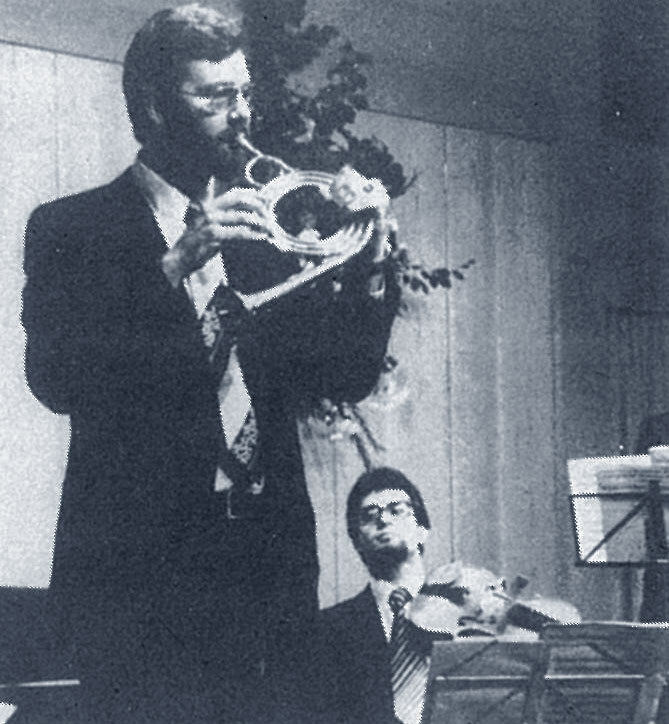
The oboist Helmut Hucke first aroused Friedemann’s interest in the natural trumpet and the cornetto (he started learning the latter in 1972, first on a Moeck instrument, then on one by Christopher Monk).
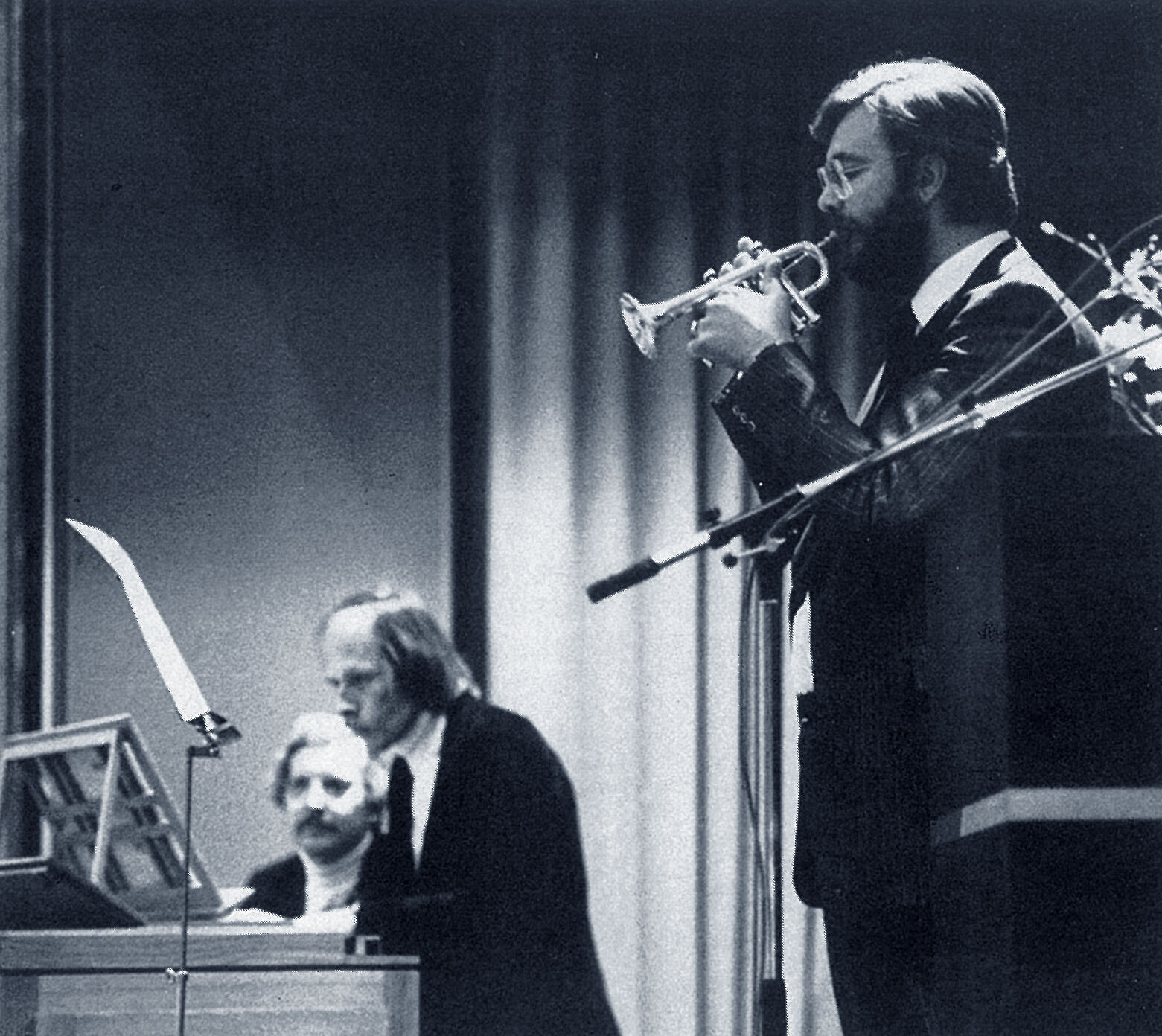
In 1976 he bought his first D/C natural trumpet from Meinl & Lauber. A year later he played the 2nd Brandenburg in public on an F natural trumpet (also made by Meinl & Lauber), the first time, in May, in Switzerland and the second in the United States where he also made a record (Smithsonian Institution, Washington DC). This was the start of a second career which was to develop parallel to, and by the same criteria as the one which had started in 1970 with the modern trumpet: B minor Mass, cantatas, oratorios etc.
Today his repertoire is divided as follow: 30% modern trumpets, 60% natural trumpets and 10% cornetto. In 1980 Nikolaus Harnoncourt invited him to record with the Vienna Concentus Musicus. In 1982 he made an exceptionally fine recording of the 2nd Brandenburg with this renowned ensemble (Teldec). Further concerts and recordings with the most distinguished early music groups followed without a break: Collegium Aureum, La Petite Bande (Belgium); Leonhardt Consort (Netherlands); Academy of Ancient Music, Taverner Players (Britain); Aston Magna (USA); H.-M. Linde Consort (Switzerland) etc.
He has played the 2nd Brandenburg concerto in public more than 40 times on the natural trumpet and more than 160 times on the modern piccolo trumpet. He has made several recordings under his own direction. Friedemann Immer is joining the top rank of the great modern trumpeters.
In a forthcoming issue Friedemann Immer will tell us in greater detail about the “fundamental techniques” necessary for good natural-trumpet playing.