17 min. read
100 Years of Kuhlo's Posaunenchor Book
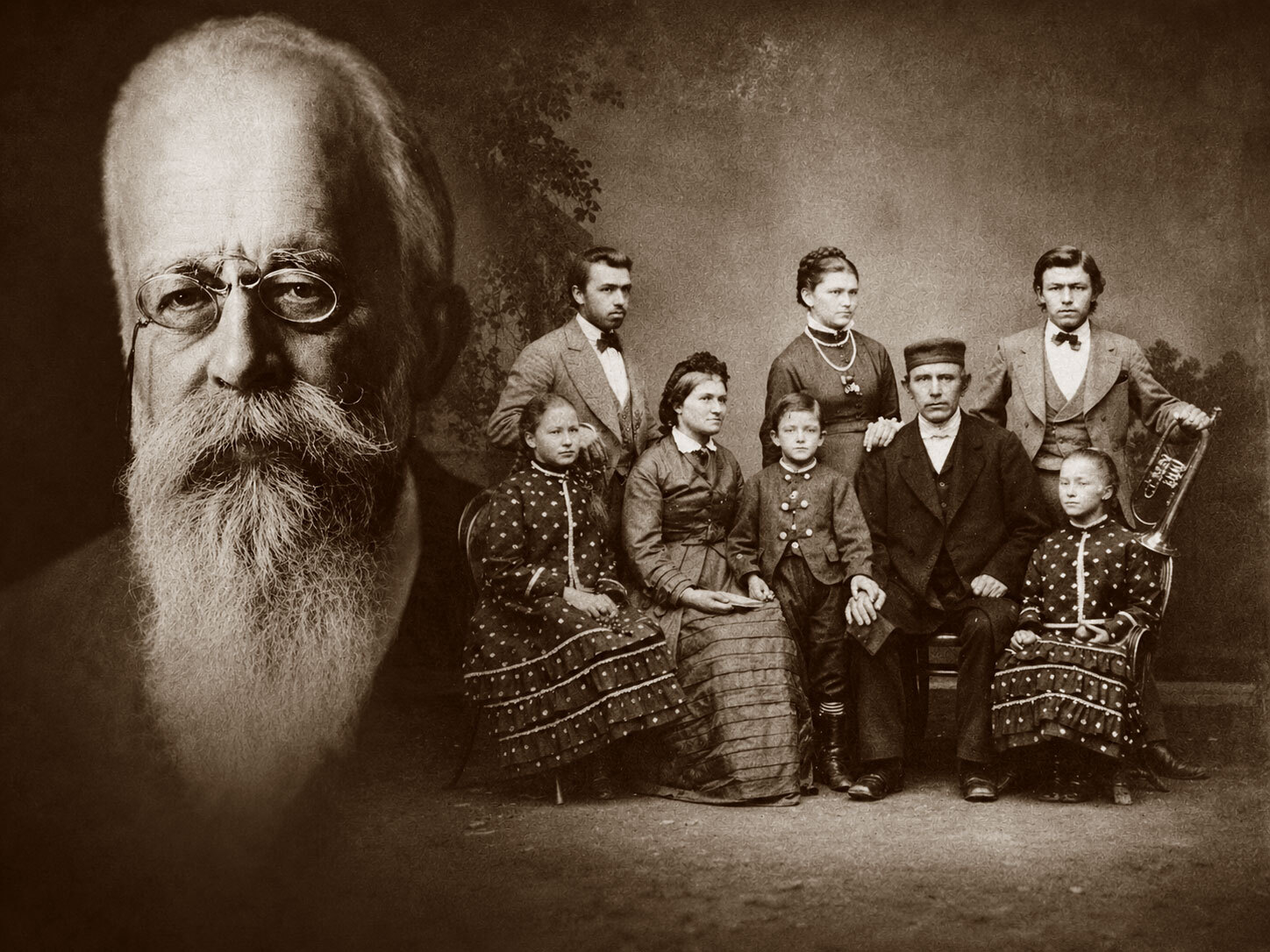
Papers of Kuhlo's have unexpectedly come to light: copies of music, musical sketch-books, manuscript song collections, first impressions, programmes, letters, notes etc. — an enormous jumble of things, disordered and for the time being impossible to take in.
Rummaging through these most informative documents, which stem from the many generations of singers and players in the Ravensberg area who were, unwittingly, to have such an influence on Westphalia, all Germany and even further afield, I came upon the first Posaunenbuch, the first Posaunenchor book, published in Gütersloh in 1881. It is therefore exactly 100 years old. A few words about its creation and its character may thus serve as a grateful contribution to Kuhlo Year.
But first an evaluation of the archive. Singing and playing started between the Teutoburger Wald and the Wiehengebirge as part of the movement of neo-pietistic revival. "Concern to become blessed" was the motive. "Bible peasants", as Kuhlo called them, gathered round the Bible and the song-book. The singing preceded the playing.
Torchbearers of the movement were the "Young Men and Women's Associations" led by Eduard Kuhlo, a parson in rural Gohfeld, near Herford and Bad Oeynhausen. It is characteristic of a "movement" that it seems suddenly to "drop from the heavens" — no-one is prepared for it, least of all for playing and singing in several parts. How would they get the music?
The young theologian had already started on a collection of songs in several parts while working as tutor to the von Laer family on their estate with its pretty little castle and lake in Westphalian style at Oberbehme, before the gates of Herford; he worked together with the daughter of the house, who was his fiancée (the collection is signed: "E. Kuhlo, Ida v. Laer, Oberbehme 1851"). The systematic arrangement proceeds from "Chorales" via "Sacred Folksongs and Children's Songs" and "Sacred Songs" to "Songs" (with piano) by Schubert and Mendelssohn in which the compiler accompanied his bride as soloist.
Written or oral sources are often indicated. Thus the song researcher included some specimens of Gregorian psalms from the Hermannsburg missionary centre (in several parts) "for additional church services". Another of Eduard's collections is intended specifically for choirs of players: "Score for the Posaunenchor at Gohfeld, begun in autumn 1867" (signed: "E. Kuhlo, parson in Gohfeld").
The Posaunenchöre were called into being by the revivalist preacher Heinrich Volkening from the village of Jöllenbeck near Bielefeld. They were to support the singing at the numerous revivalist groups' meetings in farmyards. As a basis for this Kuhlo took the Chorale Book for Evangelical Churches, Arranged in Four Parts Supplied with Preludes and Interludes by C. H. Rinck, first published in Essen in 1829 and commonly used in Westphalia, which this Bach epigone had compiled at the request of the consistory in Münster (Natorp).
Brass Bulletin 38, II / 1982 pages 33–53
All content is protected by copyright © Brass Bulletin 1982–2026