18 min. read
The trombone: changing times, changing slide positions
Howard Weiner was born 1952 in Chicago (USA). Initial trombone study with Richard Schmitt, followed by studies at Northwestern University with Frank Crisafulli and at the Schola Cantorum Basiliensis with Heinrich Huber. Member of Edward Tarr Ensemble (U.S. concert tour, 1979).
In 1975 there appeared in these pages an article by Heinrich Huber entitled, The Trombone: Changing Times, Changing Slide Positions,² to which this is intended as a sequel. Huber reviewed three early sources by Daniel Speer, Marin Mersenne and Michael Praetorius in addition to introducing one previously unknown source by Aurelio Virgiliano. The article systematically presented and compared each source to modern practice.
Since Huber's article was published, I have found additional information from Praetorius, and several more sources that deal with the trombone and with slide positions in particular: J.F.B. Caspar Majer, Johann Gottfried Walther, Johann Philipp Eisel, Johann Mattheson, Joh. Christoph and Joh. David Stössel, Heinrich Christoph Koch and F.J. Fröhlich. While some of these new sources add little to our knowledge of the early trombone, information contained in all of them taken together necessitates a review and réévaluation.
Previously it had been assumed (and Huber continues this assumption) that these early writers were describing just the diatonic positions and that the basic pitches³ of the instruments themselves were the same as our modern trombones⁴. However, all of the sources reviewed herein (with the exception of Mersenne, who doesn't give specific pitches) seem to indicate that tenor and bass trombones in A and alto and quint-trombones in D, rather than instruments in B-flat and E-flat (or F) respectively, were the norm until around 1800.
Daniel Speer (Grund-richtiger Unterricht der musikalischen Kunst, Ulm 1687⁵ and 1697⁶) gives four positions for the tenor trombone (Illustration 1). According to Huber the instrument is in B-flat with the modern first, second, fourth, sixth and seventh positions corresponding to the harmonic series of B-flat, A, G, F and E respectively. The first position with the B-flat harmonic series is omitted, Huber states, because "Speer took for granted that his 'first' position began a half a tone lower than the basic pitch of the instrument."⁷
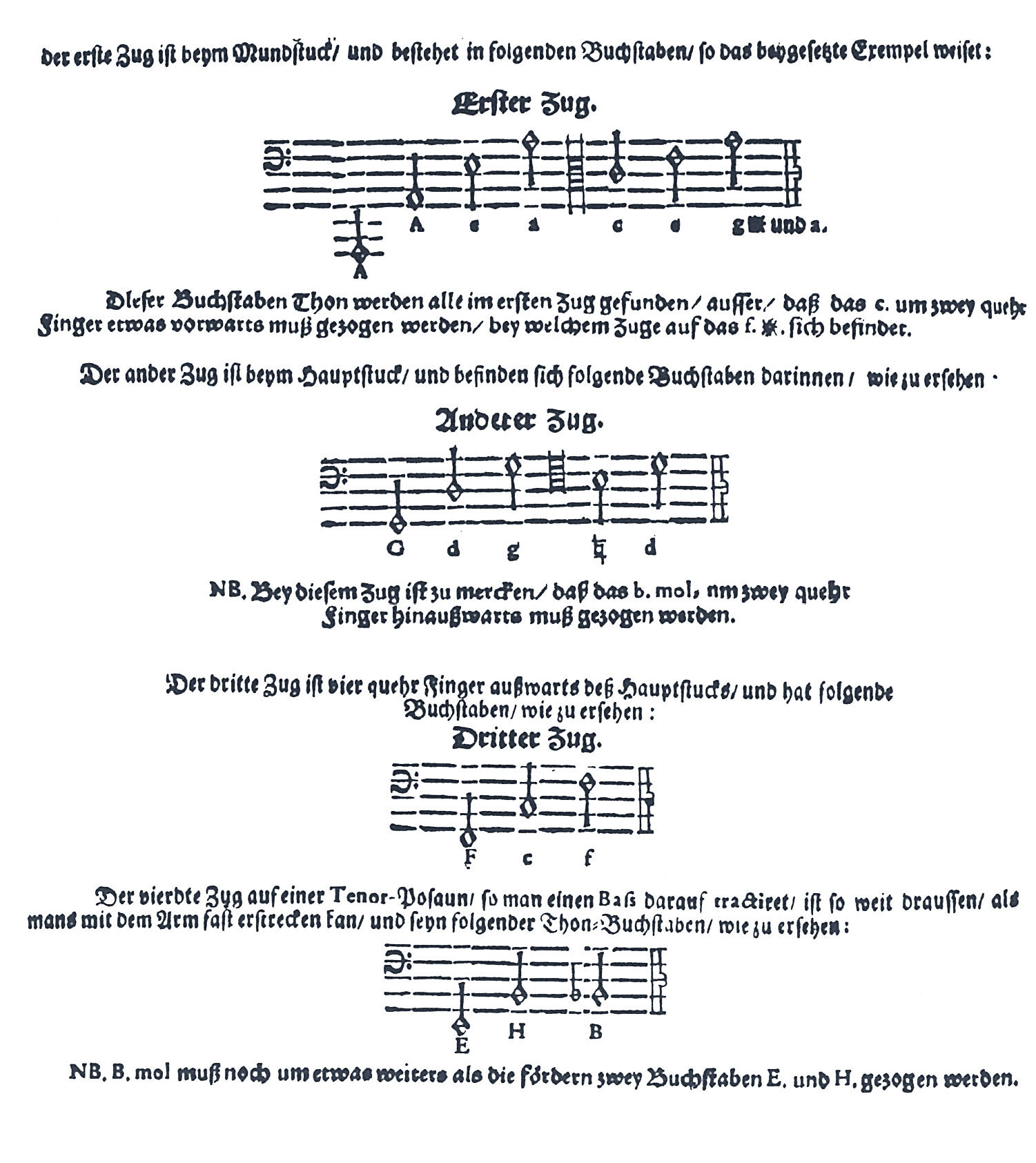
Illustration 1
However, Speer himself states that first position is "by the mouthpiece" and gives the harmonic series AA A e a c' e' g'-sharp a'. Speer also notes that the c' must be played about two Querfinger8 further out and that f'-sharp9 will also be found there. Second position for Speer is "by the bell" and has the harmonic series G d g b d'. Speer notes here that b-flat is played about two Querfinger further out from this second position and not in first position as Huber's table would indicate.
The harmonic series of F c f is given by Speer for the third position which is "4 Querfinger past the bell." Fourth position is "almost as far as one can reach" with the tones E B B-flat. Here Speer notes that the "B-flat must be played with the slide extended somewhat further past the E and B." Speer explains, moreover, in a following paragraph, that the sharp-notated semitones are played with the slide drawn in from their natural tones, but the flat-notated semitones must be played about two Querfinger further out.
Three positions are given by Speer for the alto and quint-trombones. The positions are the same for both with the quint-trombone sounding an octave lower than the alto. First position is once again "by the mouthpiece" with the harmonic series of D A d' f-sharp a' c". Second position, "by the bell", has C g c' e' g' b'. Third position, with the tones F and B, is "a few finger widths past the bell."
Brass Bulletin 36, IV / 1981 pages 52–63
All content is protected by copyright © Brass Bulletin 1981–2026