5 min. read
The contrabass trombone
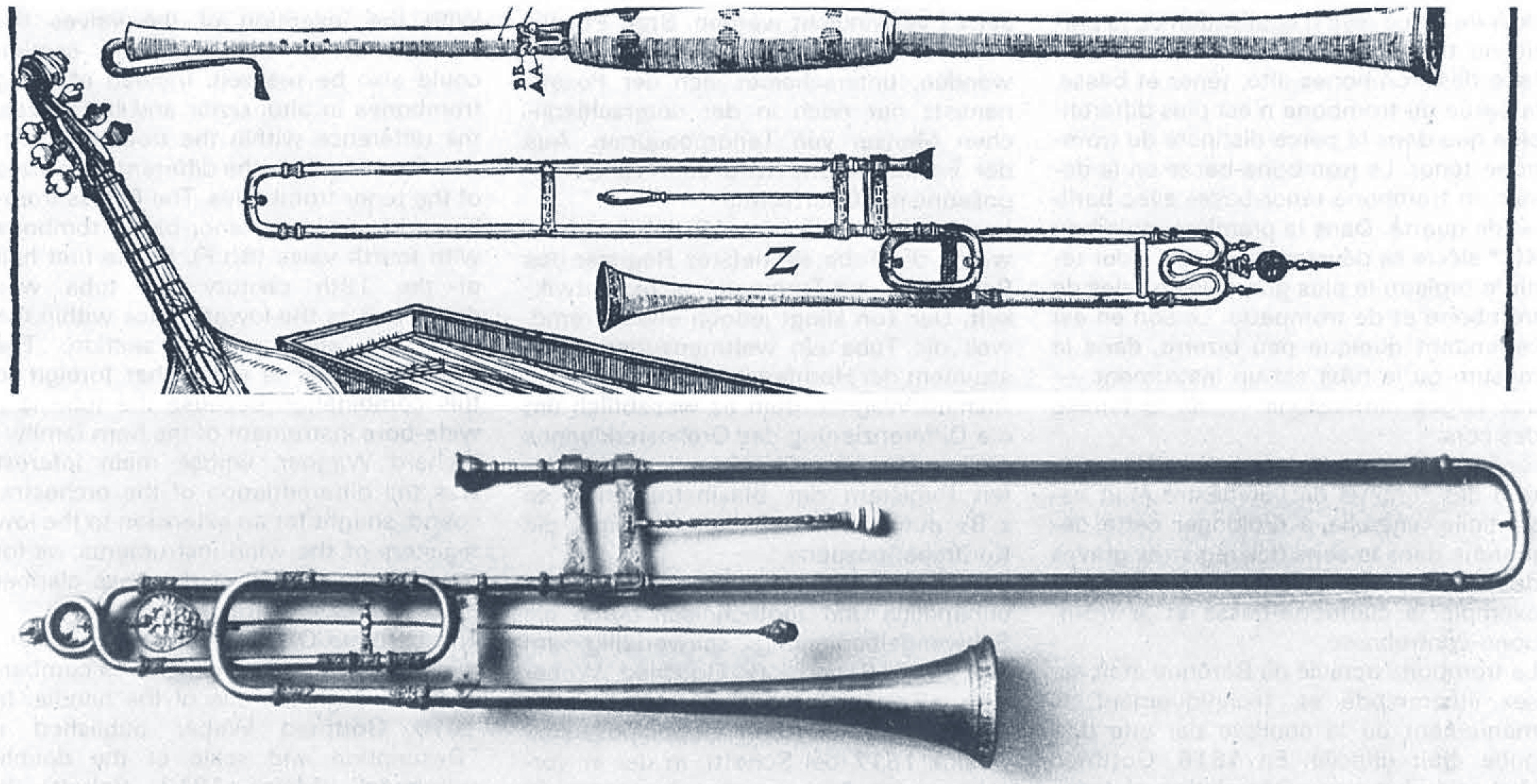
Picture and sketches, taking particularly into account the construction principles (1973)
Preliminary remarks
On musical-historical aspects:
The illustrated baroque bass trombone is an instrument by Johann Isaac Ehe, Nuremberg 1612, which is in the German National Museum in Nuremberg. Reproductions of text and pictures are taken from Vol. II, De Organographia, 1619, by Michael Praetorius.
On constructional aspects:
The illustrated contrabass trombone is a model of the writer of this article. It was made in the months of July–August 1973 in the workshop of H. Thein, Stavenstr. 7, D-2800 Bremen and serves at the same time as the masterpiece of the author. Photography: Monika von Plottnitz.
I. Musical-historical aspects
The development and use of the contrabass trombone (bass trombone) in the reflection of musical development to the present day
The origin of brass wind instruments and of trombones in particular can be seen as being synchronous with the rise of occidental cultures. In the Syntagma musicum of Michael Praetorius (1619) this idea is, for the first time, corroborated from a musicological standpoint (ill. 1).
As opposed to other brass instruments the trombone has experienced the least development. The invention of the slide was made in the 15th century and with this the basic design of the trombone was complete. The earliest instruments which have been preserved come from the renaissance and baroque eras. This time was, after all, the golden age of wind music.
Brass Bulletin 22, II / 1978 pages 53–60
All content is protected by copyright © Brass Bulletin 1978–2026