6 min. read
The trombone: changing times, changing slide positions
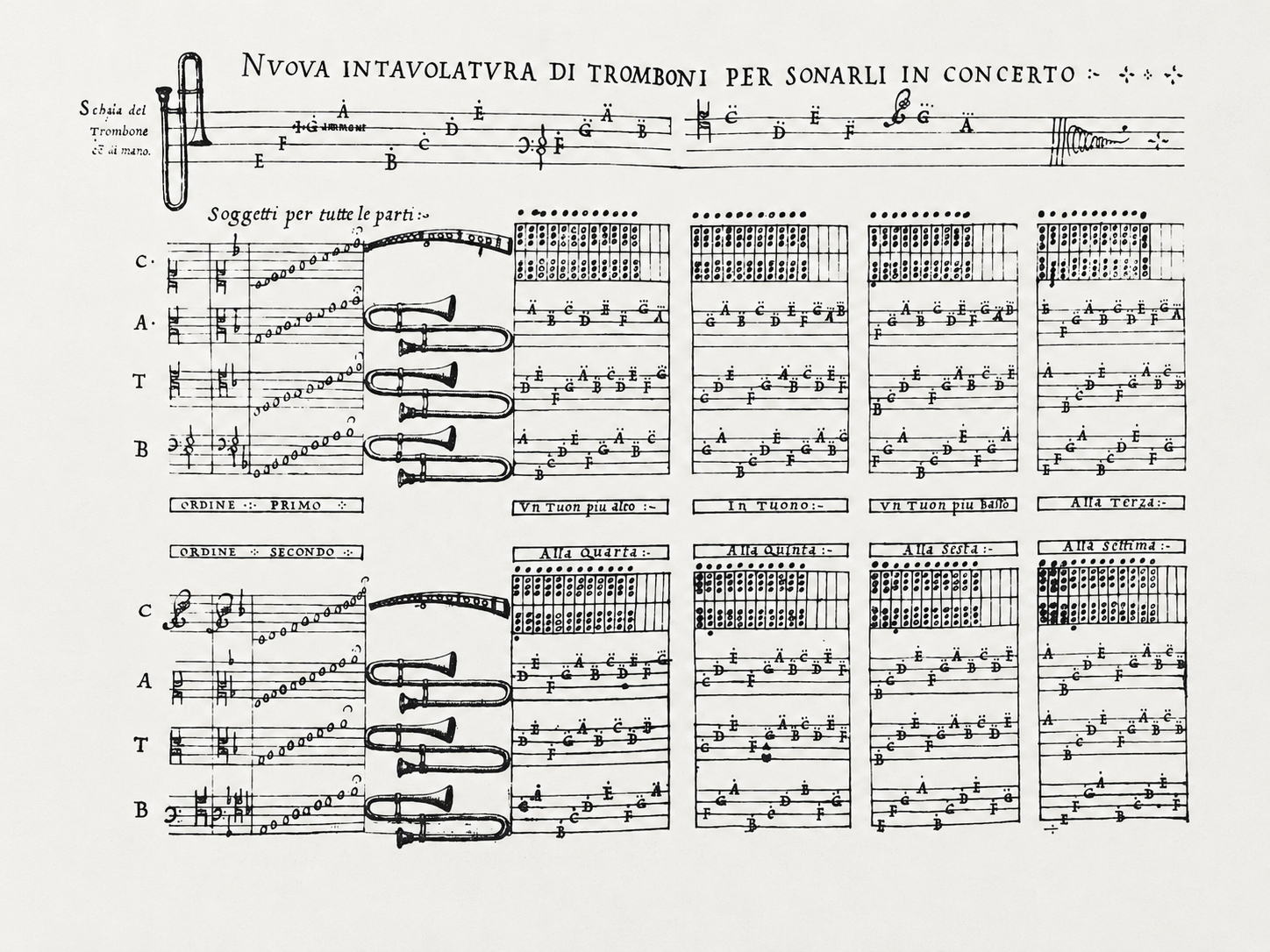
As did the trumpet a number of years ago, now the trombone is beginning to awake from its slumber. Trombonists are receiving more and more possibilities of playing solistically and in chamber music. Not only are new works being composed for the trombone, starting with Luciano Berio's Sequenza in 1966, but also older works by composers such as Albrechtsberger, Michael Haydn, Schmelzer, Wagenseil, and others have been rediscovered for performance.
Historically and musically, three different kinds of treatment of the trombone can be differentiated from one another. In music of the avant-garde, the trombone has as many as thirteen slide positions, with which quarter-tones are produced. Normally, seven positions are used, corresponding to our ideas of chromaticism within the well-tempered system of tuning. During the Renaissance and Baroque periods, however, only four positions were used.
In this short article, I would like to call attention to the source material of the early period of the trombone’s history. It is well known that the trombone originated around 1425, branching off from the (slide) trumpet, and that it subsequently became a popular member of the so-called «alta» band. This ensemble usually consisted of shawns and a trombone, could also contain crummhorns, and played courtly music for dancing and other kinds of entertainment. Almost no music of these «alta» bands has survived, since the musicians usually played from memory.
Illustration 1 shows the most famous trombonist and brass instrument maker of the early 16th century, Hans Neuschel (d. 1533), playing in such an «alta» band (with two crummhorns and two shawms), as depicted by Hans Burgkmaier in one of the woodcuts from The Triumph of Maximilian I (1518).
Brass Bulletin 11, II / 1975 pages 83–94
All content is protected by copyright © Brass Bulletin 1975–2026