17 min. read
Music in an American Frontier Communal Society
Aurora Colony
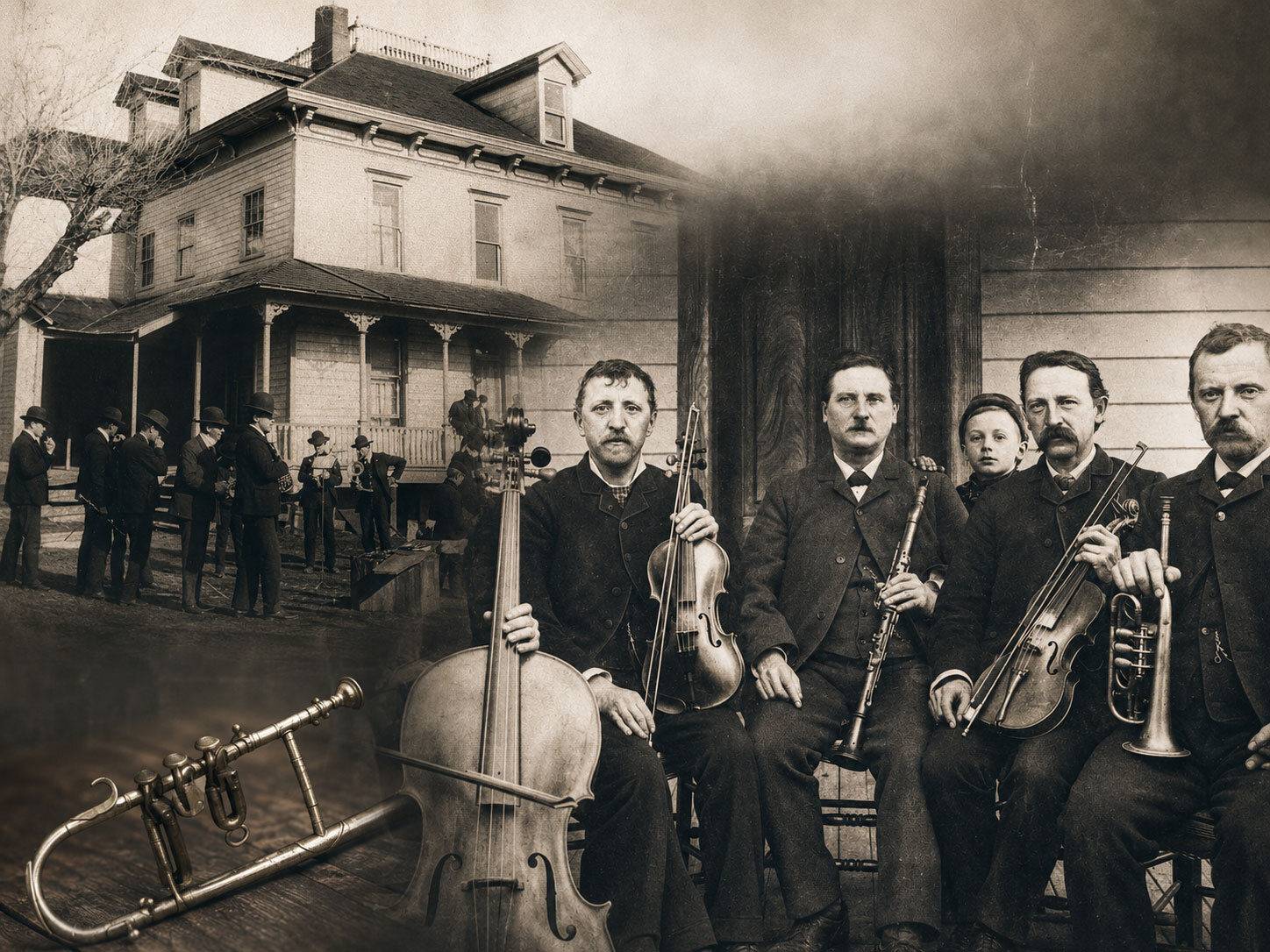
Keil's son, Frederick, who lacked the charisma to lead the colony after his father's death, was a member and sometime director of the colony band. His name appears as arranger on several band pieces, including the "Carlsbader Concert Polka" and the "Haimenskinder Polka".
The orchestra at Aurora was not as regular an organization as was the Pioneer Band. Colony historian Hendricks stated that Henry C. Finck organized and trained "several orchestras",³⁴ but there is little information concerning membership, rehearsals, performances and music of such orchestras. Small chamber music groups were common in Aurora, especially in the home of Finck, and it may be to these groups that Hendricks referred.
Finck's son described one such example in his autobiography: "Two young men, Lawrence Ehlen and William Schwaderer, often came to help us play string quartets. We began with the easy, inspired works of Pleyel, then passed upward to Haydn, Mozart, and Beethoven... The two young men who played quartets with us were real enthusiasts. Nothing could prevent their coming even when the rain poured down in torrents and their wagon had to be dragged through mud more than a foot deep."³⁵
Henry T. Finck played the cello and piano (in addition to the snare drum in the band) and his brother Edward, the flute and piano. Their father, who could play nearly every instrument, excelled on the violin and guitar. Finck left no doubt in his autobiography that chamber music was his preference and that small chamber groups at home achieved the highest level of musicality in Aurora.
In his diary he scorned people "who do not care for music unless it is a galopp or a polka, who are entire strangers to those emotions of profound happiness and ecstasy which fill the soul of a refined person on hearing music of a higher order; yes when you play a sonata of Beethoven or an overture by Mozart for them, they listen a few moments then start up from their chairs, whistle 'Marching through Georgia'... and, when you get through, they ask immediately if you can't give them 'something with a tune in it, something that can be called real music, such as "Captain Jinks"'..."³⁶
Brass Bulletin 36, IV / 1981 pages 64–77
All content is protected by copyright © Brass Bulletin 1981–2026