Rendete Brass Bulletin disponibile nella vostra università, nel vostro conservatorio o nella vostra biblioteca Scoprite l’accesso istituzionale

18 min di lettura

The trombone: changing times, changing slide positions
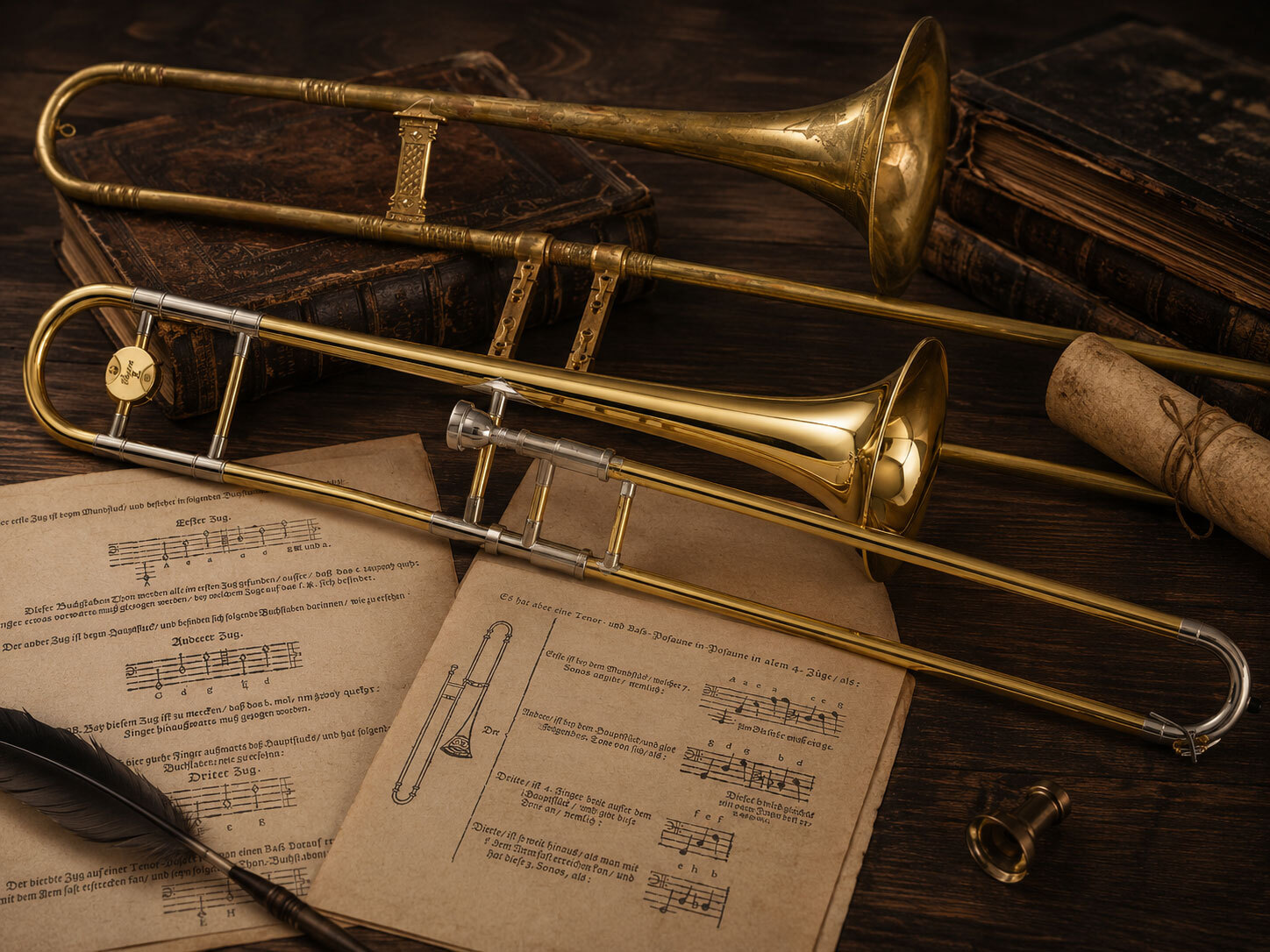
From Virgiliano to Praetorius and Eisel, early sources reshape long-held assumptions about trombone tuning, slide positions and historical playing practice.
The trombone: changing times, changing slide positions

Howard Weiner was born 1952 in Chicago (USA). Initial trombone study with Richard Schmitt, followed by studies at Northwestern University with Frank Crisafulli and at the Schola Cantorum Basiliensis with Heinrich Huber. Member of Edward Tarr Ensemble (U.S. concert tour, 1979).

In 1975 there appeared in these pages an article by Heinrich Huber entitled, The Trombone: Changing Times, Changing Slide Positions,² to which this is intended as a sequel. Huber reviewed three early sources by Daniel Speer, Marin Mersenne and Michael Praetorius in addition to introducing one previously unknown source by Aurelio Virgiliano. The article systematically presented and compared each source to modern practice.

Since Huber's article was published, I have found additional information from Praetorius, and several more sources that deal with the trombone and with slide positions in particular: J.F.B. Caspar Majer, Johann Gottfried Walther, Johann Philipp Eisel, Johann Mattheson, Joh. Christoph and Joh. David Stössel, Heinrich Christoph Koch and F.J. Fröhlich. While some of these new sources add little to our knowledge of the early trombone, information contained in all of them taken together necessitates a review and réévaluation.

Previously it had been assumed (and Huber continues this assumption) that these early writers were describing just the diatonic positions and that the basic pitches³ of the instruments themselves were the same as our modern trombones⁴. However, all of the sources reviewed herein (with the exception of Mersenne, who doesn't give specific pitches) seem to indicate that tenor and bass trombones in A and alto and quint-trombones in D, rather than instruments in B-flat and E-flat (or F) respectively, were the norm until around 1800.

Daniel Speer (Grund-richtiger Unterricht der musikalischen Kunst, Ulm 1687⁵ and 1697⁶) gives four positions for the tenor trombone (Illustration 1). According to Huber the instrument is in B-flat with the modern first, second, fourth, sixth and seventh positions corresponding to the harmonic series of B-flat, A, G, F and E respectively. The first position with the B-flat harmonic series is omitted, Huber states, because "Speer took for granted that his 'first' position began a half a tone lower than the basic pitch of the instrument."⁷
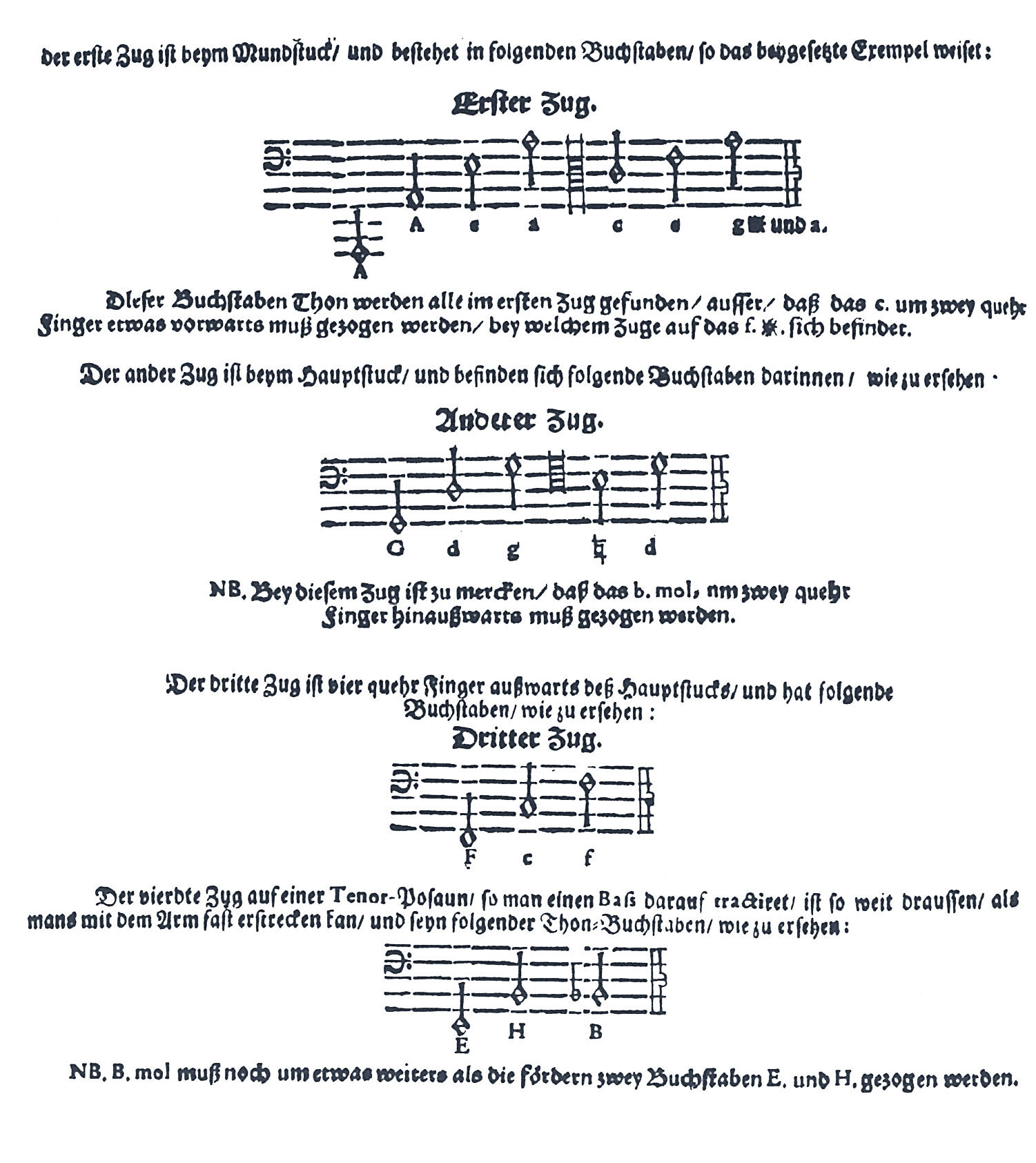
Illustration 1

Illustration 1

However, Speer himself states that first position is "by the mouthpiece" and gives the harmonic series AA A e a c' e' g'-sharp a'. Speer also notes that the c' must be played about two Querfinger8 further out and that f'-sharp9 will also be found there. Second position for Speer is "by the bell" and has the harmonic series G d g b d'. Speer notes here that b-flat is played about two Querfinger further out from this second position and not in first position as Huber's table would indicate.

The harmonic series of F c f is given by Speer for the third position which is "4 Querfinger past the bell." Fourth position is "almost as far as one can reach" with the tones E B B-flat. Here Speer notes that the "B-flat must be played with the slide extended somewhat further past the E and B." Speer explains, moreover, in a following paragraph, that the sharp-notated semitones are played with the slide drawn in from their natural tones, but the flat-notated semitones must be played about two Querfinger further out.

Three positions are given by Speer for the alto and quint-trombones. The positions are the same for both with the quint-trombone sounding an octave lower than the alto. First position is once again "by the mouthpiece" with the harmonic series of D A d' f-sharp a' c". Second position, "by the bell", has C g c' e' g' b'. Third position, with the tones F and B, is "a few finger widths past the bell."

Continue reading

Accedi all’edizione digitale completa.

Brass Bulletin 36, IV / 1981 pagine 52–63

Tutti i contenuti sono protetti dal diritto d’autore © Brass Bulletin 1981–2026

Condividi questo articolo

Facebook LinkedIn
Loading…

Domande e risposte

Come funziona l’edizione digitale

Che cosa comprende l’edizione digitale?

L’edizione digitale riunisce gli articoli già digitalizzati sotto forma di testi leggibili e ricercabili online — non semplicemente come scansioni o file PDF — insieme alle illustrazioni originali, alle note, agli autori, alle informazioni sul numero della rivista e alle traduzioni disponibili. I suggerimenti di articoli correlati comprendono attualmente solo questo materiale digitalizzato.

Gli articoli digitali sono identici agli originali?

Conserviamo il più fedelmente possibile il testo originale, la lingua, le illustrazioni, le didascalie, le note e il contesto editoriale. La presentazione viene adattata per una lettura confortevole online e gli evidenti errori di trascrizione o scansione possono essere corretti. Il contenuto e il carattere dell’articolo pubblicato rimangono invariati.

Quali lingue sono disponibili?

Brass Bulletin è stato pubblicato in inglese, francese e tedesco nel corso di tutta la sua storia. Le traduzioni italiane e spagnole sono state aggiunte a partire dal numero 60. Sui siti italiano e spagnolo, gli articoli dei numeri da 1 a 59 vengono quindi mostrati in inglese per impostazione predefinita.

Con quale frequenza vengono aggiunti nuovi articoli?

Nuovi articoli vengono aggiunti quasi ogni giorno, con circa un numero completo digitalizzato ogni settimana. Il ritmo può variare in base al lavoro di preparazione, elaborazione delle immagini e verifica editoriale necessario.

Perché non tutti gli articoli sono disponibili in formato digitale?

La collezione completa di Brass Bulletin comprende 1.246 articoli pubblicati tra il 1971 e il 2003. L’indice completo è già disponibile online e consente di scoprire tutti gli articoli della collezione, compresi quelli il cui testo integrale non è ancora stato digitalizzato.

La digitalizzazione è iniziata nel febbraio 2026. Ogni articolo viene accuratamente preparato per la lettura online, verificato e collegato al relativo numero, agli autori, agli argomenti e alle illustrazioni. Al ritmo attuale di digitalizzazione, la collezione completa dovrebbe essere disponibile online entro febbraio 2028.

Perché alcuni riferimenti citano articoli che non sono ancora disponibili?

I riferimenti presenti negli articoli originali vengono conservati anche quando il materiale a cui rimandano non è ancora stato digitalizzato. In questo modo si preserva l’integrità storica ed editoriale della rivista. Man mano che nuovi numeri vengono aggiunti all’edizione digitale, un numero crescente di questi riferimenti condurrà ad articoli leggibili online.

Posso suggerire un articolo o segnalare un errore di trascrizione?

Sì. Se desiderate che un determinato articolo venga digitalizzato, oppure se notate un possibile errore di trascrizione o un’informazione mancante, contattateci. I riscontri dei lettori ci aiutano a migliorare l’edizione digitale e a stabilire priorità utili all’interno dell’archivio.

Come posso sostenere Brass Bulletin?

Il vostro sostegno contribuisce a finanziare la preparazione, la verifica e la pubblicazione online dell’intera collezione.

Abbonati all’Edizione digitale

Preferite sostenerci senza abbonarvi?

Fate una donazione

Come procede la digitalizzazione?

Stiamo rendendo Brass Bulletin disponibile online gradualmente, articolo per articolo. Potete leggere gli articoli appena digitalizzati non appena sono pronti, anche prima che un intero numero sia completato.

Consultate il nostro calendario di digitalizzazione per scoprire le ultime aggiunte e le date di disponibilità stimate dei prossimi numeri. Le stime si basano sul nostro ritmo recente e possono cambiare.

Cerca in Brass Bulletin.