Explore institutional access Explore institutional access
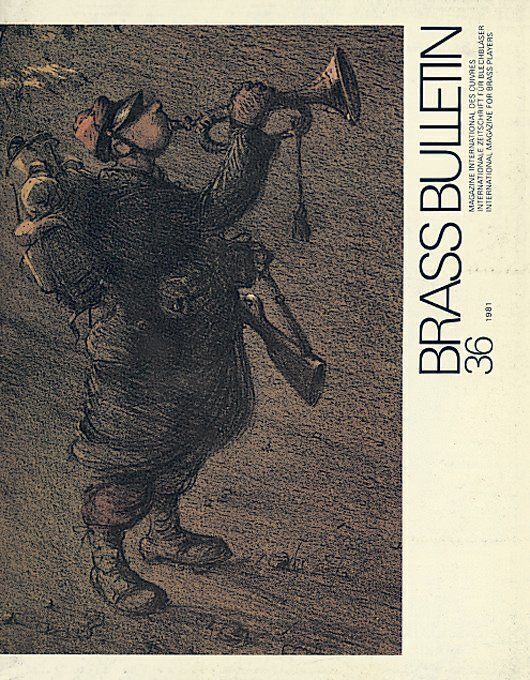
Brass Bulletin 36 - 4 / 1981
Issue
Brass Bulletin No. 36
Date
IV / 1981
Pages
96
Contents
8 articles

Out of print

All issues

Brass Bulletin No. 36

IV / 1981

Contents

8 articles

Editorial

International Competitions - Time, a perishable commodity...

Jean-Pierre Mathez

pp. 3–6 Competition Society

From competition juries to the accelerating pace of modern life, Jean-Pierre Mathez questions the judgments and pressures shaping musicians and their careers

Brass instrument research at Surrey University

John Goodwin

pp. 8–17 Acoustics Research

Acoustics, materials, bore design, and player perception meet in Surrey research linking laboratory measurements with the realities of brass performance.

Playing and singing simultaneously on brass instruments

Part 2

Benny Sluchin

pp. 18–25 Technique

From interval production and tone generation to contemporary repertoire, simultaneous playing and singing becomes a demanding extension of brass technique.

Interview with Hans Pizka

Jeffrey Agrell

pp. 26–31 Horn Encounters Teaching Equipment

From Vienna horn traditions and natural-horn training to orchestral style and pedagogy, Hans Pizka reflects on the foundations of horn playing and musical identity.

The Haydn Trumpet Concerto

Part 2

Alfred Willener

pp. 34–41 Trumpet History Repertoire

André, Wobisch, Dokshitzer, Stringer and others reveal how tempo, phrasing, ornamentation and cadenzas reshape Haydn's trumpet concerto.

Practical Hints

Part 7 – End

James Stamp

pp. 45 Technique Teaching

Tone stability remains the foundation of velocity as James Stamp reshapes a Clarke study into a preparatory exercise linking sound control with fluent technical playing.

The trombone: changing times, changing slide positions

Howard Weiner

pp. 52–63 Trombone History Technique

From Virgiliano to Praetorius and Eisel, early sources reshape long-held assumptions about trombone tuning, slide positions and historical playing practice.

Music in an American Frontier Communal Society

Part 3 – End

Aurora Colony

Deborah M. Olsen

pp. 64–77 History Society

Aurora’s bands, chamber groups and restored instruments show how communal faith, German heritage and American public life met in sound, from parlors to parades.

Loading…

Questions & Answers

How the Digital Edition works

What does the Digital Edition include?

The Digital Edition brings together the articles already digitized as searchable online texts—not simply as scans or PDF files—along with their original illustrations, notes, authorship, issue information, and available translations. Related-article suggestions currently include only this digitized material.

Are the digital articles identical to the originals?

We preserve the original text, language, illustrations, captions, footnotes, and editorial context as faithfully as possible. The presentation is adapted for comfortable online reading, and obvious transcription or scanning errors may be corrected. The substance and character of the published article remain unchanged.

Which languages are available?

Brass Bulletin was published in English, French, and German throughout its history. Italian and Spanish translations were added from issue No. 60 onward.

On the Italian and Spanish sites, articles from issues 1–59 are therefore shown in English by default.

How often are new articles added?

New articles are added almost daily, with approximately one complete issue digitized each week. The pace may vary depending on the preparation, image work, and editorial checking required.

Why aren’t all articles available digitally?

The complete Brass Bulletin collection contains 1,246 articles published between 1971 and 2003. The full index is already available online, allowing readers to discover every article in the collection, including those whose complete text has not yet been digitized.

Digitization began in February 2026. Each article is carefully prepared for online reading, checked, and connected to its issue, authors, subjects, and illustrations. At the current pace of digitization, the complete collection is expected to be available online by February 2028.

Why do some references mention articles that are not available yet?

References in the original articles are preserved even when the material they point to has not yet been digitized. This keeps the historical and editorial record intact. As more issues are added to the Digital Edition, an increasing number of these references will lead to articles that can be read online.

Can I suggest an article or report a transcription error?

Yes. If there is an article you would particularly like to see digitized, or if you notice a possible transcription error or missing detail, please contact us. Reader feedback helps us improve the Digital Edition and prioritize useful connections within the archive.

How can I support Brass Bulletin?

Your support helps fund the preparation, verification, and online publication of the complete collection.

Subscribe to the Digital Edition

Prefer to support us without subscribing?

Make a donation

Search Brass Bulletin.